Walk past any baqala in Karama just before Maghrib and the air does the talking. Someone is browning onions in ghee, a fistful of yellow spice goes in, and the whole street suddenly smells of cardamom, dried lime and cumin. That single handful is doing the work of eight separate jars. In Gulf kitchens, spice blends aren't a flourish you reach for on a special occasion. They're the quiet engine of dinner, the reason a pot of rice tastes like home and not like plain starch.
Four blends carry the bulk of that load: baharat, zaatar, bzar and dukkah. Learn what each one does, when to add it and how to keep it fresh in a climate that fights you on storage, and you can cook the everyday Middle Eastern recipes that show up on tables from Deira to Al Ain without ever feeling lost in front of the spice rack. This is a working cook's guide, built around dishes you'd actually make on a Tuesday night, not a museum tour of exotic powders.
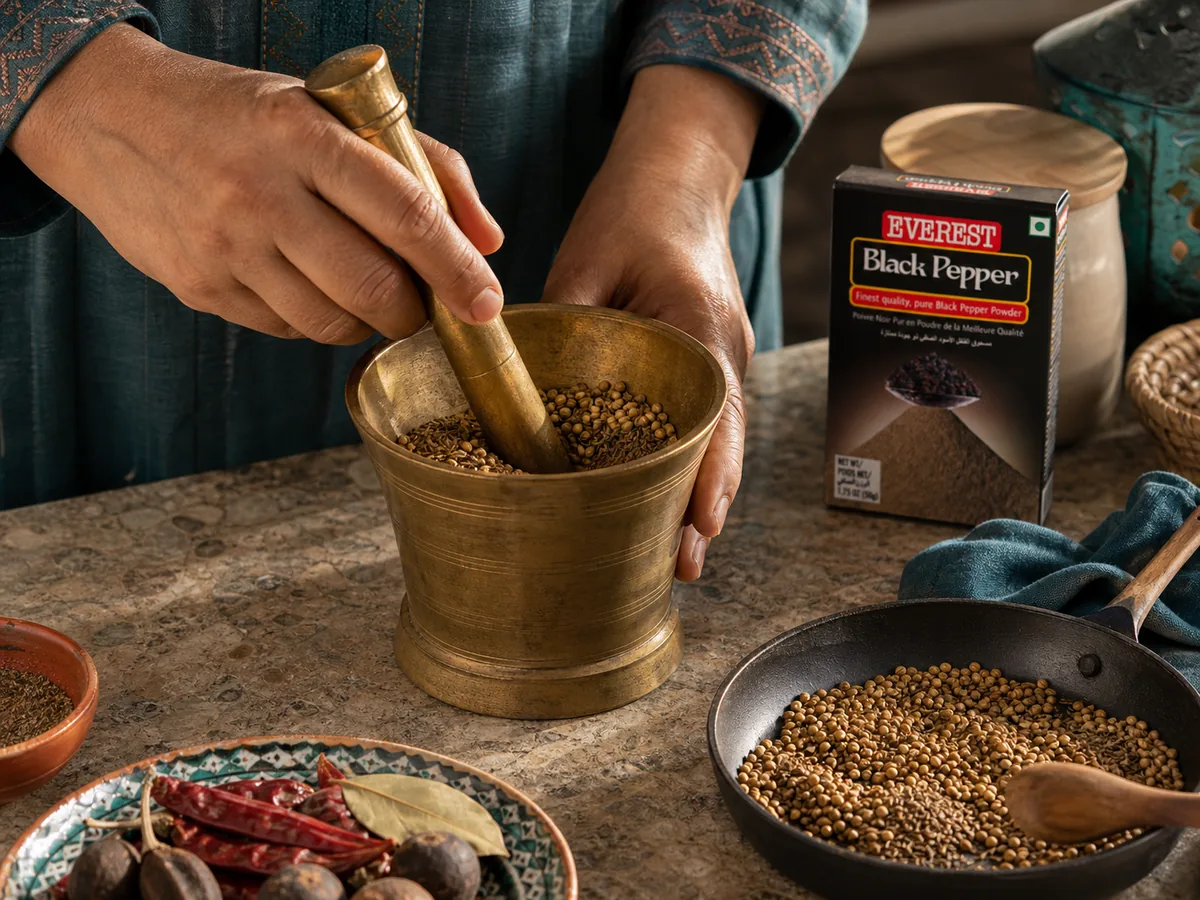
The four blends that run a Gulf kitchen
Think of these four as a small team with clearly divided jobs. Baharat is your all-purpose warm-spice base, the one you rub on meat and stir into soups and stews. Bzar is the Emirati signature, the soul of machboos and salona, leaning brighter and a touch hotter. Zaatar is green and tangy, a finishing blend you scatter on bread, labneh and eggs rather than cook down. Dukkah is pure texture and crunch, a nut-and-seed mix you sprinkle on at the very last moment. Between them they cover the long-cook savoury core, the rice pot, the bread course and the finishing flourish.
The real value of a blend is compression. A good baharat already balances black pepper against sweet cinnamon, earthy cumin against floral cardamom, so you don't have to measure and second-guess eight jars every time you want a balanced flavour. One spoonful carries a whole spice cabinet's worth of decisions that someone, somewhere along the spice routes, already made for you. That's why a busy home cook in Dubai can put a proper machboos on the table on a weeknight: the blend has front-loaded the complexity, and all you supply is heat, fat and time. Getting good-quality blends onto Gulf shelves at consistent strength is its own quiet craft, and it's exactly %how we move pantry essentials across the region% that links trusted spice houses to the hypermarkets and baqalas where most of us actually shop.
None of these are difficult once you understand their character. The mistake most people make is treating them interchangeably, dumping zaatar into a stew where it goes bitter, or stirring delicate dukkah in early so the nuts turn to mush. Get the timing right and each blend rewards you. What follows is grounded in real plates: lamb kofta, chicken machboos, manakish off a saj, labneh swiped through good olive oil. By the end you'll know which jar to reach for and exactly when in the cooking to add it.
A short history: how spice routes shaped Gulf flavour
The Gulf has been a spice crossroads for well over a thousand years. Before oil, the Arabian Peninsula sat on the seam between the pepper and cardamom forests of South India, the clove and nutmeg islands of the East Indies, and the markets of the Levant and the Mediterranean. Dhows rode the monsoon winds across the Indian Ocean, carrying pepper, ginger and cinnamon into the creekside warehouses of Dubai and Sharjah, then back out again toward Basra, Muscat and beyond. The old Deira Spice Souk, with its open sacks of dried rose, frankincense, saffron and loose loomi, is the living remnant of that trade. You can still buy spice by the scoop there, weighed on a hanging scale, exactly as merchants did generations ago.
That traffic explains why Gulf cooking tastes the way it does. Turmeric and ginger came up from India. Dried lime, loomi, is a Persian and Iraqi habit that settled deep into Emirati cooking. East African ports along the Swahili coast, tied to Oman for centuries, traded in cloves and a love of layered, aromatic rice. Every blend in this article is really a snapshot of a trade route, the flavours that happened to pass through and stay.
Regional drift is worth understanding, because it tells you where a blend belongs. Zaatar is Levantine to its core, the wild hill thyme of Palestine, Lebanon, Jordan and Syria, brightened with sumac and bulked with sesame. Dukkah is Egyptian, an Alexandria and Cairo street food of toasted nuts and seeds eaten with bread and oil. Baharat, whose name simply means "spices" in Arabic, is the broad warm-spice family of the wider Levant and Iraq, with countless local versions. Bzar is the one that's distinctly, proudly Emirati, the blend that defines the home cooking of the UAE rather than the borrowed dishes of its neighbours.
Why Gulf baharat leans yellow: turmeric, saffron and loomi
If you've only met the dark, reddish baharat of Syria or Lebanon, the Gulf version can surprise you. Here it often glows yellow-gold, because Emirati and Khaleeji cooks fold in turmeric, sometimes a thread of saffron, and lean on the sour-bitter perfume of loomi, dried lime ground to powder or dropped in whole. That Indian and Persian influence is the fingerprint of the trade routes. The result is warmer and rounder, less peppery-sharp than the Levantine style, built to stand up to long-simmered rice and meat rather than a quick grill.
Bzar as the UAE's own signature
Bzar (sometimes written b'zar or bizar) literally means "seeds" or "spice" in the local dialect, and it's the closest thing the Emirates has to a national seasoning. Where baharat is pan-Arab, bzar is the specific muscle memory of an Emirati kitchen, the smell that says someone's grandmother is cooking. Households guard their own ratios, passed down rather than written, and no two are quite alike. It's the blend that most clearly separates Gulf cooking from the rest of the Arab world.
Baharat: the all-purpose Arabic seven-spice
Baharat is the blend to learn first, because it's the most forgiving and the most useful. At its heart sits a warm, sweet-savoury balance built from black pepper, cumin, coriander, cinnamon, cloves, nutmeg, cardamom and paprika. That's the classic Arabic seven-spice idea, give or take, and in the Gulf you'll usually find turmeric added for colour and earthiness. Some cooks slip in dried rose petals or a little ground loomi; others lean harder on the cinnamon for sweetness. There is no single correct formula, which is exactly what makes it yours.
Understanding the flavour logic frees you from chasing one fixed recipe. Black pepper and cumin bring the savoury backbone. Coriander adds a soft citrus roundness. Cinnamon, cloves and nutmeg supply the warm sweetness that makes baharat smell like cold-weather comfort even in the heat. Cardamom lifts the whole thing with a floral, almost menthol brightness, and paprika gives colour and a gentle fruity depth. Once you can taste those roles, you can adjust: more cinnamon for a sweeter, dessert-adjacent warmth, more pepper and cumin to push it savoury for grilled meat.
The everyday uses are where baharat earns its keep. Work it into lamb mince with grated onion and parsley for kofta, then grill over charcoal. Use it as the base seasoning for a chicken machboos before the rice goes in. Stir a teaspoon into red lentil shorba as it simmers, and the soup goes from flat to fragrant. Toss it with olive oil over cauliflower, carrots and chickpeas before roasting, and a tray of vegetables becomes a proper dish. For kebabs, whisk baharat into olive oil with lemon juice and crushed garlic, then let the meat sit in it for a few hours. The blend does the heavy lifting; you just bring the protein.
A balanced baharat ratio to start from
If you want a starting point to grind at home, try this and adjust from there: 4 tablespoons black peppercorns, 3 tablespoons cumin seeds, 3 tablespoons coriander seeds, 1 tablespoon cassia or cinnamon, 1 teaspoon whole cloves, the seeds from about 8 green cardamom pods, half a whole nutmeg grated, and 2 tablespoons sweet paprika. For a Gulf-style yellow baharat, add 1 to 2 teaspoons of turmeric. Toast the whole spices first (more on that below), grind, then stir in the pre-ground paprika and turmeric off the heat. Taste a pinch on your tongue and rebalance before you commit the batch to a jar.
Dry rub vs wet marinade
How you apply baharat changes the result. As a dry rub, massaged straight onto chicken thighs or a lamb shoulder with a little salt, it forms a fragrant, slightly caramelised crust under high heat, best for grilling and roasting. As a wet marinade, loosened with olive oil, lemon or yoghurt and garlic, it penetrates deeper and tenderises, which suits tougher cuts and skewers that need a few hours to take on flavour. Yoghurt-based marinades are especially kind to chicken, keeping it juicy while the spices bloom. Same blend, two different jobs.
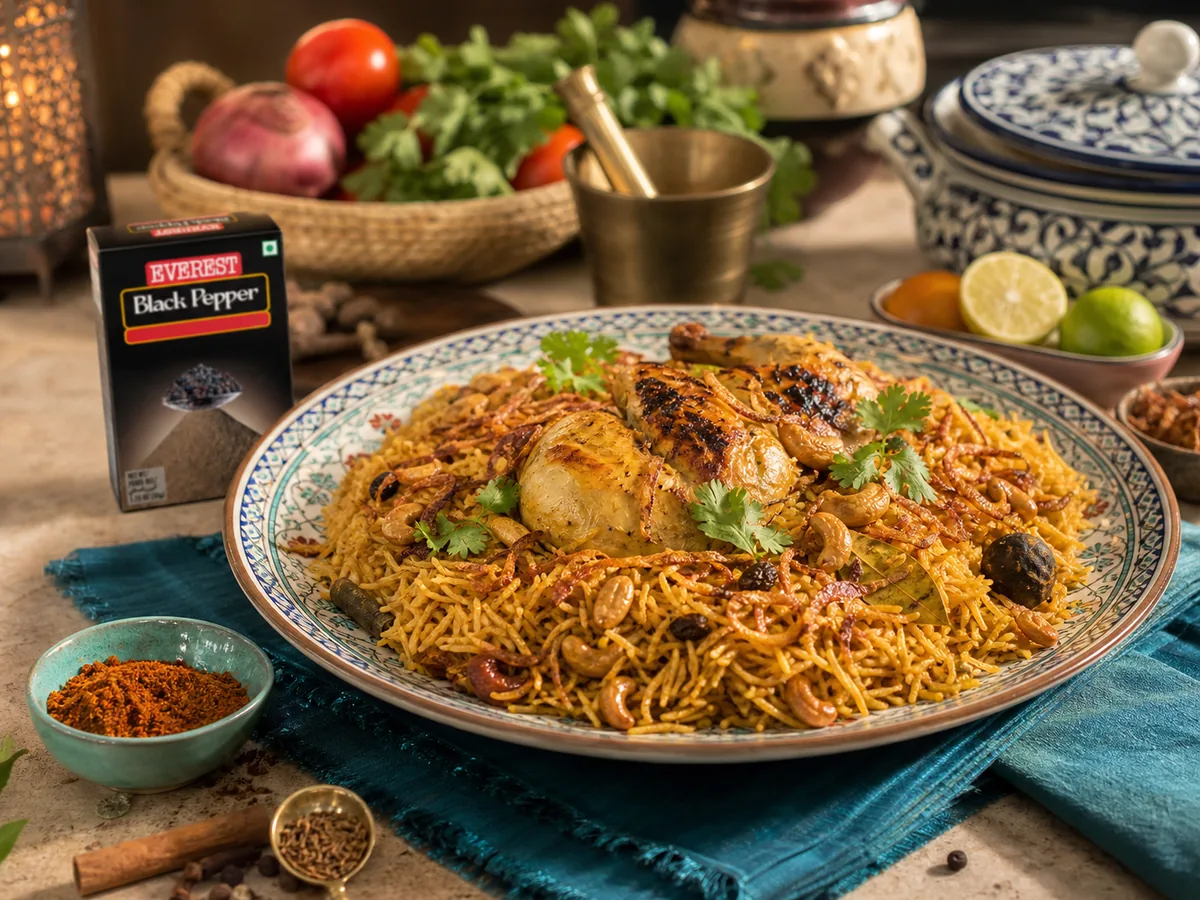
Bzar: the Emirati blend behind machboos and salona
Where baharat is the diplomat that works everywhere, bzar is local and specific. A typical Emirati bzar runs on cumin, coriander, fennel, black pepper, turmeric and cinnamon, often with a touch of cayenne or dried red chilli for a low, warming heat, plus cloves and cardamom in many versions. The fennel is the tell: that faint aniseed sweetness threading through the savour is a big part of what makes bzar taste distinctly Emirati rather than generally Arabic. Traditionally the whole spices are dried in the sun, toasted, then ground together into a coarse, golden powder.
Bzar defines the dishes at the centre of Emirati home cooking. Machboos, the spiced rice with chicken, lamb, fish or prawns that anchors so many family meals, starts with bzar bloomed in oil or ghee. Salona, the soupy tomato-based stew eaten with rice or bread, leans on it too. Harees, the slow-cooked wheat-and-meat porridge of Ramadan and weddings, is seasoned in the same key. Along the coast, bzar is rubbed onto hammour and other fish, and stirred through prawn dishes where its fennel and turmeric flatter the sweetness of the seafood.
The classic technique is bzar in hot ghee at the start of the pot. You warm the fat, soften onions and garlic, then add the bzar and let it sizzle for thirty seconds until it smells nutty and the kitchen fills, before the tomatoes, meat or rice go in. That brief frying, blooming, is what unlocks the fat-soluble aromatics so the flavour coats every grain. Because every Emirati household keeps its own ratio, bzar is also the most personal of these blends. Ask ten cooks and you'll get ten recipes, each convinced theirs is the right one, and in a sense they all are. The practical difference between baharat and bzar comes down to this: baharat is the broad warm-spice family of the Arab world, while bzar is the specific, fennel-laced, turmeric-yellow Emirati expression built for the rice pot.
Zaatar: the green herb blend you finish dishes with
Zaatar breaks the pattern of the others, and that's the most important thing to understand about it. It isn't a warm brown spice blend you cook down. It's a green, herbal, tangy mix you mostly use raw, at the end, as a finishing touch and a bread topping. The build is dried wild thyme or its hardy oregano-like cousins, toasted sesame seeds, ground sumac for sourness, often a little marjoram, and salt. Some Lebanese versions are darker and more sour with extra sumac; some Palestinian ones lean greener and more herbal. The word zaatar refers both to the herb itself and the blend made from it, which trips up a lot of newcomers.
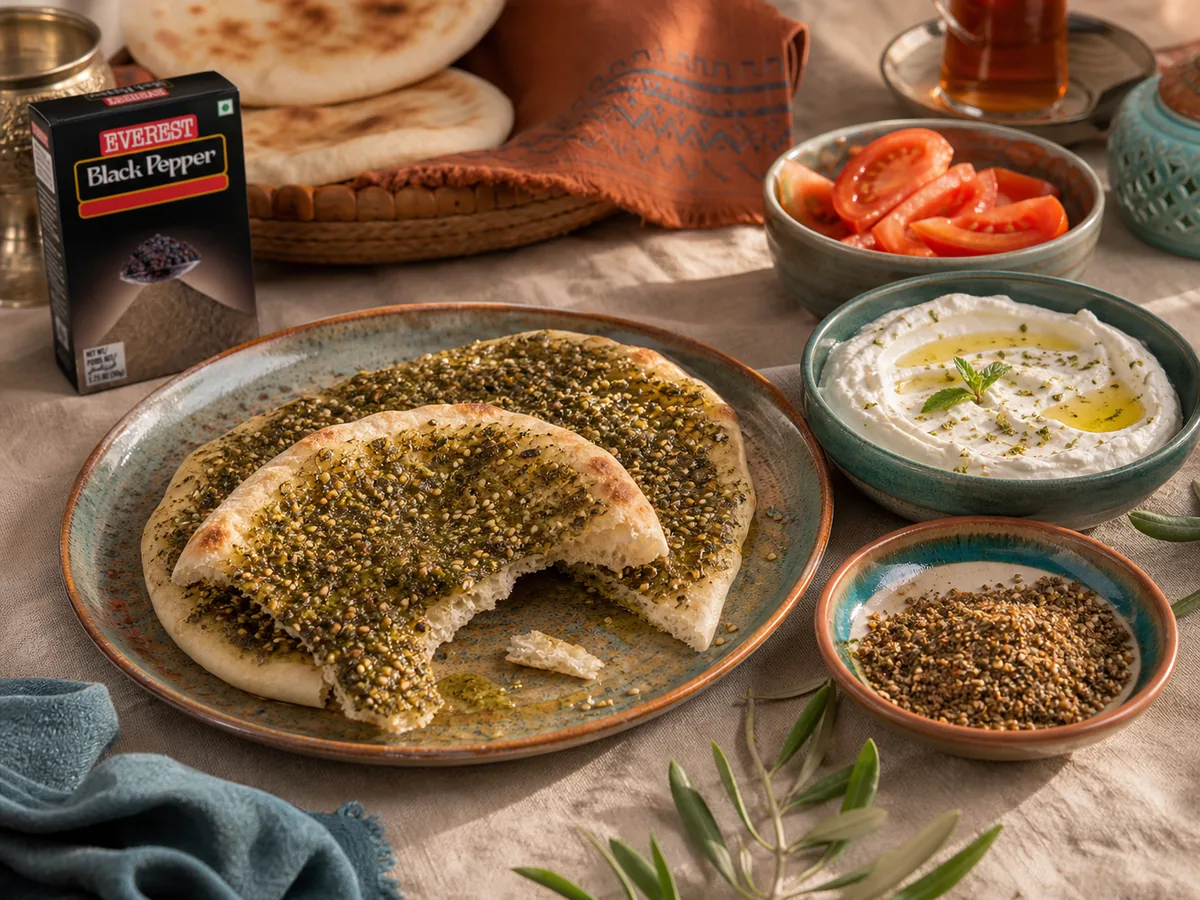
The uses are simple and deeply satisfying. Mix zaatar with good olive oil into a loose paste, spread it over flatbread dough and bake for manakish, the breakfast that fuels half the Levant. Stir it into olive oil as a dip for warm bread, or swipe a spoonful over a bowl of thick labneh with a generous slick of oil. Dust it over hummus, scatter it on fried or boiled eggs, sprinkle it on grilled halloumi, or toss roast cauliflower and potatoes with it as they come out of the oven. Anywhere you'd want a savoury, lemony, herbal lift, zaatar delivers.
The reason it works as a finisher comes down to chemistry. Sumac, the dried and ground berry of a Mediterranean shrub, carries a clean, tart, lemony acidity without any liquid. That sourness is what makes zaatar taste bright and almost citrussy, and it's why the blend wakes up rich, fatty things like labneh, eggs and oil-slicked bread. Cook zaatar hard and long, though, and the delicate thyme oils scorch and the sumac turns dull and bitter. Keep it raw or only lightly heated, the way it sits on manakish in a hot oven for just a few minutes, and it stays vivid. Sumac on its own is worth keeping too, sprinkled over grilled fish, fattoush salad or a plate of sliced onions, anywhere you want acidity without reaching for a lemon.
For households in the UAE, where so many of us are cooking across cultures in the same kitchen, these four blends are a kind of shared shorthand. A jar of zaatar from a Lebanese neighbour, a tub of bzar a colleague's mother sent over, a baharat picked up at the hypermarket: this is how flavour actually moves through Gulf life, hand to hand and shelf to shelf. The spice and pantry-essentials brands carried by distributors like %the brands we bring to Gulf shelves% sit quietly behind that movement, so the blend you grab on a Thursday grocery run is fresh, consistent and the real thing rather than a faded approximation.
By this point the division of labour should be coming into focus. Baharat and bzar are your cooking blends, added early and bloomed in fat to flavour meat, rice and stew from the inside. Zaatar is your bread-and-finishing blend, kept raw and bright. The fourth member of the team, dukkah, is something else entirely: not a seasoning you cook with at all, but a texture you add at the very end, and it deserves its own treatment in the second half of this guide, alongside how to layer all four across a single Gulf table, the nutrition behind them, and the practical business of toasting, grinding and storing spice through a UAE summer.
<
Bzar: the Emirati blend behind machboos and salona
Where baharat is pan-Arab, bzar is unmistakably Emirati. It is the spice mix that perfumes a kitchen in Al Ain or Ras Al Khaimah on a Friday, the one grandmothers measure by eye and memory rather than spoon. A classic bzar leans on cumin, coriander, fennel, black pepper, turmeric and cinnamon, with a touch of cayenne or dried red chilli for a low background heat. Many families dry-roast the whole seeds first, then grind them coarse, which gives Emirati food its particular toasted depth that pre-ground supermarket powders rarely match.
Bzar defines the dishes at the heart of Emirati cooking. It seasons machboos, the spiced rice-and-meat dish that anchors a Gulf table, and it carries salona, the tomato-based stew that turns a handful of vegetables and a piece of lamb or fish into a full meal. Along the coast, from Fujairah to the Abu Dhabi corniche, bzar seasons hammour, kingfish and prawns, where its fennel and coriander cut through the richness of grilled seafood. It also flavours harees, the slow-cooked wheat-and-meat porridge served at weddings and through Ramadan, though there the spicing stays gentle so the dish keeps its comforting plainness.
The technique most associated with bzar is the ghee bloom. Heat ghee until it shimmers, stir in a spoon of bzar with chopped onion, and let it sizzle for thirty seconds until the kitchen fills with the smell. That brief bloom wakes the oils in the spices and is the difference between food that tastes seasoned and food that tastes Emirati. No two households keep the same ratio, and asking three aunties for "the" bzar recipe will get you three different answers, each defended with total conviction. That variety is the tradition.
The shorthand many cooks ask about is baharat vs bzar. Think of it this way: baharat is the warm, sweet-leaning seven-spice you would recognise across Iraq, the Levant and the Gulf, while bzar is the Emirati cousin that leans drier and more savoury, with fennel and a whisper of chilli, built specifically for machboos and salona. They overlap, but they are not interchangeable, and a kitchen that keeps both has the range to cook far more than either alone.
Zaatar: the green herb blend you finish dishes with
Zaatar breaks the pattern. The first three blends are warm, brown and built for cooking; zaatar is green, herbal and built for finishing. The base is dried wild thyme or oregano (the plant and the blend share the name in Arabic), toasted sesame seeds for nuttiness, sumac for its tart red tang, often a little marjoram, and salt. The result is bright, savoury and lemony all at once, and it lands on the table more often as a sprinkle than as something you simmer.
The most famous use is zaatar manakish, the flatbread brushed with zaatar mixed into olive oil and baked until the edges crisp, sold from bakeries across the UAE and eaten warm with sweet mint tea. Beyond the bread, zaatar is a finishing flourish: stirred into labneh with a pool of olive oil as a dip, dusted over hummus, scattered on fried or boiled eggs, pressed onto grilled halloumi, or thrown over roast cauliflower and potatoes in the last minutes so the herbs keep their lift. %where our distribution network reaches% shows the range of pantry essentials and spice lines that move through Gulf kitchens this way, from the bakery counter to the home table.
The reason to add zaatar late rather than early is sumac. Sumac is a dried, ground berry with a sharp, lemony sourness, and it is what gives zaatar its characteristic tang and brick-red flecks. Like lemon juice, that brightness fades and dulls under long heat, so zaatar is a finishing blend by nature. Sprinkle it on after cooking, or bake it briefly into bread where the fat protects it, and you keep the zip that makes the blend worth using. Sumac uses extend well past zaatar, too: a pinch over grilled fish, fattoush salad or roast onions adds the same clean acidity that a squeeze of lemon would, without the wetness.
Dukkah: the Egyptian nut-and-seed crunch
Dukkah is the outlier and the most fun. Egyptian in origin, it is less a spice blend than a textured condiment: toasted hazelnuts or pistachios, coriander and cumin seed, sesame, salt and black pepper, all coarsely crushed so the mix stays crunchy and uneven rather than powdery. The classic ritual is bread torn, dipped in good olive oil, then pressed into a bowl of dukkah so the nuts and seeds cling. Once you have made it, you start scattering it on everything.
Its real value is texture against soft food. Press dukkah onto fish fillets or chicken before roasting and it forms a nutty, fragrant crust. Scatter it over roast pumpkin or sweet potato, where the crunch plays against the soft flesh. It transforms a bowl of labneh, a fried egg, a tomato salad or a plate of grilled vegetables from finished to memorable with one spoonful. Because the whole point is crunch, dukkah is always added late: stir it into a dish too early or simmer it and the nuts soften, the sesame goes greasy, and you lose everything that made it worth crushing by hand.
Keep dukkah coarse and keep it dry. The coarse grind is what separates it from a paste; if you grind it fine, you have made a wet nut butter, not dukkah. And because it is so nut- and seed-heavy, it carries real allergen weight, which matters when you are catering for guests at a majlis or an iftar table.
Building flavour: layering blends across a single meal
The four blends are most powerful together, each covering a different part of the table. Bzar goes into the rice. Baharat goes on the protein. Zaatar finishes the bread or the labneh. Dukkah crowns the salad or the roast vegetables. With those four jars, a single meal carries four distinct flavour signatures without you reaching for a single standalone spice, and nothing tastes like it came from the same shaker.
That spread also solves the weeknight repetition problem. Rotate which blend leads and the same basic ingredients never produce the same plate twice. Monday's baharat chicken with bzar rice becomes Wednesday's zaatar-crusted fish with a dukkah-dressed salad, becomes Friday's machboos with the bzar properly bloomed in ghee. The proteins and grains repeat; the spicing keeps the week interesting.
A sample Gulf weeknight menu
Start with basmati simmered with a spoon of bzar and a dried loomi pierced and dropped in whole, so the dried lime perfumes the pot with its sour, slightly bitter fragrance. Alongside, chicken thighs rubbed with baharat, olive oil and lemon, roasted until the skin crackles. Warm flatbread brushed with zaatar in olive oil. A tomato, cucumber and herb salad finished with dukkah and a little sumac for tang. A bowl of labneh in the middle for everyone to scoop. Dates and Arabic coffee to close. That is a full Gulf table built almost entirely on four blends and a handful of staples: basmati, freekeh or lentils, yoghurt, dates and whatever came fresh off the boat.
Vegetarian and plant-based swaps
None of this needs meat to work. Baharat-roasted cauliflower or chickpeas stand in for the protein and take the spice beautifully. Bzar seasons a lentil-and-rice mujadara or a vegetable salona just as well as it does lamb. Zaatar belongs on grilled halloumi, or on a plant-based labneh for a fully vegan dip. Dukkah over roast aubergine or pumpkin gives the crunch and richness that meat usually provides. Freekeh, the smoky cracked green wheat, makes a hearty base that carries bzar especially well for a meat-free main. %work with us to stock your spices% is where brands looking to put these spices and staples on Gulf shelves can connect with the distribution side of the business.
Nutrition and the everyday health angle
Spice blends are not medicine, but the everyday benefits are real and worth knowing without overselling them. Turmeric, the spice that yellows Gulf baharat and bzar, contains curcumin, studied for its antioxidant and anti-inflammatory properties. Cumin and coriander have long traditions across the region as digestive aids, which is part of why they anchor so many heavy rice-and-meat dishes. The toasted sesame in zaatar and dukkah brings calcium and healthy fats. The wild thyme and oregano in zaatar carry antioxidant compounds, and sumac is naturally high in them too.
The most practical health benefit is simpler than any single compound: blends let you cook with less salt. When food is layered with cumin, coriander, sumac, cinnamon and herbs, you lean on aromatics for flavour rather than reaching for the salt cellar, which matters for anyone watching blood pressure in a climate where you are already losing salt to the heat. A baharat rub or a zaatar finish makes a lightly salted dish taste full and seasoned.
One real caution: allergens. Both zaatar and dukkah contain sesame, and dukkah is built on tree nuts like hazelnuts and pistachios. If you are catering for guests at a majlis, an iftar gathering or a child's party, flag those blends clearly, because sesame and nut allergies are common and a generous scatter of dukkah is not something a guest can easily pick around.
Whole vs ground, toasting and grinding at home
The single biggest upgrade to your spice cooking is buying whole spices and grinding them yourself. Whole cumin, coriander, cardamom pods and peppercorns hold their volatile oils sealed inside until you crack them, which means they stay loud for a year or more. Pre-ground powder starts losing aroma the day it is milled, and a jar that has sat open through a Gulf summer is often little more than coloured dust by the time you use it.
Toasting before grinding is the second half of the trick, and it takes two minutes. Warm a dry pan over medium heat, add the whole spices, and shake them until they smell fragrant and turn a shade darker, usually under a minute for seeds. Let them cool, then grind in a dedicated spice grinder or an inexpensive coffee grinder kept aside for the purpose. The toasting wakes the oils and deepens the flavour, so a home-toasted, freshly ground baharat will out-perform any pre-mixed jar on the shelf, often by a wide margin. Grind only what you will use over a few weeks, since the clock starts ticking the moment the spice is broken open.
The shelf-life reality is worth internalising. Whole spices last comfortably for a year or two. Ground spices and ready-made blends fade noticeably within a few months. That is not a reason to never buy a ready blend, which is exactly the convenience that makes baharat and zaatar so useful, but it is a reason to buy them in small quantities and replace them often rather than stockpiling a kilo that goes flat before you reach the bottom.
Storing spices in UAE heat and humidity
Spice storage anywhere is about keeping out heat, light, air and moisture. In the UAE, the heat and the humidity are turned up to a level that punishes careless storage, and anyone who has opened a jar to find a solid clumped brick of turmeric knows the problem first-hand. Kitchen humidity spikes through the long summer and during heavy Ramadan cooking, when steam from big pots fills the room and finds its way into any jar left open near the hob.
Practical storage is straightforward. Use airtight glass jars with tight lids, not the flimsy plastic sachets spices often come in. Keep them in a cool, dark cupboard well away from the cooker, the kettle and any sunny window, because heat is what drives off the aromatic oils fastest. Never shake a spice jar directly over a steaming pot; the rising moisture goes straight into the jar and starts the clumping. Spoon out what you need instead. And buy in small batches you will get through in a few months rather than catering-size tubs that sit half-used.
Knowing when a blend has gone flat saves you from cooking with dead spice. Rub a pinch between your fingers and smell it: fresh baharat or zaatar should hit you immediately with a warm, aromatic punch. If you get a faint, dusty, papery smell or almost nothing at all, the oils have gone and it is time to replace it. Clumping, faded colour and a stale smell are the three signs. Spice that has gone flat will not ruin a dish, but it will quietly make everything you cook taste a little duller than it should, which is the worst kind of problem because you stop noticing it.
]]><![CDATA[Frequently Asked Questions
What is the difference between baharat and bzar?
Both are warm Arabic spice blends, but baharat is the pan-Arab seven-spice you find across Iraq, the Levant and the Gulf, leaning sweet and aromatic with cinnamon, clove and nutmeg. Bzar is the distinctly Emirati blend, drier and more savoury, built on cumin, coriander, fennel and a touch of chilli, and made specifically to season machboos, salona and Gulf seafood. A UAE kitchen happily keeps both, since they are not interchangeable.
Where can I buy good spices in Dubai and across the UAE?
You have three good options. The Deira and Sharjah spice souks sell loose, fresh spice by weight, which is the best route for whole spices you plan to toast and grind yourself. Hypermarkets carry reliable packaged blends and standalone spices for everyday convenience. Your local baqala stocks the essentials within walking distance. Whatever the source, check for a strong aroma, a recent packing date and good airtight packaging before you buy.
How do I store spices so they survive the UAE summer?
Heat and humidity are the enemies. Keep blends in airtight glass jars in a cool, dark cupboard away from the hob, kettle and any sunny window. Never sprinkle directly over a steaming pot, as the moisture causes clumping; spoon out what you need instead. Buy small batches you will finish in a few months rather than large tubs that go flat, and replace any spice that smells faint or dusty.
What is loomi and how do I use it in Gulf cooking?
Loomi is dried lime, a whole lime boiled and sun-dried until it turns dark and hard, with a sour, slightly bitter, fermented flavour central to Gulf and Iraqi cooking. Pierce a whole loomi and drop it into the pot when simmering machboos rice, salona stew or lentil soup, then remove it before serving. You can also grind it to a powder for a sharper sour note. It gives Gulf food its characteristic tang.
Are Middle Eastern spice blends suitable for guests with allergies?
Take care with zaatar and dukkah. Both contain sesame, and dukkah is built on tree nuts such as hazelnuts and pistachios, so flag those blends clearly when catering for a majlis, iftar or family gathering where sesame and nut allergies are common. Baharat and bzar are generally nut- and sesame-free, but always check the packaging of ready-made blends, since recipes and added ingredients vary between brands.
Can I use these spice blends without cooking meat?
Easily. Baharat-roasted cauliflower or chickpeas, bzar-seasoned lentil mujadara, zaatar on grilled halloumi or plant-based labneh, and dukkah scattered over roast pumpkin all work beautifully. Freekeh and lentils make hearty meat-free bases that carry bzar especially well. The blends were built to flavour grains, pulses and vegetables as much as meat, so a fully vegetarian or vegan Gulf table loses nothing in flavour.
]]>