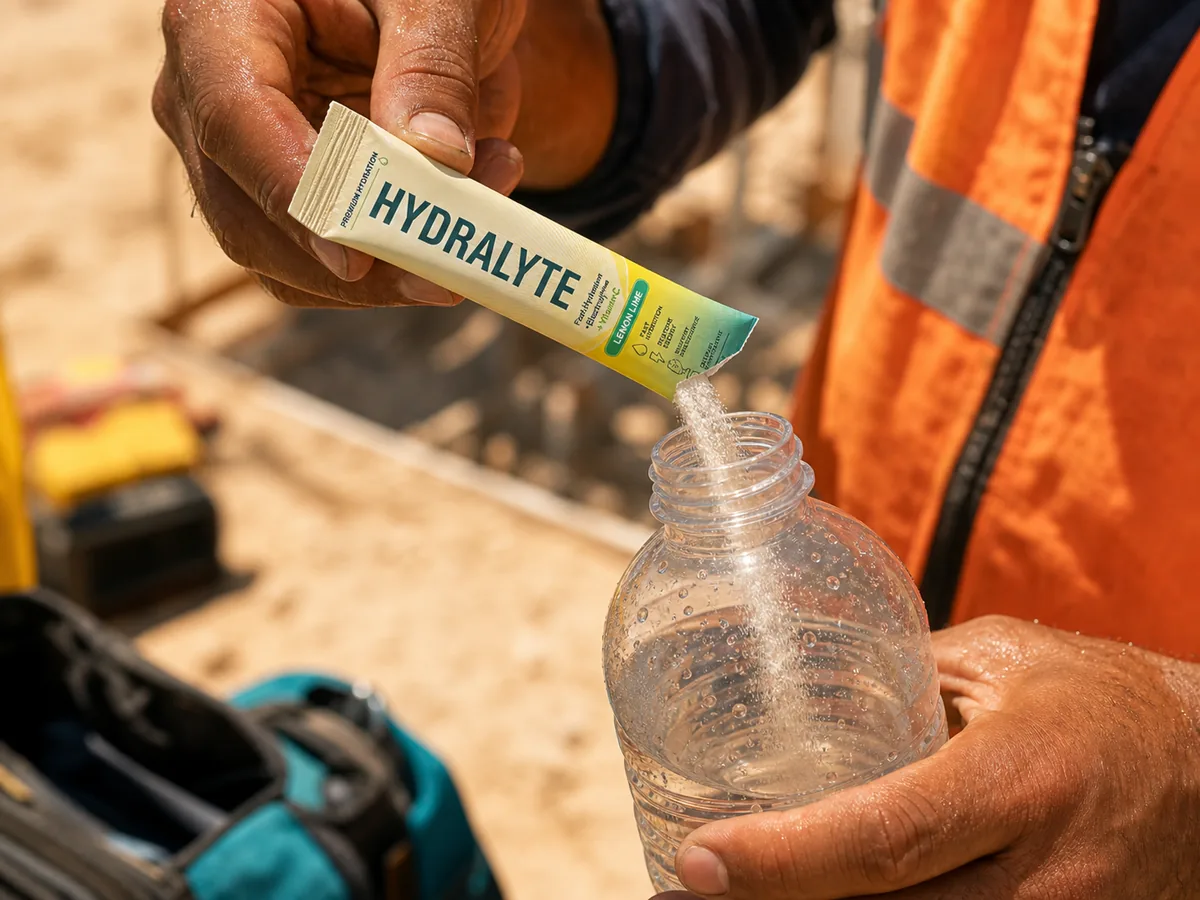
It is 1:40 in the afternoon in mid-July on a Sharjah construction site, and the steel rebar is hot enough to brand a palm. A scaffolder climbs down for the midday break, peels off a soaked hi-vis vest, and you can see the white tide-line of dried salt crusting the fabric across his shoulders. That salt is the story. It is not just water leaving his body in the 46-degree afternoon; it is sodium, potassium and chloride pouring out of him at a rate plain drinking water cannot replace. He has been sipping from a five-litre bottle all morning and still feels light-headed, his calves are starting to knot, and his head throbs behind the eyes. He is, by any clinical measure, dehydrated despite drinking constantly. This is the central paradox of a Gulf summer, and understanding it is the difference between getting through the season and getting carried off it on a stretcher.
Hydration in the UAE is not a wellness trend imported from a Californian gym. It is survival infrastructure, woven into ministerial law, baqala fridges, school sports policies and the rhythm of Ramadan. From the labourer pouring concrete in Mussafah to the office worker doing a 6pm padel match at a Dubai Sports City court, to the grandmother fasting through a 14-hour summer day, the question of how to put water back into a body that is losing it faster than it can drink is universal here. And the honest answer involves a little chemistry, a little history, and a clear-eyed look at what is actually printed on the label of every electrolyte drink, ORS sachet and effervescent tablet on the shelf. Electrolytes and rehydration in the UAE deserve more than marketing slogans, so this is the practical, specific guide.
Why water alone fails in a Gulf summer
The instinct to fight heat with plain water is correct only halfway. Water is the solvent, but the body runs on the salts dissolved in it. When those salts drain out and you top up with nothing but water, you are diluting the very system that keeps your muscles firing and your blood pressure steady. The scaffolder with the salt-crusted vest has not failed to drink. He has failed to replace what the drinking washed away.
What you actually lose when you sweat
Sweat is not pure water. It is a saline solution, and in the heat of the Emirates it leaves the body in volumes most people badly underestimate. Sweat sodium concentration typically runs between 20 and 80 millimoles per litre, which translates to roughly 0.5 to 1.5 grams of salt lost in every litre of sweat. Alongside the sodium goes chloride (its partner ion), and smaller but meaningful amounts of potassium, calcium and magnesium. These are the electrolytes: charged minerals that conduct the electrical signals running your heart, your nerves and every voluntary muscle.
The volumes at play in a Gulf summer are genuinely extreme. A person doing heavy manual labour in 45-degree heat at 90 per cent humidity, the kind of stifling, sea-thick air that settles over Dubai and Abu Dhabi in August, can lose between one and two litres of sweat per hour. Humidity is the cruel multiplier here. In dry desert heat, sweat evaporates and cools you efficiently. In the coastal humidity of the UAE, it cannot evaporate fast enough, so the body keeps pumping out more and more sweat that simply drips off, wasted, cooling almost nothing while it strips away litres of fluid and grams of salt. Over a six-hour shift, that is potentially six to ten litres of sweat and somewhere between five and fifteen grams of sodium gone. For context, a level teaspoon of table salt is about six grams. A worker can sweat out two full teaspoons of salt before lunch.
The calcium and magnesium losses matter more than most people credit. Magnesium is involved in over three hundred enzymatic reactions and is a key player in muscle relaxation; when it runs low alongside sodium and potassium, the muscle that contracts cannot properly let go, and that is the mechanism behind the vicious calf and hamstring cramps that fell footballers in the second half and wake labourers at 3am with a seized leg.
The plain-water trap
Here is where good intentions turn dangerous. When you sweat out salt and replace the lost volume with large amounts of plain water, the concentration of sodium in your bloodstream drops. The medical name for blood sodium falling too low is hyponatremia, and in its serious forms it causes nausea, confusion, crushing headaches, seizures and, in rare extreme cases, death. You do not need to drink absurd quantities to feel the milder end of it. A worker dutifully draining bottle after bottle of water across a sweaty day can dilute himself into a foggy, crampy, headachy state and assume, reasonably but wrongly, that he simply needs to drink even more.
The body has a feedback loop that makes this worse. When blood sodium is low, the thirst response and the kidneys behave erratically; you can end up feeling thirsty despite being overloaded with fluid, or feeling no thirst at all while genuinely depleted. Plain water alone gives you no sodium to switch that loop back to normal. The fix is not less water and not more water. It is water with the right pinch of salts dissolved into it, which is precisely the principle every proper rehydration product is built around. Once you grasp that sweat is salty and that replacing salty losses with unsalted water digs the hole deeper, the entire electrolyte category stops looking like a gimmick and starts looking like basic physics.
A short history of rehydration, from souk salts to ORS
The science of putting salt back into water with a little sugar to help it absorb is recent as formal medicine, but the practice is ancient. Long before a single foil sachet appeared on a baqala shelf, the households of the Gulf and the wider region had worked out, by trial and tradition, how to keep a body going through heat and illness.
Home remedies the region grew up on
Walk into any Emirati or Gulf-Arab kitchen with a heat-struck child and the old remedies appear. Laban, the salted buttermilk drink served cold across the Khaleej, is close to an accidental electrolyte solution; it carries sodium from the added salt, potassium and calcium from the dairy, and a little natural sugar in the lactose. It is poured at iftar tables and majlis gatherings for exactly the restorative reason science would later explain. The South Asian communities who make up so much of the UAE's population brought nimbu paani, the lemon-salt-sugar water that is the subcontinent's summer staple: juice of a lemon, a pinch of salt, a spoon of sugar, sometimes a touch of black salt for its mineral tang, stirred into a glass of water. That recipe is, structurally, a homemade oral rehydration solution.
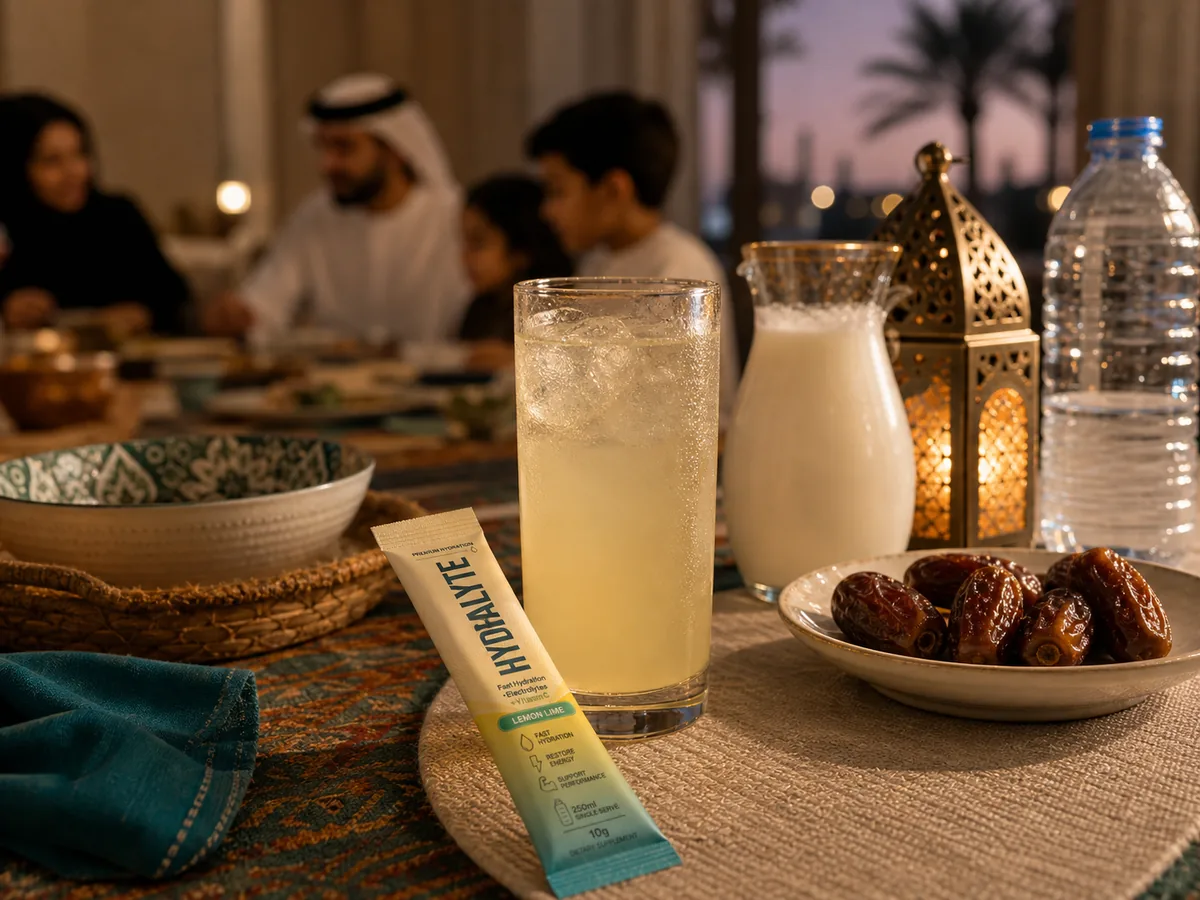
Dates close the loop. A few Khalas or Khenaizi dates at iftar deliver fast sugars and a genuinely useful dose of potassium, which is why breaking a fast on dates and water or laban is both a religious tradition and sound rehydration practice. The region's food culture had encoded the sodium-potassium-sugar logic into its hospitality long before anyone measured it in millimoles. These remedies are not obsolete; a well-made glass of nimbu paani or salted laban remains a perfectly good everyday rehydrator, and they sit comfortably alongside the modern formats on a Gulf pantry shelf.
How ORS changed the rules
The leap from folk remedy to precise medicine came in the late 1960s and 1970s, and it ranks among the most important public-health advances of the century. Researchers working on cholera in South Asia confirmed the sodium-glucose co-transport principle: in the wall of the small intestine, glucose and sodium are absorbed together, and the presence of glucose dramatically accelerates the uptake of sodium and, with it, water. Put the right small ratio of sugar to salt into water and the gut drinks it in far faster than it would take in either alone.
That single insight produced Oral Rehydration Solution, ORS, the cheap sachet of glucose and salts that the World Health Organization rolled out worldwide and which has since saved tens of millions of lives, mostly children who would otherwise have died of dehydration from diarrhoeal disease. The genius of ORS is its calibration: enough glucose to power the co-transport pump, not so much that it overwhelms the gut and pulls water the wrong way. Every electrolyte drink, sports formula and effervescent tablet stocked across the UAE today, from the pharmacy ORS sachets in Dubai to the flavoured isotonic bottles in a Mussafah cold store, is a descendant of that 1970s breakthrough. The marketing has changed; the underlying physics of sodium, glucose and water moving together across the gut wall has not.
Reading the label: sodium, potassium, sugar and the rest
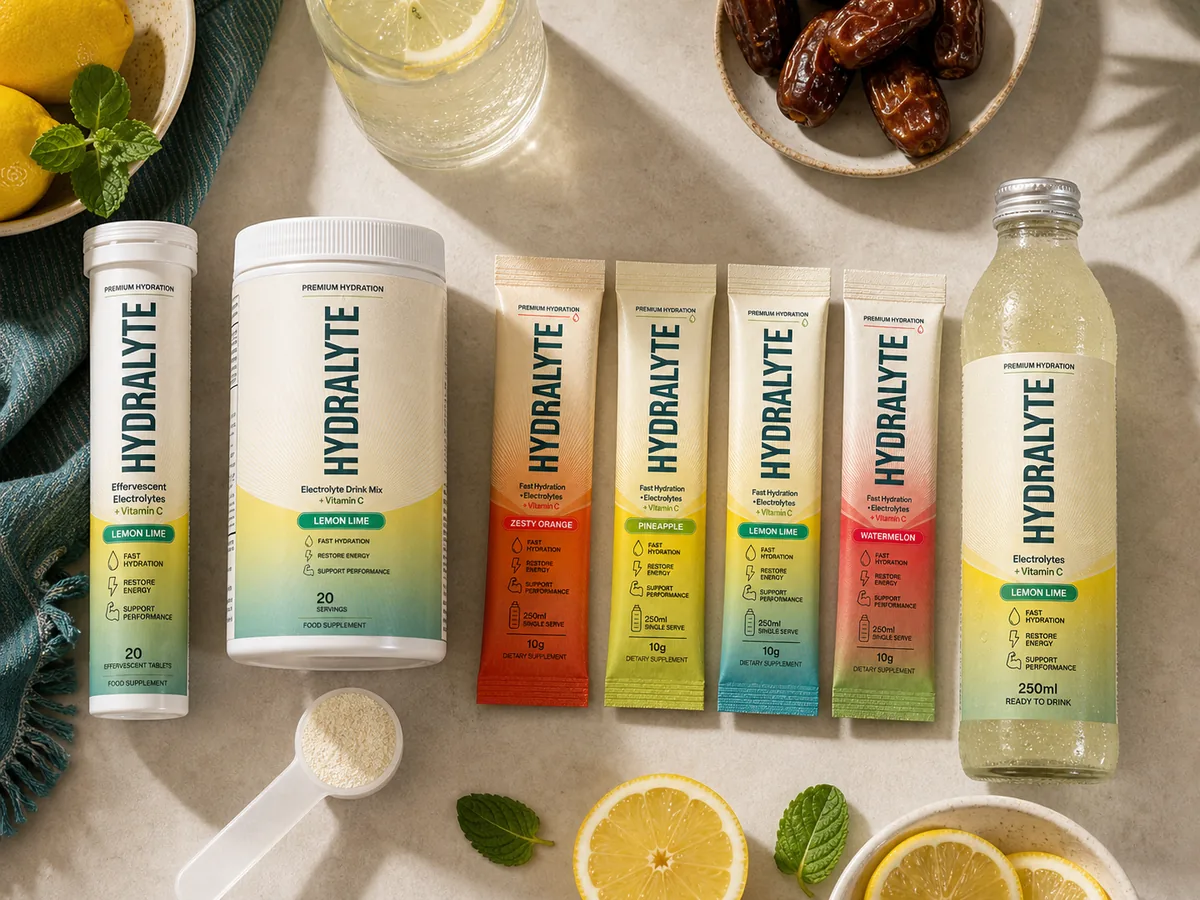
Once you understand that rehydration is a recipe, the back of the pack becomes the only part that matters. Two products with near-identical front-of-pack promises can be wildly different formulations, and a glance at three numbers, sodium in milligrams, sugar in grams, and potassium in milligrams per serving, tells you almost everything about what a drink is actually for.
Sodium and potassium: the working pair
Sodium is the headline electrolyte because it is the one that governs whether the fluid you drink stays in you. Sodium is the primary ion in the fluid outside your cells, and where sodium goes, water follows. A drink with too little sodium will pass straight through and out via the kidneys; a drink with a sensible sodium load helps the body hold onto the volume you have just taken in. For everyday heat and exercise, a serving delivering somewhere in the region of 200 to 500 milligrams of sodium is a reasonable working range. Clinical ORS, designed for serious fluid loss, runs considerably higher.
Potassium is sodium's counterpart, the main ion inside the cells, and the two work as a pair to maintain the electrical gradient that fires nerves and muscles. Potassium losses in sweat are smaller than sodium losses, but a drink that carries a useful dose, often in the 100 to 250 milligram range per serving, supports muscle function and contributes to cramp prevention. Magnesium and calcium round out the cast: magnesium for muscle relaxation and nerve signalling, calcium for the contraction side of the same equation. Not every drink contains all four, and you do not need megadoses, but a formula built only on sugar and a token sprinkle of salt is doing far less than its label implies. The working pair to look for first is sodium and potassium, in that order.
How much sugar is too much
Sugar has an undeserved villain status in hydration. In small amounts it is not the enemy; it is the engine. The glucose in a drink is what drives the sodium-glucose co-transport that speeds water across the gut wall, which is why a touch of sugar genuinely helps absorption rather than hindering it. The problem is dose. Mainstream sports drinks frequently overshoot, packing the sugar of a soft drink into a bottle marketed as a health product. A standard 500ml sports drink can carry 30 grams of sugar or more, which is around seven and a half teaspoons, well past the point of optimal absorption and into the territory of an energy spike and crash.
For most UAE situations, the sweet spot is modest. A drink with roughly 6 to 8 grams of sugar per 250ml sits near the isotonic range that the gut absorbs most efficiently. Higher than that and the drink becomes hypertonic, more concentrated than your blood, which can actually slow gastric emptying and, in the worst cases, draw water into the gut and worsen dehydration in the short term. This is exactly where sugar free electrolyte powder, increasingly popular across Dubai gyms and offices, earns its place: by stripping the sugar and keeping the salts, these formulas suit people managing blood sugar, cutting calories, or simply sipping electrolytes through a working day without wanting a sweet drink every hour. The trade-off is marginally slower water uptake than a lightly-sugared formula, irrelevant for steady daily hydration, occasionally worth weighing for hard endurance efforts. Scan the grams of sugar per serving before you scan anything else on the front of the pack.
Vitamin C, zinc and the extras worth having
Beyond the core salts and sugar, hydration products increasingly carry a supporting cast, and some of it is worth having while some is decoration. Vitamin C and zinc show up frequently; both play genuine roles in immune function, and a modest dose alongside your electrolytes does no harm and some good, particularly during the run-down weeks when sleep is short and the body is under heat stress. B vitamins appear in many formulas, marketed for energy; their real contribution is in the metabolic pathways that turn food into usable energy, so they are a reasonable inclusion rather than a miracle.
Where scepticism is warranted is the long ingredient lists of proprietary blends, exotic-sounding botanicals and undisclosed quantities. A hydration product lives or dies on its sodium, potassium and the sensible use of sugar; everything else is a bonus at best and marketing padding at worst. The cleanest formulas tend to be the ones confident enough to keep the label short. Bagason works with a spread of FMCG and hydration brands precisely so that UAE shoppers can find both the no-nonsense ORS sachets and the fortified everyday formats, and you can see the range of names we bring to Gulf shelves on our %the brands we represent across hydration and FMCG% page when you want to compare what is actually stocked locally rather than what is merely advertised.
Isotonic, hypotonic and ORS: matching the drink to the situation
The single most common hydration mistake in the UAE is not choosing a bad product; it is choosing a good product for the wrong situation. A clinical ORS sachet is excellent at its job and a poor choice for casual all-day sipping. An isotonic sports drink is ideal for a sweaty training session and overkill for a desk job in air-conditioning. The concentration of a drink, how it compares to the saltiness of your own blood, determines what it is good for, and matching the two is the whole game.
When isotonic wins
Isotonic drinks carry roughly the same concentration of dissolved particles as your blood, which means they empty from the stomach and absorb at a brisk, balanced rate without pulling water in either direction. Hypotonic drinks are more dilute than blood and absorb even faster, prioritising rapid fluid replacement over fuel. For the bulk of UAE life, daily heat exposure, a padel match, a corniche run, an afternoon moving around a hot warehouse, a hypotonic or isotonic formula is the right tool. It replaces fluid and salts at a sensible clip, carries enough sugar to drive absorption without spiking you, and is gentle enough to drink repeatedly through a day.
The practical distinction between isotonic and hypotonic drinks comes down to whether you also want fuel. A footballer or a desert cyclist burning through glycogen benefits from the carbohydrate in an isotonic formula. An office worker or a walker who simply wants to stay hydrated through the heat is better served by a lighter hypotonic option or a low-sugar electrolyte tablet dropped into a bottle. Neither is calibrated for the high salt load of illness recovery, and using them when you genuinely need clinical ORS means under-treating a serious fluid loss.
When you actually need clinical ORS
ORS sachets occupy a different category entirely, and the UAE pharmacy shelves stock them for good reason. A standard rehydration salts sachet from a Dubai pharmacy is calibrated to a sodium concentration in the region of 75 to 90 millimoles per litre, far saltier than any sports drink, because it is engineered to replace the catastrophic fluid and electrolyte losses of acute illness: a stomach bug, a bout of food poisoning, the diarrhoea and vomiting that strip litres out of a body in hours. In that emergency, the high sodium load is exactly what is needed to claw back lost volume and prevent the slide into dangerous dehydration.
That same high-sodium calibration makes ORS a poor everyday drink. Sipping clinical rehydration salts all day when you are merely warm, not ill, loads you with more sodium than you are losing and tastes, frankly, like seawater for a reason. The decision frame is simple and worth committing to memory: for light daily hydration in the heat, reach for water plus a low-to-moderate electrolyte tablet or hypotonic formula; for hard, sweaty training, reach for an isotonic drink matched to the session length; and for acute fluid loss from a stomach bug or heat illness, reach for clinical ORS sachets and, if symptoms are severe, a doctor. Three situations, three concentrations. Keep all three formats in the house and you are covered for the whole spectrum, and a sensible household across the Emirates does exactly that, treating hydration as a stocked staple rather than a panic purchase. The reach of those products across hypermarkets, pharmacies and baqalas from Abu Dhabi to Ras Al Khaimah is wider than most shoppers realise, and the geography of how they get there is mapped on our %where our distribution reaches across the UAE and GCC% page.
Hydration for outdoor and industrial workers
For the men laying paving in Al Quoz, scaffolding crews on the Sheikh Zayed Road towers, and landscape teams keeping the corniche green, hydration is not a wellness trend. It is the difference between finishing a shift and ending up on a saline drip at the nearest clinic. A labourer working under full sun in July can shed close to two litres of sweat an hour, and most of that loss happens silently because the dry-then-humid Gulf air evaporates it before the skin even feels wet. By the time a worker registers thirst, he is already a litre or more behind.
What the summer regulations require
The UAE takes this seriously enough to legislate it. Under MoHRE Ministerial Resolution 44 of 2022, the Midday Break rule prohibits work under direct sunlight and in open areas between 12:30pm and 3:00pm from 15 June to 15 September each year. The same framework obliges employers to make shaded rest areas and rehydration available on site, and inspectors levy fines per worker for non-compliance, with penalties that climb steeply for repeat offences. Rehydration here does not mean a tap and a plastic cup. Sites that get it right keep chilled water alongside electrolyte sachets or ready-mixed isotonic drink, because the regulation exists precisely because plain water cannot keep pace with the sodium a body loses at these sweat rates.
Beyond the legal minimum, the smart contractors treat hydration as productivity insurance. Heat-stressed workers slow down, make more mistakes and are far likelier to suffer an accident. A few dirhams of rehydration salts per head, per day, is cheaper than a single lost-time incident.
A site hydration routine that works
Cadence beats volume. A worker who downs a litre at the morning tea break and nothing until noon is gambling, because the body can only absorb so much at once and the rest is passed straight through. A workable rhythm for peak summer looks like this:
- Pre-load before the shift. A serving of electrolyte drink with breakfast, around 250-300ml, tops up sodium stores before the first bead of sweat appears.
- One electrolyte serving every two to three hours through the working day, alternating with plain water so the gut is never overloaded with either.
- Choose lower-sugar formulas for long shifts. A heavily sweetened sports drink delivers a quick lift followed by a slump, which is the last thing a man needs at 2pm on a roof. Sugar-free electrolyte powder, popular across Dubai sites for exactly this reason, sidesteps the crash while still carrying the sodium and potassium that matter.
- Re-hydrate after the shift, not just during. The recovery window after clocking off is when the body rebuilds its fluid reserve for the next day.
Supervisors who keep a tub of bulk rehydration powder and a stack of single-serve sachets in the welfare cabin spend very little and protect a great deal. It is the same logic a household uses with pantry essentials: you stock the staple before you need it, not in the middle of the emergency.
Sport, padel and the weekend warrior
Outdoor labour is the obvious case, but the Gulf manufactures sweat in plenty of leisure settings too. Padel has exploded across Dubai and Abu Dhabi, and a doubles match on an outdoor court in May moves more fluid than most players expect. Add the runners doing dawn loops of the Abu Dhabi Corniche, the cyclists pushing through Al Qudra before sunrise, the desert hikers on Jebel Jais, and even the CrossFit crowd in chilled boxes who still finish a metcon drenched. Air-conditioning masks the loss but does not stop it.
Calculating your sweat rate
Generic advice fails here because sweat rate is intensely personal. A heavy sweater can lose more than two litres an hour while a teammate on the same court loses half that. The only honest way to know yours is to measure it. Weigh yourself without clothes immediately before a session and again straight after, towelling off first. Each kilogram lost equals roughly one litre of sweat. Add back any fluid you drank during the session to get your true loss rate per hour. A runner who finishes a 60-minute Corniche loop 1.2kg lighter, having drunk 500ml en route, lost about 1.7 litres in an hour, and that gives a real target for both fluid and sodium replacement rather than a guess.
The salt side matters as much as the water. Some people leave white tide-marks of dried salt on their caps and shirts, a sign of a higher sodium concentration in their sweat. Those are exactly the people who cramp on plain water no matter how much they drink, and who feel the difference from a properly dosed electrolyte serving.
Tablets, powders or ready-to-drink
For most sport in the Gulf, a hypotonic or isotonic formula is the right tool, and the format is a matter of context. Effervescent electrolyte tablets drop into a bottle, weigh almost nothing in a gym bag and carry very little sugar, which suits training where you want the salts without the calories. Powders let you dial the concentration up or down and work out cheaper per serving for regular athletes. Ready-to-drink bottles win on pure convenience when you are heading straight from the office to a 7pm match. The mistake to avoid is reaching for a sugary supermarket sports drink out of habit when a session is short or low-intensity; for an easy hour on the court, you often need the electrolytes far more than the sugar.
Ramadan, travel and everyday dehydration
Some of the hardest hydration maths in the Gulf has nothing to do with sport. It is the everyday quiet draining that catches people out, and it peaks during the fasting month.
Smart fasting-month hydration
When Ramadan falls in the hotter half of the year, the entire day's fluid intake has to fit into the hours between iftar and suhoor, often while sleep is short and routines are disrupted. The instinct is to drink heavily at iftar, but flooding the system with cold water on an empty stomach mostly runs straight through. The better approach front-loads. %how Bagason moves products from brand to shelf% A measured electrolyte serving at suhoor, rather than at iftar alone, helps the body hold onto fluid through the long fasting hours, because the sodium gives the water something to bind to. Through the night, pace fluids steadily rather than chugging, and lean on hydrating foods: laban, soups, watermelon, cucumber and the dates that traditionally open the fast and happen to carry useful potassium. Skip the heavily caffeinated drinks late at night, since they nudge the body toward losing fluid just when it needs to bank it.
The hidden everyday drains
Outside Ramadan, dehydration in the Emirates is rarely dramatic. It creeps. A long-haul flight out of DXB pulls moisture out in pressurised cabin air. A drive from Dubai to Fujairah or across to Al Ain with the AC blasting dries you out without a drop of sweat in sight. A shisha night in a majlis, a few hours in a freezing mall, a desk under a vent set to 19 degrees, all of these chip away at fluid balance quietly. The early signs are easy to dismiss as something else: a mid-afternoon headache, a dip in concentration, a faint nausea, urine that has turned a darker yellow. Learning to read those as low-grade dehydration, and topping up with water plus a light electrolyte serving before it tips into a full headache, is one of the most useful habits anyone living in this climate can build.
Choosing the right format for your life
There is no single best electrolyte product, only the best one for a given moment, and most households end up keeping more than one format because their week contains more than one situation.
Sachets vs tablets vs powders vs RTD
- Single-serve sachets are the glovebox and travel champion. They survive a hot car, take no thought to dose, and a handful tucked into a work bag or a drawer at home covers the unexpected. ORS sachets in particular belong in every UAE home kit for the stomach-bug days.
- Effervescent tablets are the gym-bag and handbag option: light, low-sugar, no measuring, just drop and drink. Less economical per serving, but unbeatable for portability.
- Bulk powders are the household workhorse. A tub on the kitchen shelf is the cheapest way to keep a family topped up through summer, and you control the strength.
- Ready-to-drink bottles trade cost for zero effort. Perfect for the school run, the post-match cooldown, or handing a guest something cold in the majlis without disappearing to mix a drink.
The honest answer for most Gulf households is a small mix: a tub of powder for daily use, a box of sachets for illness and travel, tablets in the sports bags, and a few RTD bottles in the fridge for convenience. %bring your hydration brand to Gulf shoppers% That spread is exactly the kind of range a good distributor keeps moving from brand to shelf, so the format you actually reach for is the one stocked at your nearest baqala.
Storing them through 50C summers
Heat is hard on more than people. A car parked in a Sharjah lot can pass 60C inside, and that wrecks certain products. Effervescent tablets are the most vulnerable; humidity and heat make them clump, fizz prematurely in the tube or lose their pop. Keep tablets and powders sealed, dry and out of direct sun, ideally indoors rather than in a permanently roasting vehicle. Ready-to-drink bottles are fine warm but taste far better chilled, and once opened should be finished within a day. Check expiry on ORS sachets in the home kit each summer, since the one time you reach for them is the one time you do not want to find they expired two years ago.
Hydration as part of a stocked Gulf pantry
The mistake many households make is treating electrolytes as a summer-only purchase, something you panic-buy in July and forget by October. In this climate, hydration is a year-round staple that earns its place on the shelf next to the rice, the oil, the spice tins and the snacks. The AC runs in November. The flights happen in spring. The stomach bugs do not check the calendar. A sensible Gulf kitchen keeps hydration stocked the way it keeps salt and tea: quietly, always, replaced before it runs out.
Building a family hydration shelf
A practical family hydration shelf does not need to be elaborate. A workable baseline looks like this:
- A tub of sugar-free or low-sugar electrolyte powder for everyday topping-up and hot-day use.
- A box of ORS sachets kept with the medicines, for gastro illness in adults and children.
- Electrolyte tablets in each sports bag and one in the car.
- A few ready-to-drink bottles in the fridge for guests, kids and grab-and-go moments.
- Hydrating staples in the kitchen anyway: laban, lemons, dates, watermelon in season.
Rotate it like any pantry essential. When the powder tub is two-thirds gone, the next one goes on the list. That way the shelf is never empty on the day the mercury hits 48 and someone has spent the afternoon outside.
How the right brands reach UAE shelves
None of this advice matters if the products are not actually within reach, and that is the part of the chain shoppers rarely see. The reason a particular electrolyte powder or ORS sachet is sitting in your corner baqala, your local hypermarket and the online grocery app at the same time is that a distributor has done the work of bringing that brand into the country, clearing it, and pushing it out across thousands of points of sale from Ras Al Khaimah to the western desert. Bagason sits in exactly that gap, connecting trusted hydration and wider FMCG brands to retailers across the UAE and the broader GCC, so that hydration sits naturally alongside the pantry essentials, spices and snacks on the same shelves. The result for a shopper is simple: the products worth reading about are the products you can actually find, in the format you need, at a price that makes keeping them stocked an easy habit rather than a summer scramble.
Frequently Asked Questions
Is sugar-free electrolyte powder always the better choice in the UAE heat?
Not always, but often. For daily hydration, office life and long outdoor shifts where you want salts without an energy crash, sugar-free electrolyte powder is ideal, which is why it sells so well across Dubai. During hard, sustained exercise lasting over an hour, a small amount of sugar actually helps, because glucose drives sodium and water absorption through the gut. Match the formula to the effort: low-sugar for living and working in the heat, a little sugar for serious training and endurance sessions.
Can children use ORS sachets, and how is it different from an adult dose?
Yes, ORS sachets are one of the safest and most important things to keep in a UAE home with children, especially for the diarrhoea and vomiting that dehydrate little ones fast. Use a paediatric-formulated ORS where available, follow the mixing instructions exactly with clean water, and give small, frequent sips rather than large gulps. Do not improvise the concentration. If a young child cannot keep fluids down, has sunken eyes, is unusually drowsy or has dry nappies for hours, seek medical care promptly.
How much sodium do I actually need when sweating in Gulf heat?
It depends on how much and how salty you sweat. Most isotonic and ORS drinks supply somewhere between roughly 200 and 700mg of sodium per serving, and during heavy sweating an active person may need several servings across a day. Heavy, salty sweaters who leave white marks on their clothes need more than light sweaters. Rather than chasing a single number, replace fluid steadily through the day with electrolyte servings, and let thirst plus urine colour guide whether you are keeping up.
Is coconut water as good as a proper electrolyte drink?
Coconut water is a pleasant natural drink and reasonably high in potassium, but it is low in sodium, which is the electrolyte that matters most for holding onto fluid after heavy sweating. For a gentle top-up on a mild day it is fine. For an outdoor worker, a padel session in the heat, or recovery from a stomach bug, a formulated electrolyte drink or ORS sachet with adequate sodium will rehydrate you more effectively. Think of coconut water as a refreshment, not a rehydration tool for serious fluid loss.
What must UAE employers provide for outdoor workers in summer?
Under MoHRE rules, outdoor and open-area work under direct sunlight is banned between 12:30pm and 3:00pm from 15 June to 15 September. Employers must provide shaded rest areas and access to rehydration during the working day, not just plain water. Non-compliance carries fines levied per worker, rising for repeat breaches. In practice, responsible employers keep chilled water alongside electrolyte sachets or isotonic drinks on site, because plain water alone cannot replace the sodium lost at Gulf summer sweat rates.
When should I stop self-treating and see a doctor?
Most mild dehydration responds to rest, shade and an electrolyte drink. Seek medical help if you have signs of heat exhaustion or worse: dizziness or fainting, a rapid pulse, confusion, stopping sweating despite the heat, persistent vomiting that prevents you keeping fluids down, or no urination for many hours. For children, the elderly and anyone with a chronic condition, act sooner rather than later. Heat stroke is a medical emergency in this climate, and getting fluids and cooling early prevents a clinic visit turning into a hospital one.
<div class="bgn-blog-cta" style="margin-top:36px;padding:24px 26px;border-radius:14px;background:#f5f2ee;border:1px solid rgba(0,0,0,0.07);border-left:4px solid #CA7345;"><p style="margin:0 0 10px;font-weight:700;color:#1a6985;font-size:1.02rem;">Distribution solutions from Bagason Group</p><p style="margin:0 0 12px;color:#555;font-size:0.92rem;">Bagason Group distributes 700+ products to 30,000+ retail outlets across the UAE and GCC. Explore the pages most relevant to this article:</p><ul style="margin:0;padding-left:1.1rem;line-height:1.9;"><li><a href="/fmcg-distributor-uae">FMCG Distributor UAE</a></li><li><a href="/fmcg-distributor-abu-dhabi">FMCG Distributor in Abu Dhabi</a></li><li><a href="/fmcg-distributor-sharjah">FMCG Distributor in Sharjah</a></li><li><a href="/fmcg-distributor-northern-emirates">FMCG Distributor Northern Emirates</a></li></ul></div><div class="bgn-author-eeat" style="margin-top:28px;padding:20px 24px;border-radius:14px;display:flex;gap:16px;align-items:flex-start;background:#fff;border:1px solid rgba(0,0,0,0.08);"><div style="flex:0 0 52px;height:52px;border-radius:50%;background:linear-gradient(135deg,#1a6985,#CA7345);display:flex;align-items:center;justify-content:center;color:#fff;font-weight:800;font-size:1.1rem;">BG</div><div><p style="margin:0;font-weight:700;color:#2b2b2b;">Bagason Editorial Team</p><p style="margin:2px 0 8px;font-size:0.82rem;color:#888;text-transform:uppercase;letter-spacing:0.05em;">FMCG Distribution Editorial Desk · Bagason Group, Dubai</p><p style="margin:0;font-size:0.92rem;color:#555;line-height:1.6;">Written by the editorial desk of <a href="/about-us" style="color:#1a6985;font-weight:600;text-decoration:none;">Bagason Group</a>, a Dubai-based FMCG distributor operating since 2007 with 700+ products, 30,000+ retail outlets and coverage across all seven emirates and the GCC. Learn more about <a href="/what-we-do" style="color:#1a6985;font-weight:600;text-decoration:none;">how we distribute</a>.</p></div></div>