Stand near the mouth of an Emirati kitchen on a Friday afternoon and you can read the meal before you see it. Cardamom hits first, sweet and resinous, escaping the long-handled dallah coffee pot. Underneath it runs something darker and stranger: the sour, almost fermented smell of loomi simmering in a pot of machboos, the dried black limes bobbing among bay leaves and onions gone golden in ghee. A pinch of saffron is blooming in a saucer of warm water on the counter, staining it the colour of late afternoon sun over the Creek. None of this is exotic to the family living it. It is Friday lunch, the same as last week, the same as it was for their grandparents who measured wealth in pearls and counted the days until the dhows came back.
That kitchen sits at the end of a trade route thousands of years long. The spices in those jars travelled the Arabian Gulf before there were roads, before there was oil, carried on wooden boats that rode the monsoon winds between Malabar and Basra, Zanzibar and Bandar Abbas. To understand Emirati spices is to understand how a narrow strip of desert coast became one of the great flavour crossroads of the world, and how that history still seasons the food sold today in every hypermarket aisle and corner baqala from Ras Al Khaimah to the edge of the Empty Quarter.
Why the Gulf became a crossroads of spice
Geography wrote the recipe long before any cook did. The Arabian Gulf is a shallow, sheltered sea, roughly 1,000 kilometres long, threaded between the Arabian Peninsula and Persia, opening through the Strait of Hormuz into the Gulf of Oman and the wider Indian Ocean. For millennia that opening was the hinge of east–west commerce. The monsoon winds, the kaus blowing one way in winter and the reverse in summer, gave sailing dhows a reliable engine. A captain could ride the wind down to the Malabar Coast of India, load black pepper and cardamom and cinnamon, wait out the season, and ride the turning wind home. The same boats reached Zanzibar for cloves, the Persian ports for rosewater and dried limes, and the Levant for the textiles and grains that moved the other direction.
The Emirati coast was not a passive bystander to this. Towns like Julfar, near modern Ras Al Khaimah, were thriving entrepôts a thousand years ago, mentioned by Arab and Portuguese chroniclers as ports where goods changed hands and changed price. Then came pearling, which from the eighteenth century until the 1930s was the economic spine of the Trucial Coast. Pearling fleets needed provisioning, financing and a merchant class, and that class traded in far more than pearls. The same dhow that carried oyster divers in summer carried sacks of rice, coffee, dates and spice the rest of the year. Cardamom, pepper and cinnamon were not luxuries flown in for festivals; they were working cargo that flowed through Gulf ports as ordinary commerce. That is the deep reason these flavours feel native here. They have been arriving for a very, very long time.
What the local kitchen did with that abundance is the interesting part. Bedouin cooking of the interior was, by necessity, spare: dates, camel and goat milk, dried meat, flatbread baked on hot stones, flavoured with whatever could survive the journey and the heat. Coastal cooking leaned on fish, rice and the imported aromatics moving through the ports. The fusion of the two, plus generations of Persian, Indian and East African influence carried by traders, settlers and the enslaved and free communities who built Gulf society, produced a palate that is unmistakably its own. Gulf spices lean warm rather than fiery. There is chilli in the cabinet, but it plays a supporting role, a low hum rather than the lead. The signature is depth: layered cardamom, cinnamon and clove warmth, the sour lift of dried lime, the floral whisper of saffron and rose. It is a cuisine built on aromatics, not on heat for heat's sake, and that restraint is exactly what makes it so distinctive next to the chilli-forward cooking of the subcontinent that sits just across the water.
Inside the Spice Souk: Deira and the living trade today
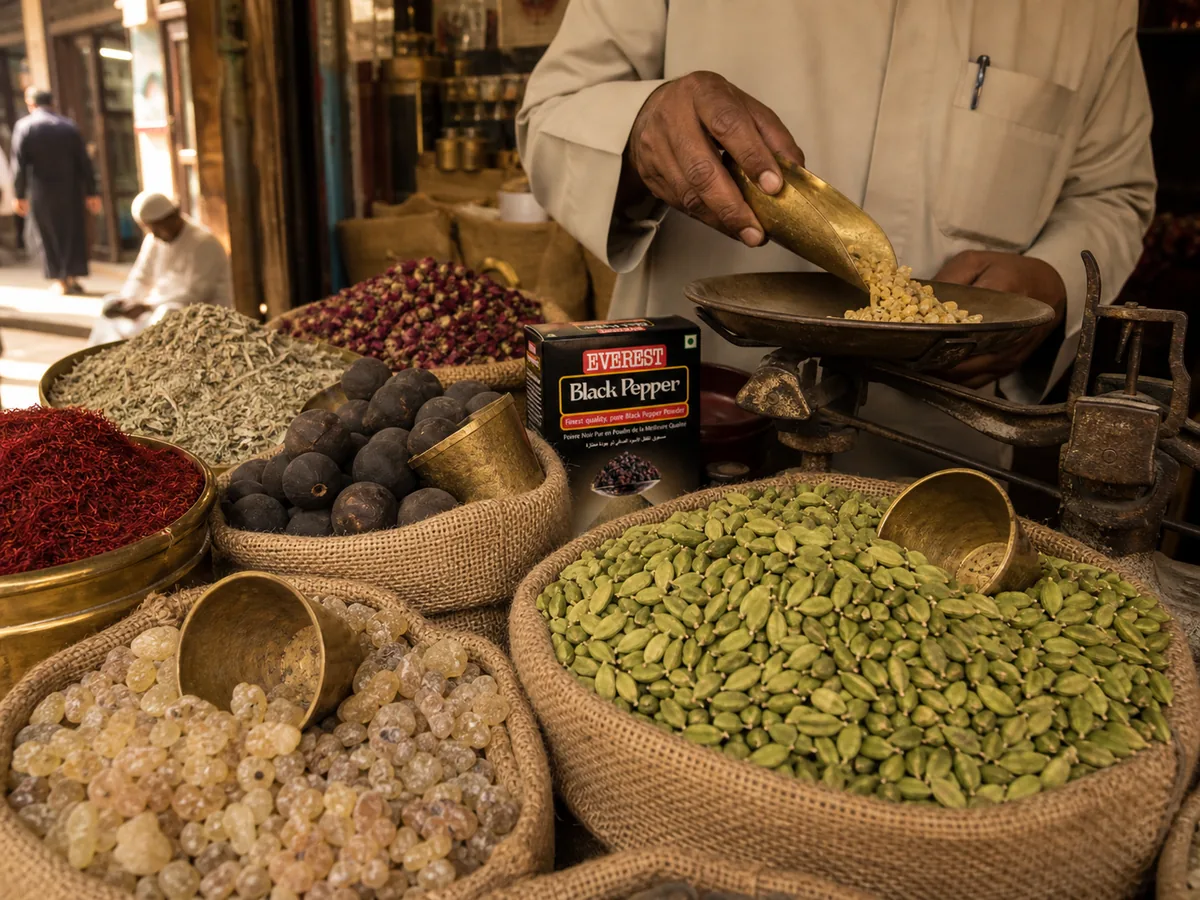
You can still walk straight into the middle of that history. Cross Dubai Creek by abra for one dirham, step off at the Deira side near Al Ras, and the Dubai spice souk opens off Baniyas Street in a warren of narrow covered lanes. The smell arrives before the shops do: a thick, layered wall of cumin and dried rose and incense smoke that gets into your clothes. The Deira souk is not a museum reconstruction. It is a working wholesale and retail bazaar where restaurateurs, home cooks and curious visitors buy from the same open sacks.
What the traders sell by weight
The defining feature of the souk is that almost everything is sold loose, by weight, scooped from burlap sacks and glass jars rather than sealed in printed packets. You see loomi dried lime piled in pyramids, dusty grey-brown on the outside, rattling when you shake one because the inside has dried hollow. There are mounds of dried rosebuds and hibiscus, ropes of cinnamon bark, sacks of green cardamom pods still faintly sticky with oil, and turmeric so vivid it looks lit from within. Frankincense, the hardened resin tears of the Boswellia tree from Oman and Yemen, sits in cloudy amber heaps beside the charcoal discs used to burn it. And there is saffron, kept behind the counter in small tins, sold by the gram, the most valuable thing in the shop. A good trader will let you smell threads before you buy and will tell you, accurately or not, exactly which valley in Iran or India they came from. Haggling is expected; the first price is a starting position, not a verdict.
Souk versus supermarket: quality and price
The romance of the souk is real, but so is the modern reality that most Emirati and expat families do their spice shopping under fluorescent lights. The same cardamom, loomi, bzar and saffron now fill dedicated aisles in Carrefour, Lulu, Union Coop and the neighbourhood baqala downstairs. Each route has trade-offs. The souk gives you freshness you can smell, the chance to buy tiny quantities, and a personal relationship with a seller, but quality varies wildly between stalls and an inexperienced buyer can overpay or be sold dyed safflower as saffron. The hypermarket gives you consistency, sealed packaging that protects volatile oils, batch dates and traceability, but a packet that has sat under bright lights for a year can be tired no matter what the label promises. The thread connecting both worlds is the distribution network behind the shelf, the importers and wholesalers who source, handle and move spice from origin to point of sale. That unglamorous middle layer is precisely where freshness is won or lost, and it is the work %how we move products from source to store% quietly does to keep authentic, well-handled pantry goods moving from source to Gulf kitchens.
Bzar: the Emirati house blend
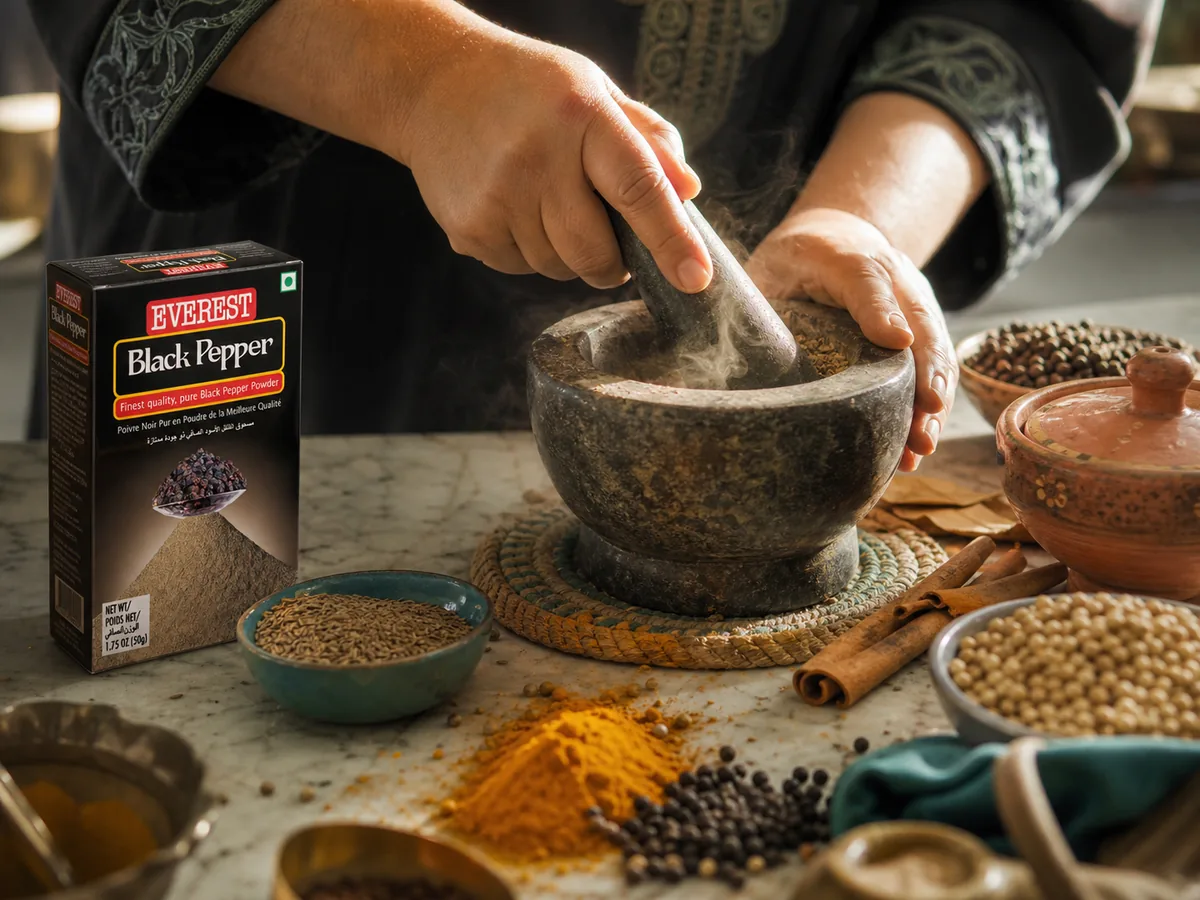
If one jar defines an Emirati kitchen, it is bzar. The word simply means "spice" or "seasoning" in Gulf Arabic, and in practice it refers to the house blend that goes into almost everything savoury. There is no single official formula, which is exactly the point. Every family, and arguably every grandmother, guards a slightly different ratio, and the differences are a matter of quiet pride. Ask ten Emirati cooks how to make bzar and you will get ten answers that agree on the core and diverge on the details.
The backbone is consistent: cumin and coriander seed for earthiness, black pepper for bite, cinnamon and cardamom for sweet warmth, turmeric for colour and a gentle bitterness, fenugreek for that distinctive maple-savoury note, and dried red chilli for a controlled heat that warms rather than burns. From there the personal touches begin. Some blends carry dried rose petals for a floral top note, others fold in ground loomi for sourness, cloves for intensity, ginger for lift, or nutmeg and a whisper of saffron for special occasions. The profile that results is warm, earthy and faintly smoky, engineered to deepen meat and rice over a long cook without shouting over the main ingredient. It is the seasoning that defines machboos, that goes into meat stews and lentil pots, that gets rubbed onto fish before grilling. Knowing how to make bzar at home is the single biggest step toward cooking real Emirati cuisine ingredients rather than approximating them.
A balanced home bzar formula
For a jar that suits most savoury dishes, start with this as a baseline and adjust to taste over time. Combine 4 tablespoons of coriander seeds, 3 tablespoons of cumin seeds, 2 tablespoons of black peppercorns, 1 tablespoon of fennel seeds, 2 teaspoons of green cardamom seeds (the seeds from inside the pods, not whole pods), a 5 cm stick of cinnamon broken up, 1 teaspoon of whole cloves, 1 teaspoon of fenugreek seeds, and 4 to 6 dried red chillies depending on how much heat you want. Toast and grind those, then stir in 2 tablespoons of ground turmeric and, if you like, 1 teaspoon of dried ground loomi and a tablespoon of dried rose petals crushed fine. The turmeric goes in after grinding because it is usually bought already ground and scorches easily. This makes a generous jar; treat the proportions as a starting conversation, not a fixed law.
Toasting and grinding for maximum aroma
The technique matters as much as the ratio. Toast the whole seeds and pods in a dry, heavy pan over medium-low heat, keeping them moving, until they turn a shade darker and release their oils into the air, roughly three to five minutes. You are chasing fragrance, not colour, and the line between fragrant and burnt is thin, especially with a Gulf hob running hot. Tip them onto a cold plate the moment they smell ready so the residual heat does not push them over. Once fully cool, grind in batches in a spice grinder or a heavy mortar. Grinding warm seeds can turn the blend pasty and dull the aroma. Toasting wakes up the volatile aromatic compounds that give the spices their punch, which is why freshly toasted and ground bzar tastes worlds apart from a pre-ground tub that has been losing its soul on a shelf for months.
Loomi: the dried lime that defines Gulf depth
Nothing announces Gulf cooking quite like loomi. Also called loomi aswad, black lime or omani lime, it is the secret behind the haunting sour-musky depth in machboos, in fish stews, in lentil and vegetable pots across the region. It is made by boiling fresh limes (or sometimes lemons) in heavily salted water, then drying them whole in the sun for weeks until they turn from green to tan to a hollow, brittle black. During that long dry the fruit ferments and concentrates, trading bright fresh acidity for something deeper: tangy, slightly bitter, with a fermented, almost smoky funk and a citrus ghost underneath. It tastes the way old wood and dried orchards smell.
There are three honest ways to use it. The simplest is to pierce a whole dried lime two or three times with a knife and drop it straight into the pot, where it slowly steeps its flavour into the liquid over a long simmer, the way a bay leaf does. The second is to crack it open, discard the seeds, and grind the shell into a powder that you can stir into rice, sprinkle over grilled fish, or fold into a spice rub or your bzar. The third is to crush it roughly and let it steep, then fish it out. The one trap every Gulf cook learns to avoid is the seeds. Loomi seeds are intensely bitter, and leaving a whole lime, or its broken pieces, in the pot too long lets that bitterness leach out and take over the dish. Pierce rather than smash for long cooks, deseed before grinding, and pull whole limes out once the dish tastes balanced. Used with that small care, loomi gives a sourness no fresh lemon or vinegar can imitate, the exact note that makes a pot of machboos spices read as unmistakably Gulf.
Saffron and cardamom: the fragrance of hospitality
If bzar and loomi are the working clothes of Emirati cooking, saffron and cardamom are the perfume it wears to greet guests. Both carry meaning beyond flavour. To serve saffron rice or cardamom-scented coffee is to signal generosity, and in a culture where hospitality is close to sacred, that signal matters.
Saffron in UAE cooking threads through both savoury and sweet. It tints festive rice a warm amber, perfumes balaleet (the sweet-savoury vermicelli and egg dish eaten at breakfast and across the table at celebrations), and golden-glows the milky sweets and the gahwa, the Arabic coffee, that anchors every gathering. Saffron is the dried stigmas of the Crocus sativus flower, each bloom giving only three threads, all hand-picked, which is why it is the most expensive spice on earth by weight. To use it, do not just toss threads into a pot. Bloom them first: steep a pinch in two or three tablespoons of warm (not boiling) water or milk for ten to twenty minutes until the liquid turns deep gold, then add liquid and threads together. This draws out the colour and the honeyed, hay-like aroma evenly through the dish.
Grading and storing saffron in a humid climate
Buying real saffron is a skill worth learning, because the market is full of fakes. Genuine saffron threads are slender, trumpet-shaped at one end, deep red with a slightly lighter orange tip, and they smell sweetly of hay and honey. The classic fraud is dyed safflower, sold loose and cheap, whose flat petal-like strands bleed red dye instantly in water. Real saffron releases its colour slowly over minutes, and a true thread stays red even after it has tinted the water gold. Grades run from the all-red tip-only sargol or negin styles down to bundles that include the paler, less potent yellow style ends. In the UAE, the enemy after purchase is the climate. Heat and humidity are murder on saffron's volatile oils. Keep it in an airtight container, away from light and the heat of the hob, and for long storage the freezer is genuinely the best home for it, sealed tight against moisture. Stored well, saffron holds its strength for a couple of years; left in a warm, bright cupboard, it fades to expensive red hay.
Cardamom in gahwa and the majlis ritual
Green cardamom is the scent of Gulf hospitality made audible. Cardamom Gulf cooking runs from machboos to sweets, but its spiritual home is the dallah and the small handleless finjan cups passed around the majlis. To make gahwa, lightly roasted coffee is brewed weak and pale, then generously perfumed with crushed green cardamom and often a thread of saffron and a little rosewater. The pour itself is ritual: the server holds the dallah in the left hand and the stacked cups in the right, fills each only a third full, and keeps refilling until the guest gently shakes the cup to signal enough. Refusing the first cup is unthinkable. The cardamom is not garnish here; it is the defining flavour, sweet and eucalyptus-cool against the bitter coffee, and the quality of the pods makes or breaks the cup. Whole pods cracked just before brewing give the truest aroma, because cardamom's volatile oils flee fast once the seeds are ground and exposed. Buy whole green pods, store them sealed and cool, and grind or crack only what you need. That small discipline is the difference between gahwa that fills a room and a cup that tastes of dust.
Bzar: the Emirati house blend
If you ask three Emirati grandmothers what belongs in bzar, you'll get three answers and a knowing look that says theirs is the right one. The bones of the blend are consistent: cumin and coriander for earthiness, black pepper for backbone, cinnamon and green cardamom for warmth, turmeric for colour and a gentle bitterness, fenugreek for that maple-savoury hum, and dried red chilli for a low, rounded heat that warms rather than burns. From there the family signatures appear. Some households fold in dried rose petals for a floral lift, others grind a whole loomi straight into the mix, and a few add a whisker of clove or dried ginger. The jar on the shelf is a fingerprint.
What bzar does in a dish is quieter than a Punjabi garam masala or a Mexican mole. It isn't there to announce itself. It deepens. Brown a shoulder of lamb, soften onions until they turn gold, and a spoon of bzar stirred into the fat at that moment binds everything with a warm, faintly smoky base note that carries the long simmer of a machboos or a meaty stew. Gulf cooking leans on this restraint. The chilli is present but polite, the aromatics broad rather than sharp, and the goal is a savoury depth that lets good meat and properly cooked rice stay the heroes.
A balanced home bzar formula
A reliable starting ratio for a first batch, by volume: four parts cumin, three parts coriander, two parts black peppercorns, one part green cardamom seeds, one part turmeric, one part cinnamon, half a part fenugreek, and dried red chilli to taste (start with one part for warmth, more if your household likes heat). Add the petals of a few dried roses and one crushed loomi if you want the full Emirati profile. Keep fenugreek modest; it turns bitter fast when you overdo it, and a heavy hand is the most common reason a home blend tastes off.
Write your ratio down. The point of mixing your own is that you can adjust it across a few batches until the jar tastes like the food you grew up with or the food you wish you had. A blend that leans sweeter on cinnamon suits chicken machboos and balaleet-adjacent dishes; one with more pepper and chilli stands up to beef and the long-cooked harees.
Toasting and grinding for maximum aroma
Toast the whole seeds before grinding and the difference is not subtle. Warm a dry, heavy pan over medium heat and add the cumin, coriander, peppercorns, cardamom and fenugreek, keeping turmeric and any ground chilli out (powders scorch in seconds). Toss them for two to three minutes until they smell nutty and the coriander starts to crackle, then tip them onto a cold plate immediately so the residual heat doesn't tip toast into burnt. Cool fully, grind in a spice mill or a dedicated coffee grinder, then stir in the turmeric and chilli. Make small batches, a month or two at a time, because a freshly ground bzar loses its top notes within weeks in a warm Gulf kitchen. Mixing it yourself also sidesteps the salt-and-filler problem of cheap pre-blends, where a third of the jar can be table salt doing nothing for flavour.
Loomi: the dried lime that defines Gulf depth
No single ingredient says "Gulf" on the palate quite like loomi. These are limes, usually small Omani limes, boiled briefly in salted water and then left to dry under the sun until they turn from green to a hard, hollow, blackish-brown. The drying ferments and concentrates them, and what comes out is unlike fresh citrus: tangy and sour, yes, but with a musky, almost smoky, slightly funky depth that fresh lime simply cannot reach. Bite into a sliver and you get sourness, bitterness and a strange savoury earthiness all at once. That complexity is exactly why loomi anchors so much Gulf cooking.
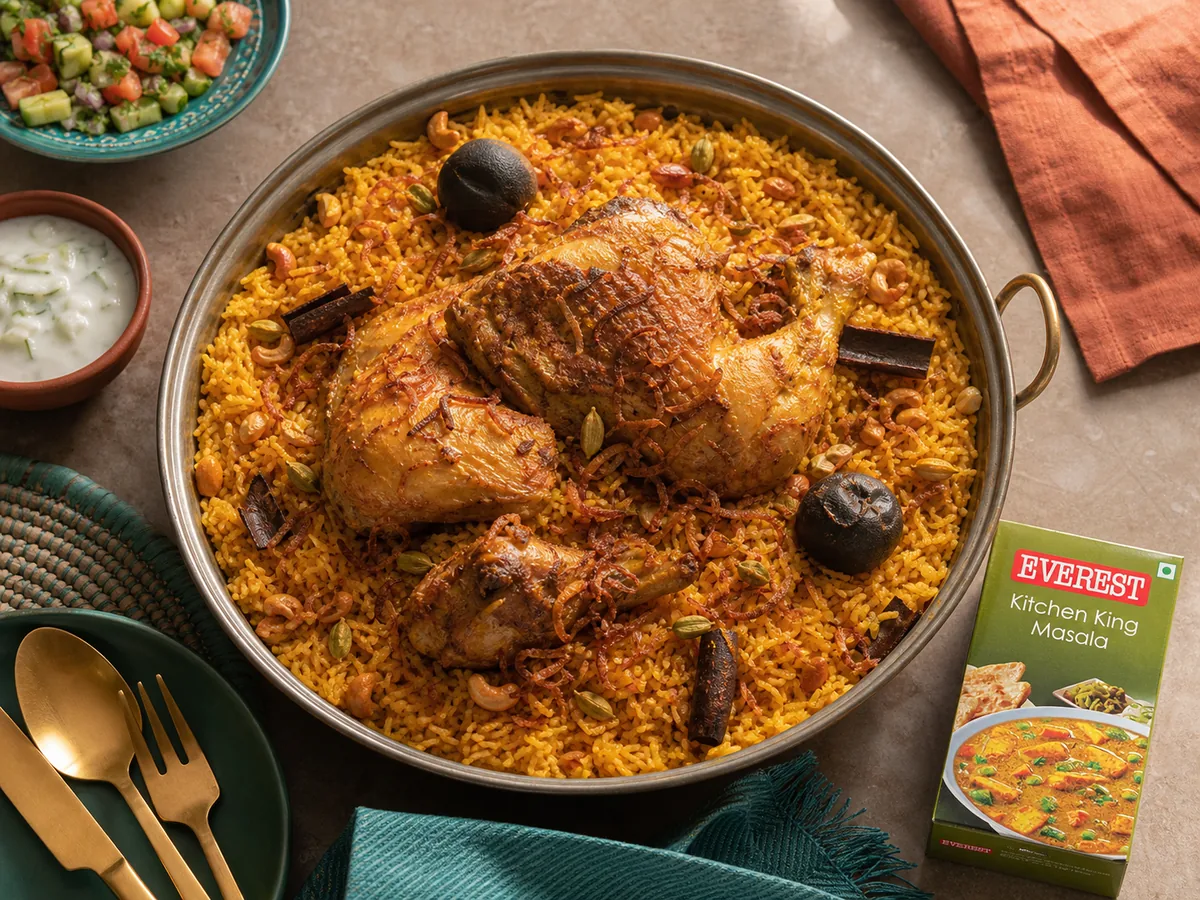
In the pot, loomi is what makes a machboos taste like machboos rather than a generic spiced rice. It cuts the richness of lamb fat, brightens a tomato-heavy stew, and gives broths a sour backbone that ties saffron, cardamom and bzar together. Persian and Iraqi kitchens use it too, in everything from fish stews to lentil soups, which is a reminder of how freely flavours travelled across these waters.
Three ways to use it, depending on the dish. Whole and pierced is the simplest: prick the lime a few times with a knife or skewer so the brine and oils leach into the liquid, then drop it into the simmering pot and fish it out before serving. Crushed into powder gives a more even, assertive sourness distributed through rice or a marinade; crack the dried lime open, discard the seeds, and grind the shell. Or steep it, breaking a lime into a little hot water and adding the strained liquid for a softer note. The one trap every Gulf cook learns: don't leave the seeds in, and don't let a whole loomi sit in the pot for hours. The pith and pips turn aggressively bitter the longer they cook, and an overstewed loomi can drag a whole dish down. Add it for the back half of cooking, taste, and remove.
Saffron and cardamom: the fragrance of hospitality
Where loomi gives depth, saffron and cardamom give a Gulf table its perfume, the scent that drifts out of a kitchen before a single plate arrives. Saffron threads colour rice a glowing amber, sweeten balaleet (the sugared vermicelli often topped with a savoury omelette that Emiratis eat for breakfast and dessert alike), and lend gahwa, Arabic coffee, its luxurious edge. To get the most from it, don't drop dry threads into a pot and hope. Bloom them: crush a pinch between your fingers, steep in two or three tablespoons of warm (not boiling) water or milk for ten to fifteen minutes until the liquid turns deep gold, then stir that elixir into rice as it finishes or into the coffee pot. Blooming releases the colour and aroma evenly instead of leaving you with stained, flavourless strands.
Cardamom, hayl, is the other half of the welcome. Green pods perfume gahwa, scent machboos, and run through sweets like luqaimat syrup and cardamom-laced milk puddings. Whole pods bruised and added to a pot give a slow, clean release; the seeds ground fresh give an immediate floral-citrus hit for baking and coffee; pre-ground cardamom from a packet fades fastest of all and should be bought in small amounts. The volatile oils that make cardamom sing are also what it loses quickest, so whole pods kept sealed are always the smarter buy.
Grading and storing saffron in a humid climate
Real saffron is deceptively easy to fake, and the Gulf market sees plenty of dyed safflower and turmeric-tinted threads sold to the unwary. Genuine saffron threads are deep red, sometimes with a slightly paler orange trumpet end, and they're brittle and dry. Drop a thread in warm water and real saffron releases its golden colour slowly over minutes while the thread itself stays red; a fake bleeds colour instantly and the strand goes pale. The aroma should be honeyed and hay-like, never harsh. The best grades (sometimes labelled sargol or all-red) are pure stigma with no yellow style attached. In a humid coastal climate, saffron's enemy is moisture, which dulls the aroma and risks mould. Keep it in a small airtight container away from light and steam, and for long storage the freezer is your friend; tightly sealed, saffron holds its character for a year or more frozen, far longer than it would in a cupboard above the hob.
Cardamom in gahwa and the majlis ritual
Gahwa is more than coffee in the Gulf; it's the language of hospitality, poured from a long-spouted dallah into tiny handleless finjan cups and offered the moment a guest sits in the majlis. The brew is lightly roasted, often pale gold rather than dark, and generously spiced, cardamom always, frequently saffron, sometimes a thread of clove or a pinch of ginger. It's served unsweetened, with a date alongside to balance the bitterness, and the unspoken etiquette runs deep: you're refilled until you gently shake the cup to signal you've had enough. To make it at home, crack a teaspoon of green cardamom pods into lightly brewed coffee, add a few bloomed saffron threads, and let it steep before pouring. That small ritual, repeated across millions of Gulf homes every day, is the clearest example of how spice and culture are inseparable here.
Baharat and the wider Gulf spice cabinet
Step beyond the Emirati kitchen and you meet baharat, which simply means "spices" in Arabic and refers to the broad warm all-spice blend used across the Levant and the Gulf. It overlaps heavily with bzar, black pepper, cumin, coriander, cinnamon, clove, cardamom and nutmeg are common to both, but baharat tends to skip the turmeric and loomi that give bzar its specifically Emirati character, and regional baharat can lean sweeter, with more cinnamon and nutmeg, or smokier in the Iraqi style with a touch of dried rose. Think of bzar as the Emirati dialect within the larger language of Gulf baharat. Knowing both means you can read a recipe from Abu Dhabi, Kuwait or Damascus and understand what flavour it's reaching for.
Around these two blends sits a supporting cast that no Gulf pantry is complete without. Turmeric does double duty as colour and a faintly bitter earthiness. Cinnamon bark, used in stick form for slow dishes and ground for sweets, brings warmth and a hint of sweetness that suits both rice and milk puddings. Cloves add an intense, almost medicinal punch used sparingly in rice and gahwa. Dried rose, edible petals or rosewater, perfumes sweets and some savoury blends. Sumac lends a tart, lemony red dusting over grilled meats and salads. Black lime powder is loomi in its most convenient form. And dried ginger gives gahwa and some stews a dry, warming heat. Stock these and you can cook your way across the entire region.
If you want to see how a distributor's range maps onto exactly this kind of pantry, from spices and pantry essentials to snacks and hydration, %the markets we cover across the UAE and GCC% lays out the categories that move through Gulf hypermarkets and baqalas every day.
The dishes the spices were built for
Spices don't exist in the abstract here; they were shaped by, and for, specific dishes. The clearest showcase is the pair at the heart of Gulf feasting: machboos and kabsa. Both are one-pot rice-and-meat dishes built in layers. You brown meat, build an aromatic base of onion, garlic, tomato and bzar or baharat, drop in pierced loomi for sourness, simmer until the meat surrenders, then cook basmati in that spiced stock so every grain drinks up the flavour. Bloomed saffron and a scatter of fried onions, raisins or nuts finish it. Machboos (the Emirati and wider Gulf term) and kabsa (more Saudi in origin) are cousins more than rivals; the spicing philosophy is identical, layered warmth with a sour-citrus spine.
A machboos spicing walkthrough
The order matters more than any single quantity. Bloom your saffron first so it's ready. Brown the meat hard for colour, then soften onions in the same fat until deeply golden, that caramelisation is half the flavour. Stir bzar into the hot fat and let it toast for thirty seconds until fragrant; this "blooming" of the blend wakes up the spices the way blooming does for saffron. Add tomato, then water and two pierced loomi, and simmer the meat low and slow. Remove the loomi before they over-steep into bitterness. Cook the rinsed basmati in the strained, spiced stock, fork through the bloomed saffron near the end, and rest it covered so the grains separate. The dish should taste layered, not loud, warmth, then sourness, then the floral lift of saffron on the finish.
Sweet-side spicing: saffron, cardamom and rose
The same cabinet sweetens the table. Balaleet pairs saffron and cardamom-sweetened vermicelli with eggs. Luqaimat, the golden Ramadan dumplings, are tossed in date syrup often scented with cardamom and a breath of saffron, sometimes finished with sesame. Saffron and rose run through milk puddings and the sweet cardamom-laced gahwa that closes every meal. The Gulf rarely draws a hard line between savoury and sweet spicing; cardamom belongs equally in a meat pot and a syrup, which is part of what gives the cuisine its coherence from first plate to last cup.
Beyond rice, the spice cabinet defines the slow, communal foods of the region. Harees, wheat and meat pounded to a porridge over hours, leans on a restrained warmth of cinnamon and cumin and is a Ramadan and celebration staple. Thareed, a Bedouin-rooted stew of meat and vegetables ladled over torn regag bread, carries bzar and loomi through its broth. These are dishes built for sharing from a communal platter, and their spicing reflects that, deep and comforting rather than sharp and individual.
Nutrition and wellness in the Gulf spice tradition
Long before anyone measured a polyphenol, Gulf cooks treated their spice shelf as half larder, half medicine cabinet, and modern nutrition gives some of that folk wisdom a fair hearing. Turmeric's active compound, curcumin, is studied for anti-inflammatory and antioxidant activity, though it's poorly absorbed on its own, which is why the traditional pairing with black pepper (whose piperine boosts absorption) and a little fat, exactly how bzar and machboos deploy it, turns out to be quietly smart cooking. Cinnamon carries a long folk association with blood-sugar balance, and while the research is mixed and far from a green light to over-consume, it's a flavourful way to sweeten the perception of a dish without adding sugar.
Cardamom has a deserved reputation as a digestive, used after heavy meals to settle the stomach and freshen the breath, which is part of why it closes a meal in the gahwa cup. Loomi's heritage is more poignant: dried limes were a portable source of vitamin C on the long pearling and trading voyages of the Gulf, a defence against scurvy carried in a sack alongside dates and rice. Ginger and clove bring their own warming, traditionally settling qualities.
An honest read matters here. Some of these effects are well supported, many are traditional belief, and a spoon of turmeric is not a substitute for medicine or a balanced plate. What is genuinely true is more mundane and more useful: whole, freshly ground spices let you build deep flavour without leaning on the heavy salt, sugar and additives that pad out cheap commercial seasoning sachets. Cooking from a real spice shelf is, almost as a side effect, a lower-sodium and more wholesome way to eat than reaching for a pre-mixed flavour packet. In a region where diet-related health is a live public conversation, that's a quiet argument for keeping the souk tradition alive in the home kitchen.
Buying spices in the UAE: freshness, storage and trust
A spice is only as good as its freshness, and freshness is exactly what the Gulf climate works against. Volatile aromatic oils, the molecules you're actually buying, evaporate faster in heat and degrade in light and humidity. A jar of ground cumin that smelled vivid in a cool warehouse can turn flat and dusty within months on a sunlit shelf above the hob. Learning to judge quality with your nose and eyes is the single most useful skill a Gulf cook can develop.
Trust your senses at the point of purchase. Whole spices should be intact, glossy where appropriate, and deeply aromatic when you rub or crack one between your fingers; if a clove or a cardamom pod barely smells, it's old. Ground spices should be vivid in colour, turmeric a bright gold, chilli a living red, and pungent through the packet. Dull colour and a faint, cardboard smell mean the oils are gone. This is where provenance and a reliable supply chain matter: spices that have been well-handled from source, stored cool and turned over quickly reach you with their character intact, while neglected stock that's sat in a hot container for a year is sold at the same price but cooks like sawdust.
Whole versus ground: what to buy in which form
The rule of thumb is simple: buy whole whenever you reasonably can. Whole spices keep their oils locked inside a protective shell and stay vivid for a year or more; the moment you grind them, the clock speeds up and they fade within weeks to a few months. Buy whole cumin, coriander, peppercorns, cardamom pods, cinnamon sticks, cloves and whole loomi, and grind small amounts as you cook. Reserve ground purchases for the few things you genuinely can't grind well at home or use fast enough to justify, and buy those in the smallest sensible quantity. A modest spice grinder or even a sturdy mortar pays for itself in flavour within a month.
Storing spices in UAE heat and humidity
The Gulf kitchen needs a deliberate storage strategy, not a rack of jars by the cooker looking pretty in the steam. Heat, light and moisture are the three thieves. Keep spices in airtight glass containers, decanting from bags that let air and humidity in, and store them in a closed cupboard away from the hob, the oven and any window that catches direct sun. Never shake a spice jar directly over a steaming pot; the rising moisture clumps and degrades what's left in the jar. For your most precious and most perishable, saffron and loomi especially, the freezer is the best home in a humid climate, tightly sealed to keep condensation out. Realistic shelf lives, stored well: whole spices roughly one to two years, ground spices three to six months at their best, and a home-ground bzar best used within a month or two. Date your jars; flavour fades long before anything looks spoiled.
For brands and producers thinking about how authentic, well-handled spices and pantry essentials actually reach Gulf shelves with that freshness intact, %partner with us to reach Gulf shoppers% is where that conversation starts.
Stocking a Gulf pantry, from souk to home shelf
You don't need fifty jars to cook the Gulf well; you need the right dozen, properly bought and properly stored. A starter list that unlocks most Emirati recipes: a jar of bzar (bought from a trusted source or, better, mixed yourself), whole loomi and a little black lime powder, saffron threads, green cardamom pods, turmeric, cinnamon sticks, a good baharat, plus the supporting players, whole cumin and coriander, black peppercorns, cloves, dried red chilli, and dried rose petals or rosewater. With that shelf you can build a machboos, a kabsa, a harees, a pot of gahwa and a tray of luqaimat without a second shopping trip.
Where you buy shapes what you get. The Deira souk rewards a cook who likes to smell, haggle and buy loose, and it's unbeatable for saffron, frankincense and sacks of loomi bought by weight. The hypermarket and the corner baqala win on convenience and consistency, and a good one carries well-known spice brands that have been handled properly from source. Both have a place; the trick is knowing which to trust for what, and judging freshness with your nose regardless of where you stand.
Behind every well-stocked baqala shelf sits a supply chain most shoppers never think about. Getting authentic spices and pantry essentials from origin, Indian cardamom, Iranian and Spanish saffron, Omani limes, to thousands of UAE hypermarkets and neighbourhood shops in good condition is a logistics and quality-control job, not an afterthought. Temperature-aware handling, fast turnover so stock doesn't age in a hot warehouse, and reliable provenance are exactly what separates a vivid jar from a tired one. That connective work, linking brands at source to Gulf shoppers at the shelf, is the quiet infrastructure behind the cuisine, and it's the role a distributor like Bagason plays across the region's pantry, spice, snack and hydration categories.
Bringing the spice route into your everyday cooking
You don't have to cook a four-hour machboos to put this tradition on your table. Start with small, confident swaps. A pinch of bzar stirred into a weeknight beef stew or a tray of roasting vegetables adds a warm Gulf backbone in seconds. Drop a pierced loomi into a pot of lentils or a chicken soup and let it steep for the back half of cooking; the sour-musky depth transforms a plain dal. Crush a cardamom pod into your morning coffee or your rice pot. Bloom a few saffron threads in warm milk and pour them over plain rice pudding. Each of these is a single ingredient doing a lot of work, and each one teaches your palate what the spice actually does.
From there, confidence builds naturally. Once you've used loomi and bzar a few times, mixing your own blend stops being intimidating, and you'll start adjusting ratios to your own taste. The spices travel well beyond Emirati recipes, too: a whisper of baharat lifts a tomato pasta sauce, sumac brightens a Western salad, cardamom belongs in banana bread, and loomi gives a roast chicken brine an unexpected edge. The point isn't to bolt Gulf flavours onto everything; it's to understand them well enough to use them with respect. Keep the soul of the cuisine, the layered warmth, the sour loomi spine, the floral saffron finish, and let it quietly change how you cook. That's the real inheritance of the spice routes: not a fixed set of recipes, but a way of building flavour that has crossed oceans, fused cultures and ended up, fragrant and alive, on a Gulf kitchen shelf within your reach.
You can also explore the brands we bring to Gulf shelves.
Frequently Asked Questions
What is the difference between bzar and baharat?
Both are warm Arabic spice blends, but bzar is the specifically Emirati version, typically built on cumin, coriander, black pepper, cinnamon, cardamom, turmeric, fenugreek and dried chilli, often with loomi or dried rose. Baharat is the broader Gulf and Levantine all-spice blend; it shares many spices but usually skips the turmeric and loomi that give bzar its distinctive Emirati colour and sour-earthy edge. Think of bzar as the local dialect within the wider language of baharat.
Where can I buy authentic Emirati spices in the UAE?
For loose, buy-by-weight shopping, Dubai's Deira Spice Souk on Baniyas Street near Al Ras is the classic destination for saffron, frankincense and sacks of loomi. For convenience and consistency, UAE hypermarkets and well-run neighbourhood baqalas carry trusted spice brands, including ready-made bzar and baharat. Whichever you choose, judge freshness with your nose: vivid colour and a strong aroma signal good handling, while dull, faint spices have lost their oils regardless of price.
How do I use loomi (dried lime) in cooking?
You have three options. Pierce a whole loomi a few times and drop it into a simmering machboos or stew for the back half of cooking, then remove it. Crack it open, discard the bitter seeds, and grind the shell to powder for an even sourness in rice or marinades. Or steep a broken lime in hot water and add the strained liquid. The key rule in any Gulf kitchen: never leave the seeds in or let it over-steep, as both turn the dish unpleasantly bitter.
How can I tell if saffron sold in the UAE is real?
Genuine saffron threads are deep red, brittle and dry, with a honeyed, hay-like aroma. Drop a thread in warm water: real saffron releases golden colour slowly over several minutes while the strand itself stays red, whereas dyed safflower or fake threads bleed colour instantly and go pale. The best grades are all-red stigma with no yellow style attached. Be cautious of suspiciously cheap "saffron" in Gulf markets, as safflower and turmeric-dyed fakes are common.
How should I store spices in the UAE's heat and humidity?
The Gulf climate degrades spices fast, so keep them in airtight glass containers inside a closed cupboard away from the hob, oven and direct sunlight. Never shake a jar over a steaming pot, as moisture clumps and spoils what remains. Buy whole spices and grind small amounts as needed; whole spices last one to two years, ground keep their best for three to six months. For saffron and loomi especially, tightly sealed freezer storage preserves their aroma far longer than a kitchen cupboard.
What spices do I need to start cooking Emirati food at home?
A dozen essentials cover most recipes: bzar (bought or homemade), whole loomi, saffron threads, green cardamom pods, turmeric, cinnamon sticks and a good baharat, plus whole cumin, coriander, black peppercorns, cloves, dried red chilli and a little dried rose. With that shelf you can make machboos, kabsa, harees, gahwa and luqaimat. Buy whole forms where you can, grind fresh, and store everything airtight away from heat for the best flavour in a Gulf kitchen.
<div class="bgn-blog-cta" style="margin-top:36px;padding:24px 26px;border-radius:14px;background:#f5f2ee;border:1px solid rgba(0,0,0,0.07);border-left:4px solid #CA7345;"><p style="margin:0 0 10px;font-weight:700;color:#1a6985;font-size:1.02rem;">Distribution solutions from Bagason Group</p><p style="margin:0 0 12px;color:#555;font-size:0.92rem;">Bagason Group distributes 700+ products to 30,000+ retail outlets across the UAE and GCC. Explore the pages most relevant to this article:</p><ul style="margin:0;padding-left:1.1rem;line-height:1.9;"><li><a href="/fmcg-distributor-uae">FMCG Distributor UAE</a></li><li><a href="/fmcg-distributor-abu-dhabi">FMCG Distributor in Abu Dhabi</a></li><li><a href="/fmcg-distributor-northern-emirates">FMCG Distributor Northern Emirates</a></li><li><a href="/fmcg-distributor-dubai">FMCG Distributor in Dubai</a></li></ul></div><div class="bgn-author-eeat" style="margin-top:28px;padding:20px 24px;border-radius:14px;display:flex;gap:16px;align-items:flex-start;background:#fff;border:1px solid rgba(0,0,0,0.08);"><div style="flex:0 0 52px;height:52px;border-radius:50%;background:linear-gradient(135deg,#1a6985,#CA7345);display:flex;align-items:center;justify-content:center;color:#fff;font-weight:800;font-size:1.1rem;">BG</div><div><p style="margin:0;font-weight:700;color:#2b2b2b;">Bagason Editorial Team</p><p style="margin:2px 0 8px;font-size:0.82rem;color:#888;text-transform:uppercase;letter-spacing:0.05em;">FMCG Distribution Editorial Desk · Bagason Group, Dubai</p><p style="margin:0;font-size:0.92rem;color:#555;line-height:1.6;">Written by the editorial desk of <a href="/about-us" style="color:#1a6985;font-weight:600;text-decoration:none;">Bagason Group</a>, a Dubai-based FMCG distributor operating since 2007 with 700+ products, 30,000+ retail outlets and coverage across all seven emirates and the GCC. Learn more about <a href="/what-we-do" style="color:#1a6985;font-weight:600;text-decoration:none;">how we distribute</a>.</p></div></div>