Most shoppers in the UAE skim a pack for maybe three seconds before it lands in the trolley. Knowing how to read food labels properly takes closer to thirty, and it changes what most people notice. The ingredients list, the nutrition table, the allergen line, the Arabic panel: each one is doing a specific job, and none of them is decoration.
We move close to 700 SKUs across roughly 17 brands through a single Dubai hub into every emirate, which means our own compliance team checks these same panels on every incoming shipment before it clears customs. What follows is the walkthrough we'd give a new buyer sitting across the table from us: what each section of a UAE food label is doing, in what order it's usually printed, and how to read it without needing a food science degree.
One note before the detail. This is a guide to reading composition and regulatory information, not a ranking of which foods are better for you. Nothing here should be read as advice about specific brands or products.
How to Read Food Labels: Where to Start on Any UAE Pack
Every prepacked food sold in the UAE carries a standard set of information under national labelling rules, most of it modelled on UAE.S GSO 9, the general standard for labelling of prepacked food, with UAE.S GSO 2233 covering nutrition labelling specifically. Both standards sit under the Ministry of Industry and Advanced Technology, which absorbed the old Emirates Authority for Standardization and Metrology, and enforcement at the point of sale runs through bodies like Dubai Municipality in Dubai and the Abu Dhabi Agriculture and Food Safety Authority in Abu Dhabi.
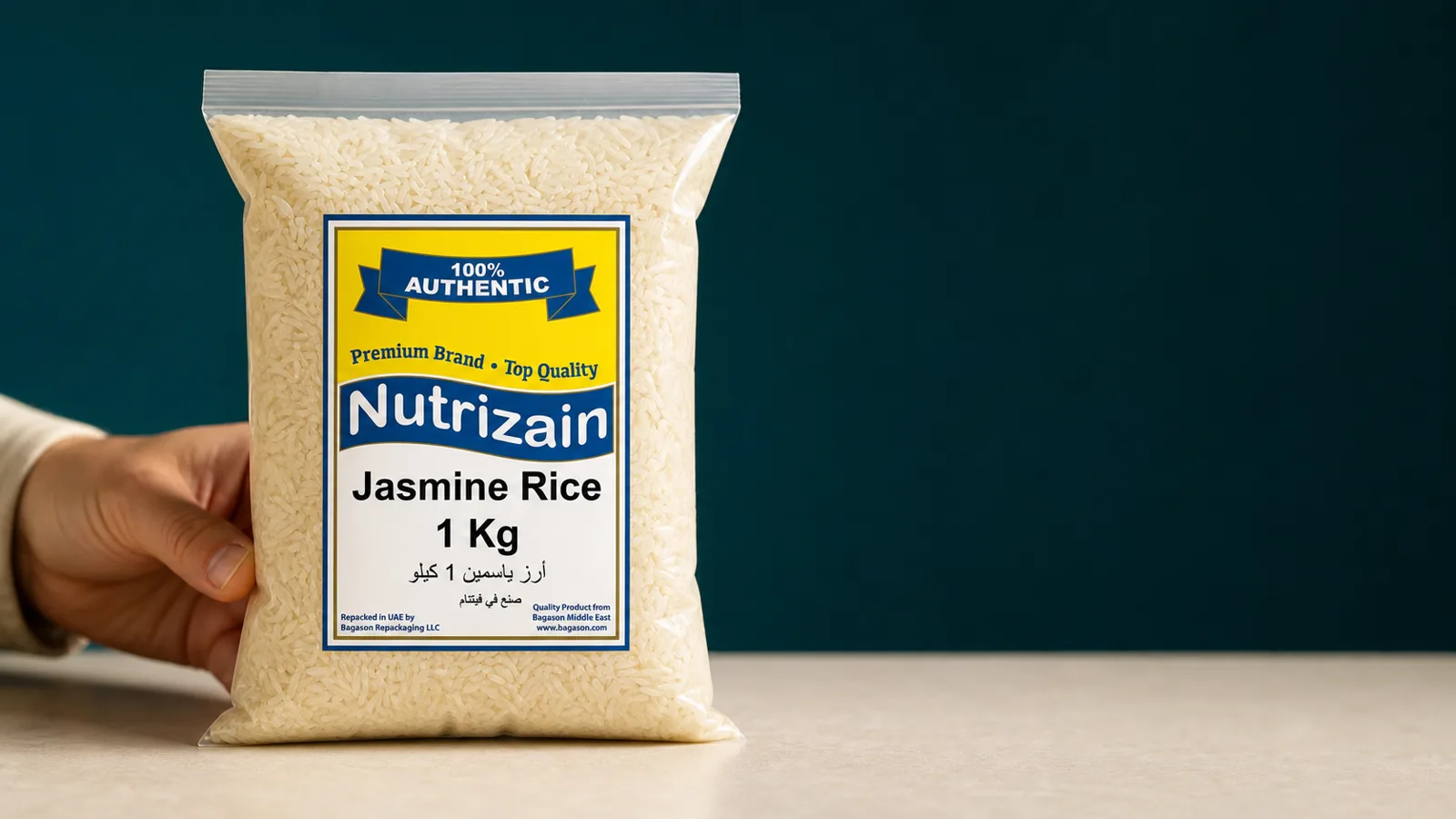
Learning how to read food labels starts with knowing what has to be there. A compliant pack sold here shows the product name, a full ingredients list in descending order, a net quantity, country of origin, storage instructions where relevant, the name and address of the manufacturer or the responsible importer, and a nutrition information panel. Allergen information sits either inside the ingredients list or directly beneath it, usually in bold. All of it, by rule, appears in Arabic as well as any other language on the pack.
That's the skeleton. The substance is in how each section is built, and most shoppers stop reading well before they get that far.
Reading the Ingredients List: Why Order Matters
Here's the thing most people miss: an ingredients list isn't alphabetical and it isn't random. It's ordered by weight, from the most to the least, measured at the point the ingredient went into the recipe. If sugar is the second item on a sauce label, sugar is the second-largest thing in that bottle by weight, ahead of everything listed after it.
That single rule does most of the work once you know it. Take a packaged snack with a long ingredients list. Whatever sits in the first three or four positions makes up the bulk of the product; whatever trails at the end, often a spice, a colour, or a preservative, is present in small amounts, sometimes fractions of a gram per hundred. A shopper comparing two similar products side by side gets more from checking what's in the first three positions of each list than from reading the whole thing top to bottom.
There's one more wrinkle worth covering in how an ingredients list works: compound ingredients. UAE labelling rules require that when an ingredient is itself made of multiple components, such as a seasoning blend or a filled biscuit layer, its own sub-ingredients are listed in brackets alongside it. That's why some labels look nested, with an ingredient followed by a parenthetical sub-list. It isn't clutter. It's the standard's way of making sure nothing hides inside a single catch-all word like "seasoning" or "filling."
Additives and E-Numbers
Additives, preservatives, colours and stabilisers appear in the ingredients list too, usually by their functional class followed by a specific name or number, such as "preservative (potassium sorbate)" or a colour code. This isn't a UAE-specific quirk; it follows an international naming convention used across most Gulf and European labelling systems, so a shopper who has seen E-numbers on packaging from another country will recognise the same format here. The class name tells you what the additive does in the product (colour, preservative, thickener); the specific name or number identifies exactly which one it is.
Water and air don't always appear where a shopper expects them. Water added during manufacture, in a sauce or a reconstituted juice for instance, counts toward the total weight and is listed in its ingredient position like anything else. Flavourings are usually the exception to full naming detail: a standard allows "flavouring" or "natural flavouring" as a general term rather than naming every individual flavour compound, since flavour formulations are often proprietary. It's one of the few places the list is deliberately less specific than everywhere else on the pack.
Net Quantity, Manufacturer and Importer Details
Net quantity sits near the front of most packs, usually close to the product name, and states the actual weight or volume of what's inside, excluding the packaging itself. For solid foods packed in a liquid, such as pickles or olives in brine, the standard also requires a separate drained-weight figure, since the liquid isn't the product a shopper is buying by weight.
Every pack also needs to name the party responsible for it in the market: the manufacturer, or, for an imported product, the importer or the local responsible entity, along with an address. This is the detail that matters most when something needs to be traced back, whether that's a consumer query, a recall, or a customs check on a new shipment. A pack missing this line, or showing an address that doesn't match a registered importer, is one of the more common reasons a shipment gets flagged for review before it clears into local retail.
The Nutrition Panel: What Each Line Tells You
The nutrition information panel is the table, usually on the back or side of the pack, listing energy and a set number of nutrients per 100 grams or 100 millilitres, often alongside a per-serving column too. Under GSO 2233 the mandatory figures are energy, protein, total fat, saturated fat, total carbohydrate, sugars, dietary fibre where declared, and sodium.
Reading it well comes down to comparing like with like. Because the standard requires a per-100g or per-100ml figure on every prepacked food, two products in the same category, say two brands of crackers, can be compared directly on that basis even if their box sizes and serving definitions differ. The per-serving column is useful for portion planning, but it's the per-100g column that lets you compare fairly across brands, since a manufacturer defines its own serving size and that figure can vary from pack to pack.
- Energy is usually shown in kilojoules and kilocalories together, reflecting the total energy contribution of the product per 100g or 100ml.
- Total fat and saturated fat are listed separately, since saturated fat is broken out as its own line under the nutrient declaration rules.
- Total carbohydrate and sugars appear as a pair, with sugars as a sub-line under carbohydrate rather than a separate total.
- Protein and sodium round out the mandatory figures, with fibre included where a manufacturer has chosen, or is required, to declare it.
No single figure here says whether a product suits a particular diet. What they let you do together is compare one pack against another on a consistent, standardised basis, which is the entire point of the nutrition panel existing in the first place.
Per-Serving Figures: Useful, but Read the Fine Print
Most packs add a second column next to the per-100g figures, expressed per serving, alongside a stated serving size such as "30g" or "one cup (250ml)." That serving size is set by the manufacturer, not by a shared national standard, so it varies between brands even within the same product category. Two cereal boxes might define a serving as 30g and 45g respectively, which means their per-serving columns aren't directly comparable even though their per-100g figures are.
A quick habit closes that gap: check whether the stated serving size roughly matches what you'd pour or portion out. If it doesn't, the per-100g column is the more honest number to work from, since it strips out any difference in how generously a brand has defined "one serving."
Understanding Allergen Declarations on UAE Packaging
Allergen labelling in the UAE follows the same logic as most major food-safety systems: a defined list of ingredients that trigger the most common food allergies or intolerances must be called out on the pack, not left buried inside a generic ingredient name. The recognised list typically covers cereals containing gluten, crustaceans, eggs, fish, peanuts, soybeans, milk, tree nuts, celery, mustard, sesame seeds, sulphur dioxide and sulphites above a set threshold, lupin, and molluscs.
On most UAE packs, allergens are handled one of two ways. Either the specific allergenic ingredient is written in bold directly within the ingredients list itself (so "milk" or "peanut" stands out visually where it occurs), or a separate "Contains" statement runs directly beneath the ingredients list, spelling out each allergen present. Some manufacturers add a voluntary "may contain traces of" line for cross-contact risk during production, which is not the same as a declared ingredient. That line reflects a manufacturing precaution, not a confirmed presence.
For a household managing a specific allergy, the practical habit is simple: check the bold text or the "Contains" line every time, even on a product bought regularly, since recipes and sourcing can change between production runs without necessarily changing the pack design.
Sesame deserves a specific mention for shoppers in this region, since it appears constantly across Middle Eastern and South Asian cooking, from tahini and halva to bread toppings and spice blends, and it's one of the allergens most often present as a genuine trace risk in shared production facilities. A "may contain sesame" line on a bakery product or a spice mix is common here for exactly that reason, and it's worth reading even on packs that don't list sesame as a direct ingredient.
The Arabic Panel: What's Required and Why It's There
Every mandatory element on a UAE food label, the ingredients list, the nutrition panel, allergen statements, storage and origin information, has to appear in Arabic alongside any other language used on the pack. This isn't a translation courtesy. It's a labelling requirement enforced at the point of import and again at retail, and it's one of the more common reasons a shipment gets held at customs when a brand enters the market for the first time.
An Arabic food label done properly mirrors the source-language panel line for line rather than summarising it. If the English ingredients list has fourteen items in descending order, the Arabic version carries the same fourteen items in the same order, not a shortened version. The same applies to the nutrition table: the figures per 100g or 100ml must match exactly, since it's the same product being described in two languages, not two separate declarations.
For shoppers who read Arabic as their first language, or alongside English, this means the Arabic panel is a full, equally authoritative source, not a secondary summary. For brand owners bringing a new product into the UAE, getting Arabic labelling right the first time, matched precisely against the source panel, is one of the more straightforward ways to avoid a hold-up at the port before a product ever reaches a shelf. If you're bringing a new SKU into the market and want a second set of eyes on the artwork before it goes to print, talk to our team before the run ships.
A Quick Note on Front-of-Pack Grading Schemes
Beyond the standard back-of-pack panel, some UAE shelves now carry an additional front-of-pack element too: a small graded badge sitting on the front of the pack rather than in the fine print on the back. The best known of these is Abu Dhabi's Nutri-Mark scheme, a letter-and-colour grading system that ranks a product's nutrient profile against others in its own category. It sits alongside the mandatory nutrition panel rather than replacing it, and it's currently running on a voluntary basis in a defined set of categories.
We've covered how that specific scheme works, what it grades, and where it currently applies in a separate piece, since it deserves its own detailed walkthrough rather than a rushed paragraph here. The short version for this guide: if you see a lettered badge on the front of a pack, treat it as a category comparison tool sitting on top of the fuller nutrition table on the back, not a replacement for reading that table yourself.
Common Label Claims and What They Mean
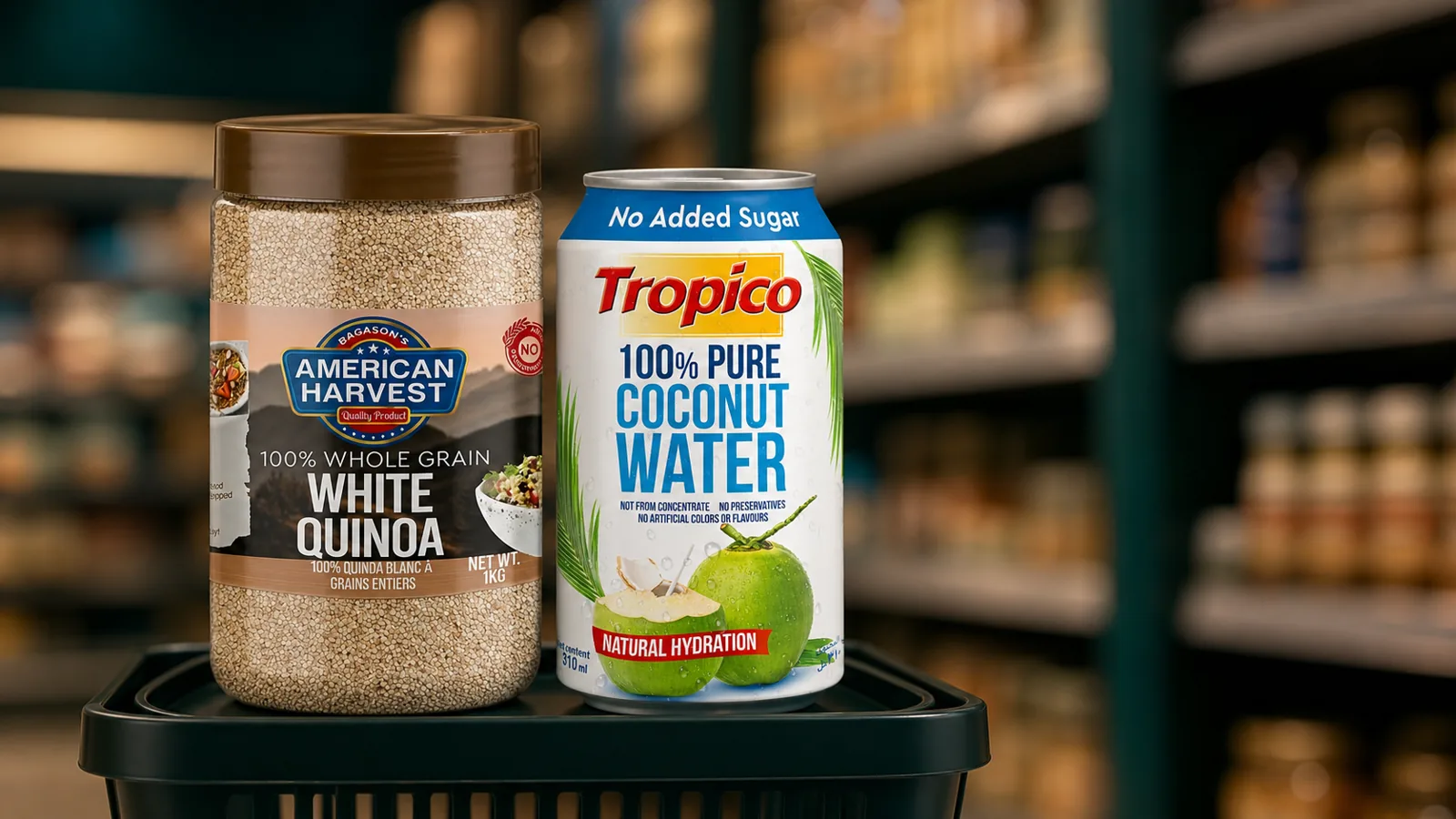
Packs also carry marketing claims: "no added sugar," "source of fibre," "low fat," and similar phrases printed near the product name. These claims are regulated, not free text a manufacturer can print at will. A claim like "source of fibre" generally corresponds to the product containing fibre above a defined minimum level per 100g, and "no added sugar" means exactly that: no sugar was added during manufacture, which is a different statement from the product containing no sugar at all, since some sugars are already present in an ingredient like fruit or milk.
The most reliable way to use these claims is to treat them as pointers back to the panel, not as the final word. If a pack says "low fat," the actual total fat figure sits a few centimetres away on the nutrition table, and checking it takes a moment. Reading the claim and the panel together gives a fuller picture than either one alone, and it's a habit that pays off more the more often you compare similar products side by side in the same aisle.
Country of Origin and "Made In" Statements
Country of origin has to appear on every prepacked food label sold here, and it refers to where the product was last substantially transformed into its final form, not necessarily where every raw ingredient was grown. A cereal blended and packed in one country from grains sourced in several others typically carries that packing country as its declared origin. This distinction matters for shoppers who specifically look for a particular country of origin, since the label answers a narrower question than "where did every ingredient come from."
Comparative Claims: What "Reduced," "Less" and "Extra" Require
Comparative wording, "25% less salt," "reduced fat," "extra fibre," is regulated in a different way than a simple factual statement. A claim comparing one product to another has to name what it's being compared against, usually the manufacturer's own standard version of the same product, and the percentage difference has to be genuine and verifiable against that reference. A "reduced sugar" version of a sauce, for instance, is compared to the standard recipe of that same sauce from the same manufacturer, not to every similar sauce on the shelf from every brand.
What that means in practice for a shopper: a "less" or "reduced" claim tells you about a relationship between two versions of one product, not an absolute ranking against everything nearby on the shelf. Two brands can each carry a "reduced fat" claim and still land at meaningfully different total fat figures from each other, since each is being measured against its own baseline. The nutrition panel is what settles that comparison, not the claim on its own.
Storage Instructions and Packaging Symbols
Storage instructions appear on most packs as a short phrase: "store in a cool, dry place," "keep refrigerated," "refrigerate after opening." These reflect how the manufacturer has tested the product to hold its intended quality and are worth following as written, since a product formulated for ambient storage and one formulated for the chiller aren't interchangeable even if they look similar on shelf.
Packs also carry a small set of standard symbols that aren't about the food itself but about the packaging material: a recycling triangle with a resin code, a "keep dry" umbrella icon for products sensitive to moisture, or a fragile-glass symbol on certain jars and bottles. None of these are nutrition or safety claims. They're handling and disposal information, useful mainly for storage at home and for sorting packaging correctly at the end of its life.
A Practical Label-Reading Checklist for the Aisle
So what does this look like in practice, standing in front of a shelf with two similar products in hand, deciding between them in the time it takes to load a trolley? A short routine covers most of what matters.
- Check the first three to four items on the ingredients list; that's where most of the product's weight sits.
- Scan for bolded allergens or a "Contains" statement if you're managing a specific allergy.
- Compare the per-100g or per-100ml column on the nutrition panel across similar products, not just the per-serving figure.
- Read any front-of-pack or marketing claim alongside the panel rather than instead of it.
- Confirm the Arabic panel matches the other language on pack if you're relying on it directly.
- Note the country of origin if that's a factor in your decision, understanding it reflects final processing, not every raw ingredient's source.
Sound like a lot for a supermarket aisle? It's four or five seconds of attention once the habit sets in, not a research project.
Why This Matters More the More You Shop Here
The UAE's shelves draw on food manufactured across dozens of countries, arriving through import channels, customs clearance and product registration before they ever reach a chiller or a dry shelf. That range is part of what makes local retail interesting to shop, and it's also exactly why a consistent labelling standard, applied the same way to every pack regardless of where it was made, matters as much as it does. A shopper who knows how to read food labels gets the benefit of that range without needing to memorise a different label format for every country of origin on the shelf.
For distributors and brand owners, the same standard is the reason labelling review happens well before a product reaches a UAE port, not after. Getting the ingredients order, the nutrition figures, the allergen statement and the Arabic panel right the first time is less about avoiding a fine and more about not holding up a container at the exact moment a retailer is expecting stock on the shelf. Our own registration and Arabic-label compliance process runs through the same GSO 9 and GSO 2233 requirements described above, on every SKU we bring in, before it goes anywhere near a warehouse pallet position.
A UAE food label guide like this one is a shared reference point for both sides of the same shelf. The shopper reading a pack in a Carrefour or LuLu aisle and the compliance team reviewing artwork before a container leaves origin are checking the same panels, the same ingredients order, and the same Arabic requirements, just at different stages of the same product's journey. That overlap is why label literacy holds up better as a standing habit than as a one-off skill pulled out for a single confusing purchase.
A shopper working through a trolley of unfamiliar brands and a brand owner preparing artwork for a first UAE shipment are, underneath it, reading for the same logic. Every mandatory element on the pack is there to answer one specific question. Reading them in the right order gets you further than scanning the whole pack top to bottom looking for a single verdict that was never going to be printed on it.
Key takeaways
- Learning how to read food labels starts with the ingredients list, which is ordered by weight from most to least, not alphabetically.
- The nutrition panel reports mandatory figures per 100g or 100ml under UAE.S GSO 2233, which is the fairest basis for comparing similar products.
- Allergens appear either in bold within the ingredients list or in a separate "Contains" statement directly beneath it.
- Every mandatory label element, including the full ingredients list and nutrition panel, must appear in Arabic and match the other language on pack exactly.
- Front-of-pack grading badges, such as Abu Dhabi's Nutri-Mark scheme, sit alongside the standard nutrition panel rather than replacing it.
- Marketing claims like "low fat" or "source of fibre" are regulated terms tied to specific thresholds, best read together with the nutrition panel rather than on their own.
A food label is a set of specific, regulated answers, not a single verdict about a product. Once you know which section answers which question, checking a pack in the aisle takes moments rather than minutes, and the habit tends to stick once it's formed. For more on food labelling and packaged goods across the UAE market, our blog covers the categories and standards that affect what lands on local shelves, and Bagason is glad to walk any brand through what compliant labelling looks like before a shipment goes to print.
Frequently asked questions
What is the correct order to read a food label in the UAE?
Start with the ingredients list, since it's ordered by weight and tells you what makes up most of the product. Then check the allergen statement, followed by the nutrition panel for the per-100g figures. Finally, glance at the country of origin and any marketing claim on the front, reading it alongside the panel rather than on its own.
Is the ingredients list always in the same order everywhere on the pack?
The ingredients list itself is always ordered by descending weight, from most to least, measured at the point each ingredient went into the recipe. Compound ingredients, such as a seasoning blend, are listed with their own sub-ingredients in brackets. This ordering rule is consistent across every prepacked food sold in the UAE.
Why do the Arabic and English panels need to match exactly?
UAE labelling rules require every mandatory element, including the ingredients list and the nutrition panel, to appear in Arabic alongside any other language on the pack. The Arabic version has to mirror the source panel line for line and figure for figure, since it's describing the same product, not a summarised translation of it.
What's the difference between the nutrition panel and a front-of-pack grading badge?
The nutrition panel is the mandatory table on the back or side of the pack, listing figures per 100g or 100ml. A front-of-pack badge, such as Abu Dhabi's Nutri-Mark scheme, is an additional, currently voluntary layer that ranks a product against others in its category. It sits alongside the panel and doesn't replace it.
How can I tell if a product contains a specific allergen?
Check for the allergen name in bold within the ingredients list, or look for a separate "Contains" statement printed directly beneath it. Some packs also carry a voluntary "may contain traces of" line for cross-contact risk during manufacture, which reflects a precaution rather than a confirmed ingredient.
Does "no added sugar" mean a product has no sugar at all?
No. "No added sugar" means no sugar was added during manufacture, which is different from the product containing zero sugar, since some ingredients like fruit or milk already contain naturally occurring sugars. Reading this claim alongside the sugars line on the nutrition panel gives the fuller picture.