Walk down any confectionery aisle in a Dubai hypermarket during the week before Eid and you will see the category at its busiest: gift tins stacked three deep, gondola ends full of chocolate boxes, and a namkeen shelf that gets restocked twice a day. The GCC confectionery market runs on moments like this, but it also runs quietly, all year, through the school-bag chocolate bar, the office bowl of mixed nuts and namkeen, and the small gum pack at the till.
For a distributor, that mix of steady daily demand and sharp seasonal spikes is what makes the category interesting to plan for. This piece looks at how confectionery and snacks actually move through UAE and GCC retail: the segments, the gifting calendar, why so much of it is imported, and where buyer habits are shifting.
We will also touch on where Bagason's own snack portfolio, including Bikaji namkeen and our Desi Treat range, sits inside the wider snacks category that GCC retailers stock today. Not as a sales pitch, just a useful reference point for how a distributor thinks about assortment in this space.
What sits inside the GCC confectionery market
"Confectionery" is a wide umbrella. On a retail planogram it usually splits into a handful of recognisable blocks, and each behaves differently at the shelf.
Chocolate
Chocolate confectionery covers everything from single-serve bars at the checkout to boxed assortments built for gifting. The UAE chocolate market sits at both ends of the price ladder: mass-market bars that get bought on impulse, and premium boxed chocolate that gets bought with intent, usually for a person or an occasion.
Sugar confectionery
Boiled sweets, toffees, jellies, and hard candy make up this segment. It tends to be price-driven and habit-driven rather than gift-driven, and it moves fastest through traditional trade and impulse counters near school routes and petrol stations.
Gum and mints
A small-format, high-frequency category. Gum and mints live at the point of sale, get bought on repeat, and depend heavily on visibility at the counter rather than deliberate browsing.
Bakery and pastry snacks
Packaged cakes, wafers, biscuits with a confectionery angle, and pastry-style snacks sit adjacent to classic confectionery on most shelves. They compete for the same impulse spend and often share a shopper mission: "something sweet with tea" or "something for the lunchbox."
Savoury namkeen and snacks
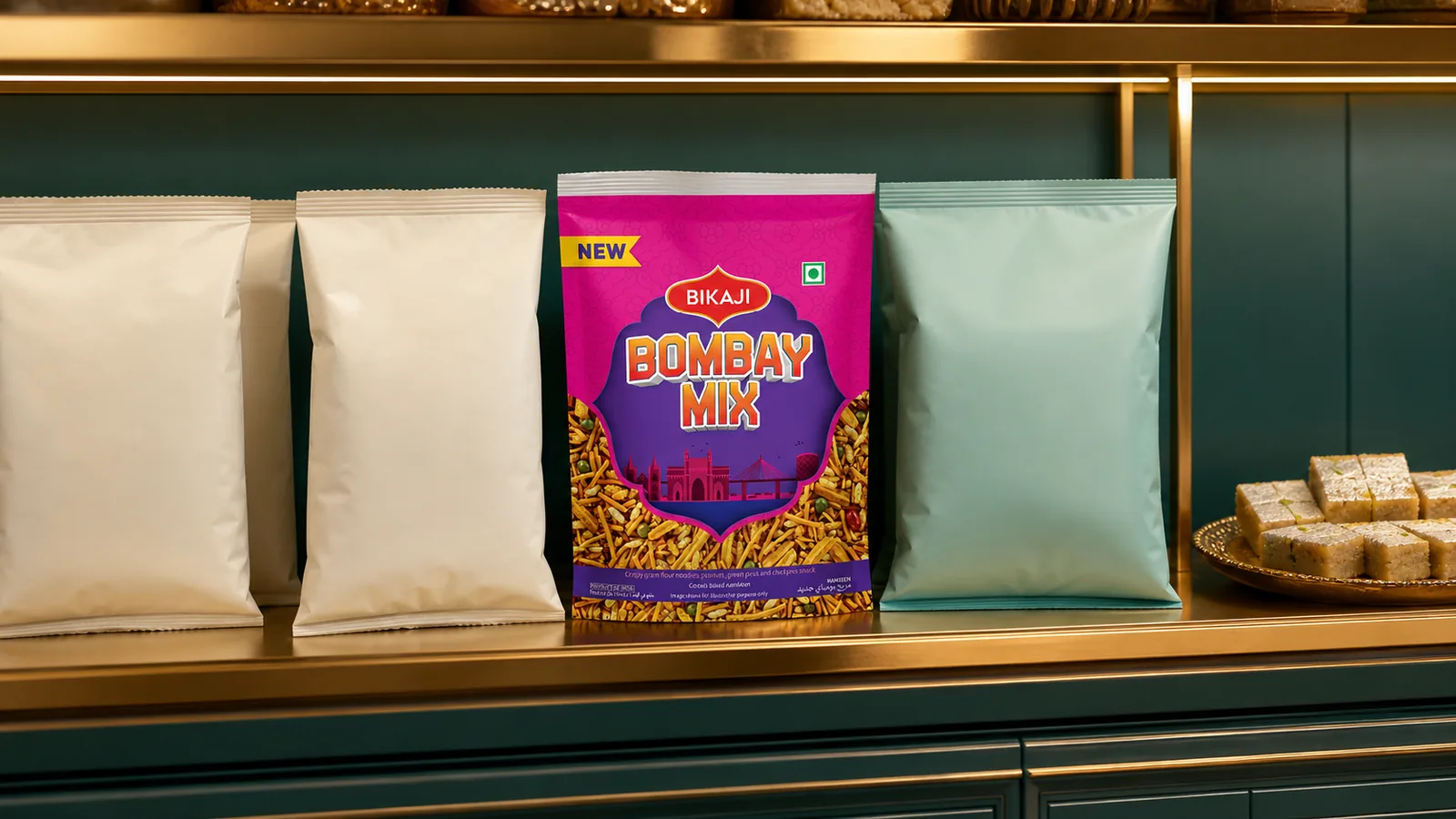
This is where the category gets distinctly regional. Namkeen, the savoury, spiced snack mixes rooted in South Asian food culture, has a large and loyal audience across the UAE and wider GCC, given the size of the South Asian resident population. Brands like Bikaji have built deep ranges here, from bhujia and sev to mixture blends and coated peanuts, and they sit on shelf next to Western-style chips and pretzels rather than in a separate "ethnic" corner in most modern trade stores today.
Each of these segments has its own buying rhythm, but together they make up what most people mean when they talk about the wider GCC confectionery market: sweet and savoury, everyday and celebratory, local and imported, sitting side by side on the same aisle.
Why the segments increasingly share shelf space
A decade ago, a typical hypermarket kept namkeen in a "world foods" or "Asian foods" corner, separate from the main confectionery and snacks run. That has changed in most modern trade stores across the UAE. Buyers now plan namkeen, chips, pretzels, and nuts as one adjacent snacking block, because shoppers treat them as substitutes for the same occasion, a movie night, a car journey, an office break, rather than as separate cultural categories.
This matters for how a brand pitches itself to a retailer. A namkeen range competing only against other namkeen is fighting for a narrow slot. A namkeen range positioned as part of the broader savoury snacking set, next to the crisps and mixed nuts, is fighting for a much bigger piece of basket spend, and category managers increasingly plan it that way.
Why gifting occasions matter so much here
Ask any Dubai Municipality-registered distributor which weeks matter most for confectionery and the answer is consistent: Ramadan and Eid, Diwali, and National Day. These are not small bumps. They reshape what gets ordered, how it gets packed, and how fast it needs to move.
Ramadan and Eid gifting: the biggest confectionery moment of the year
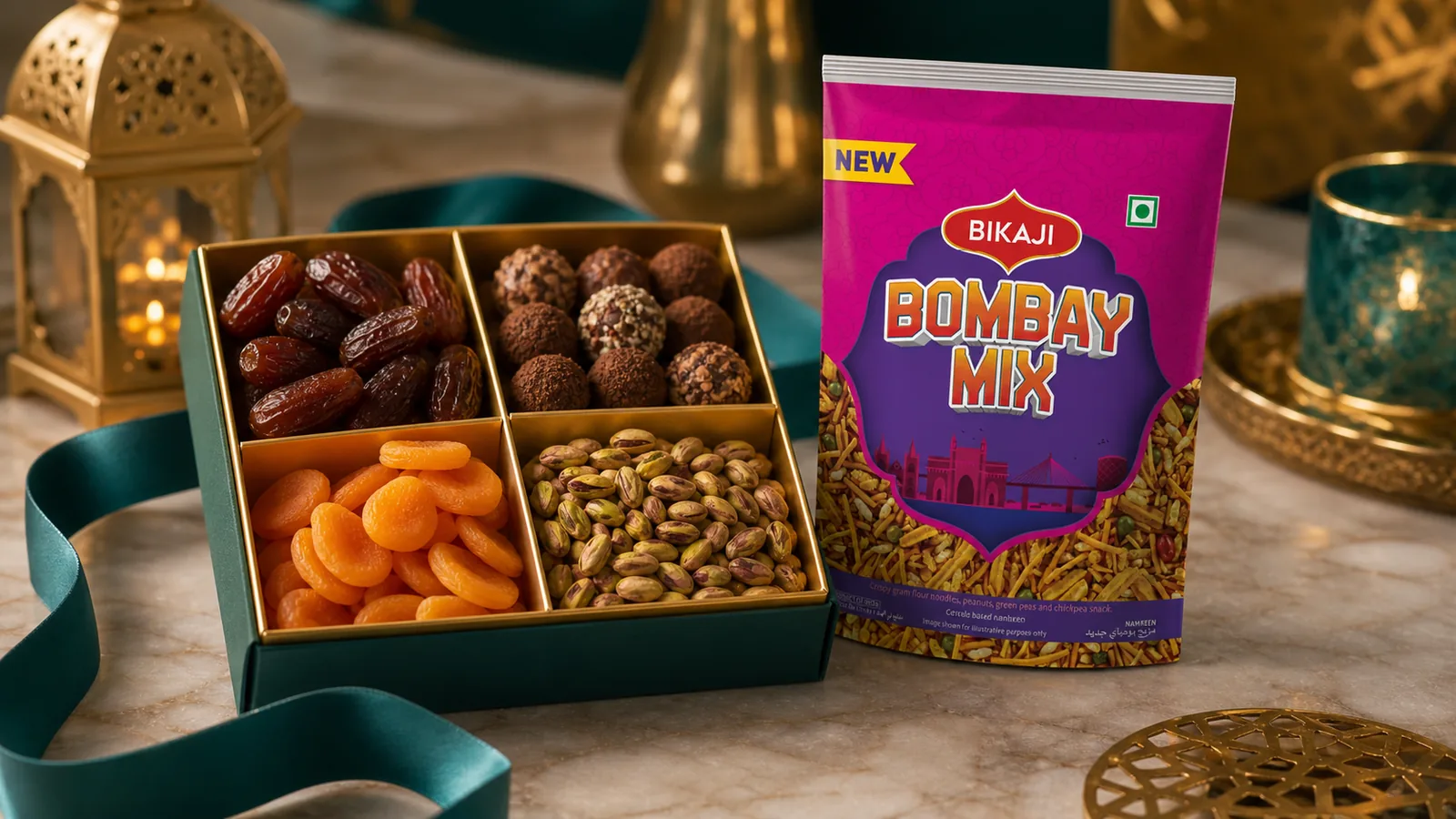
Ramadan changes daily consumption patterns first: dates, sweets, and confectionery become part of the iftar table across the region. Then, in the run-up to Eid, gifting takes over. Boxed chocolate, dates, and mixed sweet trays become the default gift for family visits, office exchanges, and neighbour deliveries. Retailers build dedicated Ramadan and Eid gifting bays weeks ahead, and packaging matters as much as the product: a tin or box that looks presentable on a coffee table sells better than a plain pouch, even if the contents are similar.
Diwali and the South Asian calendar
Diwali brings its own gifting wave, heavily weighted toward mithai-style sweets and premium namkeen gift boxes. South Asian households across the UAE exchange sweets and snack hampers with neighbours, colleagues, and extended family, and retailers serving these communities plan dedicated Diwali sections well in advance. Namkeen gift assortments, in particular, do double duty here: they read as festive and they get eaten immediately, unlike a box of sweets that might sit untouched.
UAE National Day
National Day in December brings a shorter but sharp spike, mostly around flag-themed packaging, chocolate gift sets, and corporate gifting for offices and schools. It is a smaller occasion than Ramadan or Diwali in volume terms, but retailers and brand owners use it as a visibility moment: end-caps, co-branded packaging, and short-lead promotional runs.
What this means for planning
Three separate calendars, each pulling demand for a different sub-segment of confectionery, means a distributor cannot plan the category as one flat curve. A warehouse that is quiet in early Ramadan can be at its busiest in the final ten days before Eid. Get Ramadan and Eid gifting confectionery onto the shelf a week late, and you have all but lost the sale, since the occasion carries a hard deadline that a normal SKU never has to meet.
How order volumes actually swing through the year
Ask a merchandiser who covers confectionery bays year-round and they will describe the pattern in terms of weeks, not months. Ramadan itself brings a steady lift in dates and everyday sweets, but the real order spike sits in the ten to fourteen days before Eid, when gifting stock has to already be sitting in the warehouse and ready to flow to stores on a tight schedule. Diwali behaves similarly but on a shorter runway, since the festival date is fixed on the lunar calendar and gift-hamper assembly, for brands or retailers that build them, needs finished stock in hand well before that.
National Day is smaller in absolute volume but sharper in timing: flag-themed and gift-set confectionery has almost no shelf life as a concept after December 2, so anything left unsold has to be cleared fast rather than held for next year. Planning around three calendars with different lengths, different intensities, and different clearance risk is one of the more specialised parts of running this category well.
Why so much of this category is imported
The UAE and the wider GCC import the large majority of the confectionery on their shelves. Local manufacturing exists, particularly for bakery items and some regional sweets, but the bulk of packaged chocolate, sugar confectionery, gum, and much of the branded namkeen range arrives from outside the region.
That import reliance shapes how the category actually works on the ground:
- Lead times drive the calendar. Ocean freight from source markets means Ramadan and Diwali stock has to be ordered months ahead, based on a read of last year's sell-through and this year's calendar shift (Ramadan moves roughly eleven days earlier each Gregorian year).
- Registration and labelling take time. New confectionery SKUs need Dubai Municipality (or the relevant emirate authority) product registration, and packaging needs Arabic-language compliance before it can sit on a UAE shelf.
- Temperature control matters more than people expect. Chocolate in particular needs a cold chain through summer heat, from the port through the warehouse to the last-mile delivery van, or the product arrives on shelf with bloom or a soft, misshapen bar.
- Currency and freight swings hit landed cost directly. A distributor bringing in confectionery from Europe, India, or Southeast Asia is exposed to exchange rate and shipping cost movement in a way a purely local manufacturer is not.
Distributors with an established "port to shelf" operation, covering customs brokerage, product registration, HACCP-aligned warehousing, and last-mile delivery, tend to do well in this category for exactly this reason. Getting one imported gift box onto a shelf on time is a project. Getting hundreds of SKUs onto shelves across seven emirates and several GCC markets, on a Ramadan deadline, is a much bigger one.
How demand differs across Saudi Arabia, Oman, Kuwait, Bahrain, and Qatar
The UAE is often the first market a confectionery brand enters in the region, partly because of Jebel Ali's re-export infrastructure and partly because Dubai retail gives a fast read on shopper response. But the wider GCC is not one uniform extension of the UAE, and a distributor exporting into these markets has to plan for real differences.
Saudi Arabia
The largest population in the GCC means the largest volume opportunity, and gifting occasions carry the same weight, Ramadan and Eid especially. Product registration and labelling requirements run through the Saudi Food and Drug Authority, which is a separate process from Dubai Municipality registration, so a brand cannot assume UAE paperwork carries straight across the border.
Oman, Kuwait, Bahrain, and Qatar
These markets are smaller individually, but each has loyal modern trade chains and a similar gifting calendar to the UAE. Many brands enter them through re-export out of Jebel Ali once they have a track record in the UAE, since consolidating shipments through an established free zone is usually more efficient than shipping directly from origin to each smaller market. Shelf preferences do vary at the margins, some Gulf markets lean more toward date-based gifting alongside chocolate, for instance, so a brand's UAE planogram is a starting point for these markets, not a template to copy exactly.
Premiumisation: what is actually changing on the shelf
Premiumisation in confectionery shows up less as a new category and more as an upgrade within existing ones. A few patterns are visible across UAE modern trade right now.
Single-origin and higher-cocoa chocolate
Alongside mainstream milk chocolate, shelves increasingly carry higher-cocoa bars, single-origin claims, and smaller-batch positioning. Premium chocolate in the UAE sits at a noticeably higher price point than a decade ago, and it targets a shopper who is buying for themselves, not just for a gift.
Gifting formats that look the part
Tin boxes, ribboned trays, and reusable containers have become part of the product itself for premium chocolate and mithai. A shopper buying a gift is often paying as much for how it presents on a coffee table as for the sweets inside, and brand owners have responded with packaging that photographs well for social sharing too.
Premium namkeen
Namkeen has followed a similar path. Alongside everyday bulk packs, there is now a clear premium tier: better packaging, cleaner ingredient lists on the pack, and gifting-format tins and hampers built specifically for Diwali. Bikaji's range spans both ends of this, from the everyday family pack to festive gift assortments, which mirrors the shopper behaviour distributors see at retail: the same household buys the everyday pack in October and the gift box in October for Diwali gifting.
Craft and small-batch positioning
A smaller but visible shelf presence now goes to confectionery positioned as artisanal or small-batch, often with a UAE or regional origin story attached. It rarely displaces the mainstream brands in volume, but it earns disproportionate shelf-facing and social media attention relative to its size.
None of this means the mainstream, everyday confectionery segment is shrinking. It means the category has stretched at the top, giving retailers more price tiers to merchandise and giving distributors more SKUs to manage per brand.
What good gifting merchandising actually looks like
Walk the Ramadan or Diwali bay in a well-run hypermarket and a few things are usually true. Gift sets are grouped by price tier rather than by brand, so a shopper with a set budget in mind, say, a corporate gift for a colleague, can scan one section instead of comparing prices across the whole aisle. Bestselling formats from last year get the most prominent facings, based on the retailer's own sell-through data rather than guesswork. And there is almost always a value-tier gifting option alongside the premium one, because gifting in this market spans a wide household budget range, not just the shoppers buying the most expensive box on the shelf.
In-store activation and sampling play a bigger role here than in most other FMCG categories. A shopper is far more willing to try an unfamiliar chocolate or namkeen brand when it is a small free sample handed out at the gondola end than when it is sitting on a shelf among a dozen competitors, and this is especially true in the weeks before a major gifting occasion when shoppers are actively browsing rather than doing a routine top-up shop.
On-the-go snacking and the smaller pack size
Alongside gifting and premiumisation, the other visible shift is toward snacking that fits a moving day rather than a sit-down occasion.
Smaller pack sizes have become common across chocolate, namkeen, and bakery snacks: single-serve bars, mini pouches, and grab-and-go tubs sized for a car cup holder or a desk drawer. A few forces are behind this. Quick commerce apps like Talabat and the delivery arms of major grocers have made it normal to order a single snack pack for immediate delivery rather than stocking a large multipack at home. Office and school routines favour something that fits a bag without spilling. And price-conscious shoppers sometimes prefer a smaller, cheaper unit over a bigger pack, even if the per-gram cost is higher.
For namkeen specifically, on-the-go formats have opened up occasions that used to belong to Western snack brands: a small bhujia or mixture pouch now sits comfortably next to a chip bag in a lunch bag or a car door pocket. Desi Treat's snack range has grown into some of that same on-the-go, everyday space, sitting alongside the more festive namkeen gifting tier rather than competing with it.
The move toward lower-sugar and "better-for-you" options
One of the clearer shelf trends over the past few years is a growing lower-sugar and "better-for-you" tier inside confectionery. This is a market trend, not a health claim about any single product, and it is worth being precise about that distinction.
What it looks like in practice:
- Reduced-sugar versions of familiar chocolate and confectionery formats appearing alongside the original recipe, rather than replacing it.
- Cleaner, shorter ingredient lists on pack fronts, which shoppers increasingly check before buying, especially for children's snacks.
- Nut, seed, and dried-fruit-based snack bars sitting in or near the confectionery aisle as an alternative snacking choice.
- Namkeen and savoury snacks marketed around cooking method or oil type on pack, again as a product attribute rather than a health promise.
Retailers have responded by giving this tier dedicated shelf space rather than scattering it through the aisle, which makes it easier for a shopper who is specifically looking for it to find it, and easier for a distributor to track how the tier performs against the mainstream range.
Whether this "better-for-you" shift keeps growing at the same pace, or settles into a steady niche alongside mainstream confectionery, is something worth watching over the next few buying cycles rather than something anyone can call with certainty today.
How the category moves through UAE retail channels
Confectionery does not sell the same way in every channel, and that shapes how a distributor allocates stock and merchandising support.
Modern trade
Hypermarkets and supermarkets such as LuLu, Carrefour, and Choithrams carry the full breadth of the category, from mainstream bars to premium gift tins, and give it dedicated seasonal bays around Ramadan, Diwali, and National Day. Planogram space here is competitive, and a brand's in-store activation and sampling activity often determines whether it gets a second facing next season.
Traditional trade
The baqala and small grocery network, tens of thousands of outlets across the UAE, is where impulse confectionery, gum, and everyday namkeen packs move fastest. Van sales relationships matter enormously here: a driver who visits a baqala twice a week and knows which small pack sizes sell keeps that shop stocked in a way a central warehouse order never could.
HORECA
Hotels, cafes, and catering buy confectionery differently again, often in bulk formats for guest amenities, buffet dessert stations, or corporate gifting on behalf of a client. Namkeen also shows up here as a bar snack and catering accompaniment, particularly for South Asian-focused catering and events.
E-commerce and quick commerce
Amazon.ae, Noon, and quick commerce apps have become a real channel for confectionery, especially for gifting searches close to Ramadan, Diwali, and National Day, and for repeat orders of everyday snack packs that a household reorders online rather than picking up in-store.
Online listings for confectionery reward clear pack imagery and accurate weight or count information more than almost any other grocery category, since a shopper buying a gift set online cannot pick it up and judge the size or presentation the way they would in a store aisle. Getting product content, images, titles, and descriptions right on these marketplaces has become its own specialised skill, sitting somewhere between merchandising and marketing.
What this means for a brand deciding how to enter or grow in this market
For a brand owner looking at the UAE or wider GCC, a few practical questions tend to come up early, and they map directly onto everything above.
Which segment and which gifting window fits the brand?
A premium chocolate brand and a mainstream namkeen brand need almost opposite go-to-market plans: one leans on gifting-format packaging and modern trade seasonal bays, the other leans on distribution breadth across traditional trade and consistent everyday availability.
Is the packaging and labelling ready for this region?
Arabic-language labelling, Dubai Municipality product registration, and halal coordination for relevant ingredients all need to happen before a product reaches a shelf, and getting this wrong on a first shipment costs weeks a seasonal launch cannot spare.
Can the supply chain hit the gifting deadline?
Because Ramadan, Eid, Diwali, and National Day are hard dates, not soft targets, a brand's shipping and customs clearance plan has to work backward from the retail reset date, with real buffer for port delays or documentation issues.
Does the brand need a distributor with warehousing and last-mile reach, or a broader partner?
Some brands need only import clearance and a few key accounts. Others want a partner running the full chain: registration, HACCP-aligned storage, van sales into traditional trade, and e-commerce listing support, so the brand can focus on product and marketing rather than logistics. This is where a house-of-brands distributor covering marketing, sales, and distribution under one roof tends to add the most value, since gifting-season execution touches all three at once.
How much assortment breadth is realistic to launch with?
It is tempting for a new entrant to launch with a full range across chocolate, sugar confectionery, and snacks all at once. In practice, most successful launches in this market start narrower: a handful of hero SKUs that a retailer can slot into an existing planogram gap, proven over one or two gifting cycles, before the range expands. A distributor who already has SKUs on shelf in the relevant channel, whether that is Bikaji's namkeen range in modern trade or a smaller brand's snacks moving through traditional trade, can usually judge that gap more accurately than a brand new to the region.
Key takeaways
- The GCC confectionery market spans chocolate, sugar confectionery, gum, bakery and pastry, and savoury namkeen, each with its own buying rhythm.
- Ramadan and Eid, Diwali, and UAE National Day drive sharp, calendar-fixed gifting spikes that reshape ordering and warehousing well ahead of the actual dates.
- Heavy import reliance means lead times, product registration, Arabic labelling, and cold-chain handling all shape when and how confectionery reaches the shelf.
- Premiumisation is visible across chocolate and namkeen alike, through higher-cocoa recipes, gifting-format packaging, and a growing craft or small-batch tier.
- On-the-go snacking has pushed pack sizes smaller, and namkeen has expanded into everyday snacking occasions once dominated by Western snack brands.
- A lower-sugar, "better-for-you" tier is growing inside confectionery as a market trend worth tracking, not a health claim about any specific product.
- Channel behaviour differs sharply: modern trade rewards seasonal merchandising, traditional trade rewards van-sales relationships, and e-commerce increasingly captures gifting searches.
Confectionery and snacks reward distributors who can hold two plans at once: a steady, everyday supply chain for the namkeen pack that sells every week of the year, and a tightly timed seasonal operation for the gift tin that has to be on shelf before a fixed date. If you are weighing where your brand fits into that picture, or want a second opinion on entering the UAE or GCC with a confectionery or snack range, our team is happy to talk it through with you. You can also browse more category reads like this one on the Bagason blog, or see who we are at bagason.com.
Frequently asked questions
What is included in the GCC confectionery market?
It covers chocolate, sugar confectionery like toffees and jellies, gum and mints, bakery and pastry snacks, and savoury namkeen and snack mixes. These segments sit side by side on most UAE and GCC retail shelves and increasingly get planned as one broad snacking and gifting category rather than separate aisles.
Why is confectionery in the UAE mostly imported?
Local manufacturing exists for some bakery and regional sweet items, but most packaged chocolate, sugar confectionery, gum, and much of the branded namkeen range is sourced from outside the region. Import reliance means lead times, product registration, Arabic labelling, and cold-chain handling all shape when confectionery reaches the shelf.
Which occasions drive the most confectionery gifting in the UAE?
Ramadan and Eid bring the largest gifting spike, followed by Diwali, which is heavily weighted toward mithai-style sweets and namkeen hampers within South Asian communities, and UAE National Day, which is smaller but sharp around flag-themed packaging and corporate gifting.
Is lower-sugar confectionery a real trend in the UAE and GCC?
Yes, retailers have given more shelf space to reduced-sugar and cleaner-ingredient options over the past few years. This is a shopper preference and merchandising trend, not a health claim tied to any specific product, and it sits alongside mainstream confectionery rather than replacing it.
Does namkeen count as part of the confectionery and snacks category?
In practice, yes. UAE retailers increasingly merchandise namkeen alongside chips, pretzels, and nuts as one savoury snacking block, given the large South Asian resident population. Brands like Bikaji span both everyday packs and premium festive gift tiers within that same space.
How do I get a confectionery brand onto UAE and GCC shelves?
It starts with product registration through the relevant authority (Dubai Municipality in the UAE, the Saudi Food and Drug Authority in Saudi Arabia, for example), Arabic-language labelling, and a distribution partner who can plan around the fixed gifting calendar. A distributor with existing warehousing and retail relationships can usually shorten that path considerably.