A brand director asked us last quarter why her range kept growing in volume while margin barely moved. She'd already run the numbers on landed cost and shelf price, and both looked fine on paper. What she was missing wasn't a pricing fix. It was revenue growth management, the wider discipline FMCG teams use to make pricing, mix, promotions and pack architecture pull in the same direction instead of fighting each other. In the GCC, where one brand can sit on a hypermarket shelf, a baqala counter and a quick-commerce app all in the same week, that discipline matters more than most head offices realise.
We write this from the distribution side of the table, not as consultants selling a framework. Bagason moves close to 700 SKUs across roughly seventeen brands through UAE modern trade, traditional trade, HORECA and e-commerce, and we sit in the room for a lot of these conversations: the promo calendar review with a hypermarket buyer, the SKU count argument before a range reset, the pack-size debate for a baqala-only variant. Revenue growth management, or RGM, is the term for tying all of that together on purpose rather than reacting to each piece separately.
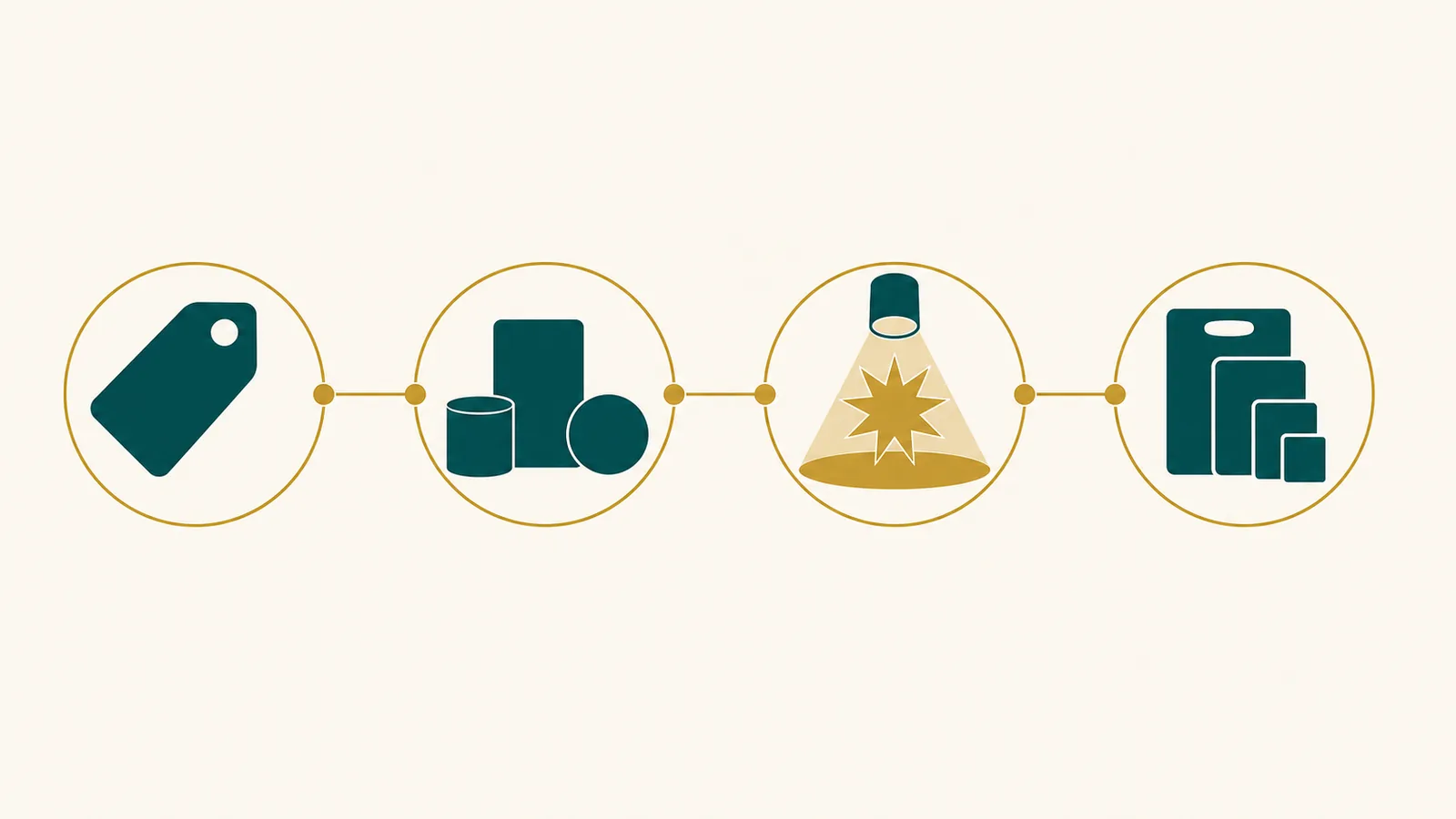
This piece walks through the four RGM pillars the way we see them play out in this market: strategic pricing, portfolio and mix, trade promotion effectiveness, and pack-price architecture for GCC channels. Any figures below are illustrative only, made up to show how the logic works, not a market number or a rate we're quoting anyone.
What revenue growth management for FMCG actually means
Revenue growth management is a system for deciding where growth comes from before you chase it. Instead of treating price, promotion, pack size and portfolio as four separate departments, RGM treats them as levers on the same dashboard. Pull one without checking the others and you tend to solve one problem while creating a new one somewhere down the chain.
Here's an example. A brand cuts its trade promotion depth to protect margin, and volume drops at the hypermarket chain that relied on that promo cadence to hit its own category targets. The buyer responds by trimming facings at the next range review. The brand's margin improved for one quarter and its distribution shrank for the next four. That's not a pricing failure or a promotion failure on its own. It's a system failure, the kind RGM exists to catch before it happens.
Most FMCG teams already do pieces of this. A pricing team owns the price list. A trade marketing team owns the promo grid. A category team owns SKU count. What's often missing is someone asking whether those three groups are actually rowing in the same direction, and whether the answer changes by channel. In the GCC, where the channel gap between a Carrefour hypermarket and a Sharjah baqala is enormous, that question isn't optional.
Why this looks different from a pricing waterfall
We've written elsewhere about the pricing waterfall, the sequence of landed cost, distributor margin, retailer margin and shelf price that decides what a shopper actually pays. That waterfall is one input into RGM, not the whole system. RGM sits a level above it, asking a broader question: given everything you know about this market's channels and shoppers, where should you actually be pushing for growth, and through which lever?
Pillar one: strategic pricing across GCC channels
Strategic pricing is not one number. It's a position, held deliberately, across every channel a brand touches. A product can sit at a premium price point in a hypermarket aisle and a slightly different price, adjusted for pack size and service cost, at a baqala counter three streets away. Done well, neither price undercuts the other. Done badly, one channel quietly cannibalises the other and nobody notices until volume has already shifted.
The starting point is a price corridor: a defined band for each channel type, wide enough to allow for local negotiation but narrow enough that a shopper moving between a hypermarket and an online grocery app doesn't see wild swings on the same SKU. Modern trade chains watch this closely. A retailer who discovers a brand selling meaningfully cheaper through a competitor's app will raise it at the next buyer meeting, and that conversation rarely goes well for the brand.
Pricing corridors by channel, not by SKU
We find it more useful to build corridors around channel type first, then check individual SKUs against them, rather than pricing SKU by SKU and hoping the pattern holds. A few channel realities shape those corridors in this market:
- Modern trade chains negotiate list price, promo funding and listing terms together, as one package, not as separate line items.
- Traditional trade through van sales carries a different cost to serve, smaller drop sizes, more frequent visits, cash handling, which a flat national price often ignores.
- HORECA buyers care more about consistency of supply and case pack size than about shaving a few fils off unit price.
- Quick commerce and e-commerce shoppers compare prices across apps instantly, which makes any channel price gap visible within hours, not weeks.
A strategic pricing position accounts for all four before a single number gets quoted to a buyer. Skip that step and you end up negotiating each channel in isolation, which is how brands end up in a price war with themselves.
When to hold a price and when to move it
Not every cost increase deserves a price increase, and not every competitor move deserves a response. A brand with genuine differentiation, a recognisable pack, a loyal repeat buyer, a category where private label hasn't yet built real share, has more room to hold a price than a brand competing purely on being the cheapest option on the shelf. Knowing which situation you're in before a renewal negotiation starts is half the battle.
Pricing across GCC export markets, not just the UAE
Strategic pricing gets harder the moment a brand looks past the UAE toward Saudi Arabia, Oman, Kuwait, Bahrain and Qatar. Each of these markets has its own retail landscape, its own mix of hypermarket chains and traditional trade, and its own sense of what a fair price looks like for a given category. A price corridor built only around Dubai and Abu Dhabi tends to break the first time a brand exports into a neighbouring market through the same distributor network.
The safest approach treats each GCC market as its own corridor, linked loosely to the others so a shopper crossing the border, or a retailer buying across multiple markets, doesn't spot an obvious gap. That doesn't mean identical prices everywhere. It means a defensible logic behind the differences, tied to freight, duty and local cost to serve rather than to whatever number felt convenient at the time.

Pillar two: portfolio and mix across premium and value tiers
Portfolio and mix is the pillar that decides which SKUs deserve investment, which deserve to be left alone, and which deserve to be delisted. In a GCC context this usually shows up as a tiering question: does a brand need a premium variant for a Waitrose-style shelf, a mainstream pack for Carrefour and LuLu, and a value pack for traditional trade, or does trying to cover all three dilute the brand everywhere at once?
The honest answer depends on category and brand strength, not on a rule that applies everywhere. A brand with a genuinely differentiated recipe or ingredient story can usually support a premium tier without much cannibalisation, because the shopper buying premium isn't comparing it to the value pack on the same shelf. A brand competing mostly on habit and availability often finds that adding a value tier just moves existing buyers down a rung rather than bringing in new ones.
Mix shift as a growth lever, not a side effect
Mix is often treated as something that happens to a brand rather than something a brand manages on purpose. That's a mistake. If your highest-margin SKU is losing share to your lowest-margin SKU inside your own range, that's a mix problem worth solving directly, through merchandising, through where promotional spend goes, through what the field sales team is told to push at the counter.
Say a brand runs three pack sizes of the same product. The largest size on the range card might carry the thinnest margin per unit but the best margin per case, while the smallest size sells fastest through van sales but ties up disproportionate warehouse and picking time relative to its revenue. Managing that mix well means being deliberate about which size gets pushed into which channel, rather than letting whichever size a distributor happens to have in stock become the default.
Rationalising SKUs without losing distribution
Every brand accumulates SKUs that made sense at launch and stopped making sense two years later. A limited edition that never got delisted. A pack size a single retailer requested and nobody else stocks. Rationalising these is part of portfolio management, but it needs care in this market specifically, because losing a facing at a major chain is far harder to win back than it was to lose.
Before delisting anything, it's worth asking whether the SKU is genuinely unprofitable, or whether it's just small and therefore invisible in a spreadsheet sorted by total revenue. A slow-moving SKU that anchors a shelf block, or blocks a competitor from taking that facing, sometimes earns its place for reasons a pure margin analysis misses.
Pillar three: trade promotion effectiveness and ROI
Trade promotion effectiveness, often shortened to TPE, is about knowing whether a promotion actually grew the category or just moved volume that would have sold anyway, at a lower margin. In the GCC, where promo calendars around Ramadan, back-to-school, national holidays and hypermarket anniversary sales are dense and recurring, this is one of the highest-stakes pillars of the four.
Here's the thing about most trade promotions: they look successful on a volume chart and unsuccessful on a margin chart at the same time, and both charts are telling the truth. A multibuy that doubles units sold during promo week can still lose money overall if most of that volume came from shoppers who would have bought the product anyway, just later, at full price. That's called pull-forward, and it's the single most common reason a promotion that felt like a win doesn't show up as one in quarterly numbers.
What a promo actually needs to prove
A promotion earns its place on the calendar if it does at least one of three things: brings in a shopper who wasn't buying the category before, defends a facing against a competitor's own promo in the same week, or clears seasonal stock ahead of a range reset. A promotion that does none of these, that just gives existing loyal buyers a discount on something they'd have bought anyway, is a margin transfer dressed up as growth.
Measuring this properly means looking past the promo week itself. Volume in the two weeks after a promotion ends tells you almost as much as volume during it. A sharp dip right after suggests pull-forward. A steady baseline suggests the promo actually recruited new buyers who kept purchasing at full price.
Listing fees and the real cost of a promo slot
Promo effectiveness in GCC modern trade can't be judged on discount depth alone, because getting a promo slot in the first place usually costs something before a single unit is discounted. Listing fees, end-cap placement charges, catalogue inclusion costs and gondola rental all sit on top of whatever margin the promotion itself gives up. A brand calculating ROI only on the discount percentage is missing a real chunk of the true cost.
That's why we push brands to model promotion ROI as one number that includes the slot cost, the margin given up, and the volume lift, rather than three separate line items reviewed by three different people. Only then does it become clear whether a promotion in a given chain, during a given week, actually paid for itself.
Building a promo calendar that survives contact with the retailer
A workable GCC promo calendar usually needs to plan around a few fixed points rather than being spread evenly across the year:
- Ramadan and the weeks either side of it, when grocery spend and category behaviour shift sharply for several weeks at once.
- Back-to-school, which matters for a wider set of categories than it first appears, well beyond stationery and lunchbox items.
- National Day and other public holiday weekends, which hypermarket chains plan major promotional pushes around.
- Each retailer's own anniversary or loyalty-tier promotional windows, which differ chain to chain and often can't be moved once agreed.
Slotting a brand's own promotional calendar around these fixed points, rather than around a head-office fiscal quarter that means nothing to a shopper, is a small change that tends to improve promo ROI more than any change to discount depth.

Pillar four: pack-price architecture and willingness to pay
Pack-price architecture, sometimes written as price pack architecture, or PPA for short, is about matching pack size to what a specific shopper in a specific channel is actually willing to pay, in that moment, for that occasion. A price pack architecture built for the UAE has to account for baqala, hypermarket and quick-commerce buying habits all at once, since the same brand can face all three in a single week. It sounds close to portfolio and mix, and the two overlap, but PPA is narrower: it's about the ladder of pack sizes within one SKU family, not the broader question of which SKUs exist at all.
A baqala shopper buying a single serving of cooking oil for tonight's dinner has a completely different willingness to pay, per millilitre, than a family doing a monthly bulk shop at a hypermarket. Neither shopper is wrong, and neither is more valuable than the other. They're buying against a different occasion, a different basket size and a different frequency of visit. Pack-price architecture in the UAE means building a ladder that serves both without either one undercutting the other.
How pack laddering actually works in the GCC
A well-built pack ladder usually has three or four rungs, each aimed at a distinct occasion rather than being a smaller or larger version of the same pack:
- A single-serve or small-format pack, priced for immediate need through a baqala or a quick-commerce order, where convenience matters more than per-unit cost.
- A standard household pack, the default size most shoppers recognise, usually the anchor SKU across modern trade.
- A value or bulk pack, aimed at a hypermarket or cash-and-carry shopper who wants the lowest cost per unit and is willing to carry more product home to get it.
- In some categories, a gifting or occasion pack, priced on presentation rather than pure volume, which behaves almost like a separate product.
Each rung needs its own price logic, not a simple per-unit discount as pack size grows. If the value pack offers too steep a discount per unit, it pulls shoppers down from the standard pack and quietly erodes margin across the whole family. If it doesn't offer enough of a discount, hypermarket buyers won't stock it at all, since the entire point of a bulk SKU on their shelf is a visible per-unit saving.
The baqala versus hypermarket pack question
We get asked constantly whether a brand needs a genuinely different pack for traditional trade versus modern trade, or whether one range can serve both. It depends on the category and the drop pattern. A baqala shopper buying rice or lentils daily for a small household has different needs from a family stocking a pantry for a month, and a single pack size trying to serve both ends up either too small for the hypermarket shelf or too expensive per unit for the daily shopper.
Wondering where to start if you're unsure? Look at your own sales data by channel first. If your baqala volume through van sales skews heavily toward one pack size and your hypermarket volume skews toward another, you likely already have a de facto ladder. The work is making it deliberate, priced and merchandised on purpose, rather than something that happened by accident.
How the four pillars work as one system, not four projects
The real value of RGM isn't any one of these four pillars on its own. Most brands already have a pricing view, a rough sense of their SKU mix, a promo calendar and some idea of pack sizes. What's usually missing is a single view that checks all four against each other before a decision gets made.
Take a simple case. A brand wants to launch a value pack for traditional trade. That's a pack-price architecture decision on its face. But it also touches portfolio and mix, since it adds a SKU that competes with an existing size. It touches strategic pricing, since the new pack needs its own channel corridor. And it touches promotion, since a value pack launched without a plan for how it gets sampled or trial-driven in traditional trade often just sits on a shelf. Treat it as a pack decision alone and you'll likely solve one problem while creating three smaller ones elsewhere in the range.
Who owns this inside a brand team
RGM doesn't require a dedicated department, particularly for a brand still building out its GCC presence. It requires one person, or one recurring meeting, whose job is to look across pricing, mix, promotion and pack architecture together rather than let each sit with a different owner who never compares notes. For brands working through a distributor, that conversation should include the distributor's own view of channel performance, since we're often the first to see a mix shift or a promo underperforming before it shows up in a brand's own sales dashboard.
Common RGM mistakes we see with GCC brand launches
A few patterns come up often enough that they're worth naming directly, since most of them are avoidable with a bit more planning before launch rather than a correction six months in.
- Setting one national price and assuming it works identically across modern trade, traditional trade and e-commerce, without adjusting for cost to serve or shopper occasion.
- Treating every promotion as successful because volume went up during the promo week, without checking what happened in the weeks before and after.
- Adding a new pack size to chase one retailer's request without checking how it affects the rest of the family's pricing and margin.
- Reviewing pricing, mix and promotion in three separate meetings that never reference each other's decisions.
- Assuming a pack ladder that works in a brand's home market will translate directly to GCC shopping patterns without adjustment.
None of these mistakes are unusual, and none of them are hard to fix once they're visible. The harder part is building the habit of checking all four pillars together before a decision ships, rather than after a quarter's numbers come in.
What this looks like in a first ninety days
For a brand newer to this market, a workable starting point is smaller than it sounds. Map your current pricing by channel first, even roughly. Then look at your last two promotions and check volume in the weeks before, during and after each one, not just the promo week itself. Next, list every SKU in your range and be honest about which ones are actually earning their shelf space versus which ones are legacy decisions nobody has revisited.
Only after that groundwork does a pack-price architecture conversation make sense, because you'll know which occasions and channels genuinely need a distinct pack size rather than guessing. This is roughly the sequence we walk new brand partners through before their first full trading year in the UAE, and it tends to surface more low-hanging fruit than a first pricing negotiation with a single retailer ever does on its own.
Key takeaways
- Revenue growth management ties pricing, portfolio and mix, trade promotion effectiveness, and pack-price architecture into one system, rather than treating them as separate department decisions.
- Strategic pricing means holding a deliberate price corridor by channel, not one national number that ignores cost to serve.
- Portfolio and mix decisions should be made on purpose, including which SKUs to invest in and which to quietly retire.
- Trade promotion effectiveness requires looking at volume before, during and after a promo, plus the real cost of the listing slot, not just discount depth.
- Pack-price architecture matches pack size to shopper occasion, building a ladder that serves a baqala shopper and a hypermarket shopper without either undercutting the other.
- The biggest wins usually come from checking all four pillars against each other before a decision ships, not from perfecting any single one in isolation.
Getting revenue growth management right in the GCC isn't about adopting a framework wholesale from another market. It's about building the habit of asking how a pricing move, a promo, a pack size or a SKU decision affects the other three before it goes live. That habit, more than any single tactic, is what separates a brand that grows steadily here from one that keeps solving the same margin problem every quarter. If you're building or defending a range across UAE modern trade, traditional trade and HORECA and want a second read on where your own pillars might be pulling against each other, talk to our team. You can also browse more on pricing, mix and shelf strategy on our blog, or learn more about how Bagason works across all three pillars of distribution on our homepage.
Frequently asked questions
What is revenue growth management in FMCG?
Revenue growth management, or RGM, is the discipline of managing pricing, portfolio and mix, trade promotion, and pack architecture together as one system rather than as separate department decisions. The goal is to grow revenue and margin in a way that holds up across channels, instead of solving one problem while creating another elsewhere in the range.
How is RGM different from a pricing strategy?
A pricing strategy, like a price waterfall, usually covers one question: what should the shelf price be, given landed cost and margin needs. RGM sits a level above that. It asks whether pricing, promotion, portfolio and pack size are all pulling in the same direction, and where growth should actually come from across the whole range.
What is pack-price architecture?
Pack-price architecture, or PPA, is the practice of building a ladder of pack sizes, each priced and sized for a specific shopper occasion, from a small single-serve pack for a baqala or quick-commerce order up to a bulk pack for a hypermarket or cash-and-carry shopper. Done well, no single pack size undercuts another in the same family.
Why does trade promotion effectiveness matter so much in the GCC?
GCC modern trade runs a dense promotional calendar around Ramadan, back-to-school, national holidays and retailer anniversary events. A promotion that looks successful on a volume chart can still lose money once listing fees and pull-forward volume are accounted for, which is why measuring effectiveness properly, not just discount depth, matters here more than in slower promotional markets.
Do small and mid-size brands need a full RGM function?
No. RGM doesn't require a dedicated team, especially for a brand still growing its GCC presence. It usually starts with one person, or one recurring review, whose job is to check pricing, mix, promotion and pack decisions against each other before they ship, rather than letting each sit with a different owner.
How does pack laddering differ between traditional trade and modern trade in the UAE?
Traditional trade shoppers buying through a baqala or van sales often prefer smaller, frequent purchases suited to daily needs, while modern trade and hypermarket shoppers tend to buy larger packs less often for better per-unit value. A brand's pack ladder should reflect that split rather than using one pack size across every channel.