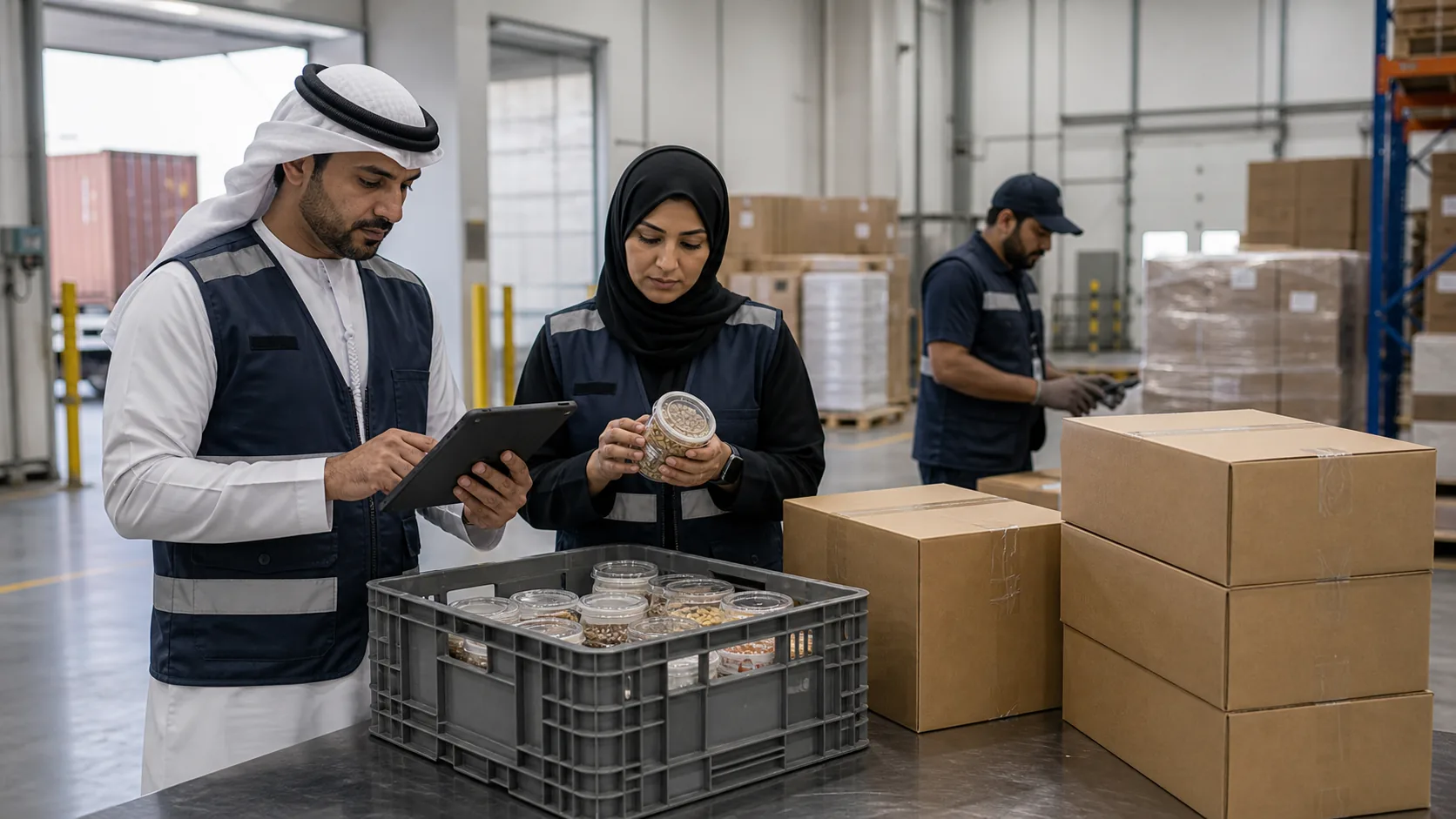
The United Arab Emirates is one of the most attractive food import markets in the world — a high-income population of 10 million, near-zero domestic food production, and a regulatory framework that, while rigorous, is navigable for prepared brands. But many international food and beverage companies enter the UAE market without fully understanding the compliance landscape, leading to delays, rejected shipments, and lost business.
This guide covers everything FMCG brands need to know about UAE food import regulations in 2026, from registration requirements to labelling standards, Halal certification, and the role of a local distributor in simplifying compliance.
The UAE Food Regulatory Framework
Food imports into the UAE are governed by two primary authorities:
- ESMA (Emirates Authority for Standardisation and Metrology) — sets national food safety and labelling standards (UAE.S standards)
- MOCCAE (Ministry of Climate Change and Environment) — manages food import permits and inspection at points of entry
Additionally, individual Emirates have their own municipal food control departments — Dubai's Food Safety Department (under Dubai Municipality) and Abu Dhabi Agriculture and Food Safety Authority (ADAFSA) are the most active. Products distributed within each emirate must meet their specific requirements.
Step 1: Product Registration
Most food and beverage products imported into the UAE must be registered with the relevant authority before distribution. The registration process involves:
- Submitting product specifications, ingredient lists, and nutritional information
- Providing laboratory test certificates (from accredited labs)
- Submitting label samples in both English and Arabic
- Providing the manufacturer's food safety certification (ISO 22000, HACCP, or equivalent)
- Halal certificate for meat, poultry, and any product containing animal-derived ingredients
Registration timelines vary — Dubai Municipality registration typically takes 2–4 weeks for compliant products. Abu Dhabi ADAFSA can take longer. Working with an experienced local distributor who has pre-existing relationships with these authorities dramatically shortens the timeline.
Step 2: Labelling Requirements
UAE food labelling requirements are among the most detailed in the region. Key requirements include:
- Bilingual labels: All mandatory information must appear in both English and Arabic
- Country of origin: Must be clearly stated
- Nutritional information: Per 100g/ml and per serving, using UAE standard format
- Ingredient list: In descending order of weight
- Allergen declaration: 14 major allergens must be highlighted
- Best before / expiry date: In day/month/year format
- Storage conditions: Required for temperature-sensitive products
- Net weight: In metric units
- Importer details: Name and address of the UAE importer/distributor must appear on the label
This last point — importer details — is critical. The label must feature your UAE distributor's name and contact information. This is one reason why selecting the right distributor early is essential: their details become part of your product's legal packaging.
Step 3: Halal Certification
The UAE is a predominantly Muslim country, and Halal certification is mandatory for:
- All meat and poultry products
- Products containing gelatin, animal fats, or other animal-derived ingredients
- Any product where Halal status might be ambiguous
Even for products that are inherently plant-based (certain snacks, beverages, condiments), displaying a Halal certification significantly improves retail acceptance and consumer confidence. UAE retailers often require Halal certification as a condition of listing.
Accepted Halal certifying bodies include JAKIM (Malaysia), IFANCA (USA), HFA (UK), and various GCC-based bodies. Your distributor can advise on which certification is most widely accepted for your product category.
Step 4: Custom Documentation
Each shipment into the UAE requires:
- Commercial invoice
- Packing list
- Certificate of origin (attested)
- Health certificate from the country of export
- Laboratory analysis certificate
- Halal certificate (where applicable)
- Free sale certificate (for some categories)
Documents must typically be attested by the UAE Embassy in the country of origin. Your distributor handles the customs clearance process on your behalf, but ensuring documents are in order before shipment prevents costly port delays.
The Role of a Local Distributor in Regulatory Compliance
Navigating UAE food import regulations is significantly easier with an experienced local distribution partner. A distributor like Bagason Group provides:
- Product registration support with Dubai Municipality, ADAFSA, and ESMA
- Label review and Arabic translation coordination
- Customs documentation management and clearance
- Ongoing regulatory monitoring — UAE standards update regularly
- Retailer compliance requirements (each major chain has its own supplier compliance standards)
Common Mistakes International Brands Make
- Shipping before registration: Products can be held at the port indefinitely or destroyed
- English-only labels: Immediate rejection at UAE Customs
- Wrong expiry format: dd/mm/yyyy is required — US-format (mm/dd/yyyy) labels are rejected
- Missing importer details: Products without UAE importer information on the label cannot legally be sold
- Assuming GCC registration transfers: Saudi SFDA registration does not automatically cover UAE
Key Timelines to Plan For
For brands entering the UAE for the first time, allow:
- 4–8 weeks for initial product registration
- 2–4 weeks for label artwork review and revision
- 2–6 weeks for Halal certification (if not already in place)
- 2–4 weeks for first shipment customs clearance
Total: Plan for 3–4 months from initial contact with a distributor to first products on shelves.
Ready to bring your brand to the UAE market? Bagason Group has helped over 17 international food brands navigate the UAE import process successfully. Learn about our brand partnership programme or contact us directly to discuss your brand's UAE market entry.
Sources and References
This article draws on publicly available government data, industry body reports, and Bagason Group operational experience. All figures are estimates and should be treated as directional.
- UAE Ministry of Economy — National economic indicators and trade data
- Dubai Chambers — Dubai Economic Report
- UAE Federal Competitiveness and Statistics Centre (FCSA) — Consumer spending and trade statistics
- Gulfood — Industry Insights and Market Reports
- UAE Ministry of Human Resources (MOHRE) — Labour and workplace regulations
- Bagason Group — Internal distribution operations and market coverage data