Ask five people in Dubai to name the biggest supermarkets in UAE and you'll get five different answers, because "biggest" means something different depending on whether you're talking about floor space, number of branches, or how often a brand shows up in a shopping basket. Rather than crown a winner, this is a directory: a category-by-category walk through the chains that stock the shelves across the seven emirates, from vast hypermarkets to the petrol-station store you duck into for milk on the way home. If you supply food or beverage products and you're trying to work out where your brand could sit, this is the map.
We're writing this from the distribution side. Bagason moves FMCG through modern trade, traditional trade, HORECA and e-commerce out of a Dubai hub, and our sales team walks into most of the stores named below every week. What follows is a neutral profile of each chain: how it positions itself, roughly where it sits in the market, and who tends to shop there. No rankings, no invented numbers, just what's publicly known about each one.
One thing worth saying upfront. Search "UAE retail chains ranked" and you'll find plenty of lists that order these names by size or reputation. We're not doing that here. Store counts and footprints change constantly as leases turn over and groups expand, so anything beyond a general sense of scale should be checked against the retailer's own current materials.
What "biggest supermarkets in UAE" covers
The UAE grocery market runs across five broad formats, and most shoppers move between all of them in an ordinary week. At the top sits the hypermarket, a single vast store selling everything from fresh produce to electronics. Below that is the everyday neighbourhood supermarket, smaller and usually closer to home. A premium tier competes on service and sourcing rather than sheer size, while a discount tier competes mainly on price. Then there's the convenience format, the small store you visit for a handful of items rather than a weekly shop.
A single group can straddle more than one of these formats at once. Carrefour, for example, runs full hypermarkets alongside smaller Carrefour Market and Carrefour Express branches under the same Majid Al Futtaim umbrella. LuLu does something similar with its Express and mini-market formats sitting underneath the flagship hypermarket brand. That layering is part of why "biggest" is such a slippery word here: a group can be huge in total footprint while its individual store formats look different from one branch to the next.
For a brand owner, the format matters more than the name on the sign. A listing in a hypermarket's grocery aisle behaves differently from a spot on a convenience-store counter, and getting that difference right is most of what makes a listing decision work. With that groundwork laid, here's the directory, organised by format rather than by name.
Why UAE grocery retail ended up with this many formats
The country's retail landscape grew up alongside a population that's overwhelmingly made up of residents rather than long-settled families, and that shaped how grocery retail developed. A resident population drawn from South Asia, the Arab world, East Asia and the West wants a wide spread of familiar products under one roof, which is part of why the hypermarket, built around breadth as much as scale, became the dominant format so early.
Cooperative retail took a different path. Union Coop grew out of a government-sponsored cooperative movement aimed at Emirati households specifically, which is why its ownership structure and customer base still look different from the privately owned chains around it. Meanwhile, groups with roots in trading families going back generations, Choithrams and Al Maya among them, built their supermarket networks on relationships and distribution know-how that predate the country's modern retail boom by decades.
More recently, the format list has kept growing rather than settling. Premium grocers like Spinneys and Grandiose responded to a shopper base willing to pay for curated ranges and a nicer in-store experience. Viva answered the opposite instinct, building a discount format around the idea that quality and low price aren't mutually exclusive. And convenience retail, Zoom especially, grew directly out of the country's dense network of petrol stations, turning a fuel stop into a grocery occasion almost by accident. There wasn't a single plan behind any of it. It's the result of several different retail logics competing for the same shopper, which is exactly why any one directory of UAE supermarkets ends up covering so many different kinds of store.
Hypermarket tier: the big-box stores that carry almost everything
Hypermarkets are the anchor format of UAE grocery retail. A single store typically spans thousands of square metres and stocks food alongside electronics, homeware, apparel and more, which is why a weekly family shop so often ends at one of these five names. Shelf space in this tier is competitive precisely because the audience is so wide: a single hypermarket branch can see shoppers ranging from a construction worker picking up lunch to a family doing a full monthly stock-up, all in the same aisle within an hour of each other.
LuLu Hypermarket
LuLu is one of the most recognisable grocery names in the country, operating large-format stores designed for a full weekly shop alongside a much bigger non-food range. The group also runs LuLu Express and smaller mini-market formats for shoppers who want a quicker trip. Its stores sit across all seven emirates and draw a broad, multicultural shopper base, from residents doing a big monthly haul to people stopping for daily essentials.
Carrefour
Carrefour operates in the UAE under Majid Al Futtaim's exclusive regional franchise, and its hypermarkets anchor many of the country's largest malls. Alongside the flagship stores, the group runs a smaller Carrefour Market format and Carrefour Express convenience branches, plus an online delivery service. The shopper base spans everyone from mall-based weekly shoppers to residents ordering groceries for home delivery.
Union Coop
Union Coop is Dubai's own consumer cooperative, set up under government sponsorship in the early 1980s and still structured as a member-owned cooperative rather than a private retail group. It runs a network of hypermarket branches across Dubai together with a loyalty programme for its large member base. Its shopper base leans heavily toward Emirati families and long-term Dubai residents who value the cooperative model and its community ties.
Nesto Hypermarket
Nesto has grown quickly across the UAE and wider GCC, positioning itself as an accessible, value-focused hypermarket for a diverse resident population. Its stores stock a wide mix of international and regional products aimed at the multi-ethnic communities that surround each branch. Nesto tends to draw budget-conscious families doing a full shop who still want breadth of choice under one roof.
Géant
Géant arrived in the UAE as the regional franchise of a French hypermarket brand and has changed hands more than once since, with a large share of the original stores rebranded to Carrefour after a 2017 acquisition. What remains under the Géant name today includes a hypermarket at Dubai Hills Mall and a run of smaller Géant Express convenience branches around Dubai. Shoppers encounter it mainly as a mall anchor or a quick top-up stop rather than a country-wide network.
Everyday supermarket tier: neighbourhood-scale grocery
Below the hypermarket giants sits a tier of supermarket groups built around smaller, more numerous branches rather than one flagship destination. These are often the stores nearest a resident's home, and for many households they handle the bulk of routine grocery spending even though no single branch is especially large. Buying decisions in this tier tend to sit closer to the branch or area manager than in a large hypermarket chain, which can make a regional listing conversation move faster once the paperwork is in order.
Choithrams
Choithrams has operated in the UAE since the mid-1970s and has grown into a chain of supermarkets spread across the emirates, part of a wider group with interests in wholesaling and distribution as well as retail. Its branches tend toward a standard supermarket footprint rather than the hypermarket scale, positioned as a dependable, familiar option for a regular grocery run. The shopper base is broad and long-established, reflecting the chain's decades of presence in local communities.
Al Maya
Al Maya Group runs a network of supermarkets and convenience stores across the UAE alongside a separate food distribution arm, giving it a foothold on both the retail and supply side of the business. Several of its outlets operate around the clock, and the group has built part of its reputation on home delivery going back years before that became standard practice. Its shopper base includes residents who want a nearby store with long or 24-hour opening hours rather than a single big weekly destination.
West Zone
West Zone describes itself plainly as a neighbourhood supermarket, and its branch network bears that out: well over a hundred stores sized for a local catchment rather than a mall-anchor format. Locations sit close to residential areas and metro stations across Dubai and other emirates, aimed at shoppers who want groceries within easy reach rather than a destination trip. It's a chain built on density of coverage rather than the size of any individual store.
Premium tier: quality and service ahead of scale
A smaller number of UAE grocers compete on experience and sourcing rather than sheer footprint or price. These stores tend to carry a curated range, invest more visibly in fresh and imported categories, and draw a shopper who's willing to pay for that positioning. For a brand, that usually means slower listing conversations and stricter quality expectations, but shelf space that carries a different kind of credibility with a certain shopper.
Spinneys
Spinneys has operated in the UAE since the early 1960s and has built its identity around premium positioning rather than store count, framing its own goal around the quality of the shopping experience rather than the number of branches it runs. The group operates under three UAE and Oman banners, Spinneys, Waitrose and Al Fair, giving it more than one price point within a premium-leaning family of stores. Its shopper base skews toward residents seeking a wider range of imported and specialty products alongside everyday groceries.
Grandiose
Grandiose is a homegrown UAE brand under the Ghassan Aboud Group, positioned around a premium food and grocery experience across hypermarket, supermarket and neighbourhood convenience formats. The chain places a visible emphasis on fresh food counters and locally sourced products alongside imported ranges. Shoppers tend to come for a broader in-store experience, including prepared food and dining areas, rather than a purely functional grocery run.
Discount tier: value as the whole proposition
One UAE grocer has built its entire model around a discount format rather than a full-range hypermarket, and it deserves its own category because the buying and merchandising logic works differently from every chain above it.
Viva
Viva positions itself as the region's first food discounter, running a leaner store format with a smaller, more tightly curated range than a typical hypermarket or supermarket. The chain rotates limited-time special offers alongside its everyday range, a merchandising approach common to discount grocery formats elsewhere in the world. Its shopper base is price-driven and values-conscious, drawn by the discounter promise of quality at a lower everyday price rather than breadth of choice.
Convenience tier: the quick-trip format
The smallest format in UAE grocery retail isn't about a weekly shop at all. It's about the two or three items a shopper needs right now, and it's often built into somewhere the shopper already is rather than being a standalone destination.
Zoom
Zoom is the convenience store arm of ENOC Retail, and its stores sit inside ENOC and EPPCO service stations across the country alongside a smaller number of standalone locations in residential and commercial areas. The format leans toward snacks, drinks, and everyday essentials rather than a full grocery range, built for speed rather than selection. Shoppers here are typically drivers, commuters and residents grabbing a handful of items on the way somewhere else.
Top grocery chains Dubai shoppers mix and match
Here's the pattern that gets missed when people search for a single "best" chain. Most UAE households don't pick one grocer and stay loyal to it. A typical resident might do a monthly stock-up at a hypermarket, top up mid-week at a neighbourhood supermarket, treat themselves to something at a premium store, and grab a cold drink at a Zoom on the drive home. The top grocery chains Dubai residents use in a given month are rarely just one name; they're a rotation across formats depending on the errand.
That rotation matters enormously for a brand deciding where to list. A product that only ever sells in a hypermarket misses every one of those top-up and convenience occasions. A product that only sells through convenience stores misses the bulk of the volume that moves through a proper weekly shop. Understanding which format a shopping occasion belongs to is the first real decision in a UAE listing strategy, well before any conversation about price or promotion, and it holds whether the retailer in question is one of the biggest supermarkets in UAE or a much smaller regional name.
Online grocery and quick commerce as another layer on top
None of this stays confined to physical stores anymore. Most of the chains named above run their own online grocery ordering and delivery, and several have added quick-commerce style express delivery on top of that, promising groceries within an hour or less from a nearby store or dark store. Carrefour's 24/7 express delivery service is one public example of a hypermarket chain building a rapid-delivery layer directly on top of its existing store network rather than treating online as separate from the shelf.
Then there's the marketplace layer that sits alongside the chain names entirely: Amazon.ae, Noon and Talabat all carry grocery and packaged food, sometimes stocked by the brand directly and sometimes fulfilled through a retailer's own online storefront. A shopper today might do a big physical shop at a hypermarket, order a forgotten item through that same chain's app an hour later, and pick up something else entirely through Talabat before dinner. For a brand, this means the listing conversation with a retailer increasingly includes an online SKU range and delivery-ready packaging alongside the in-store one, not as an afterthought bolted on later.
What this means for a food brand trying to get listed
Names like LuLu, Carrefour, Union Coop and Spinneys mean different things to a category buyer, and each one runs its own listing process, its own minimum order quantities, and its own expectations around packaging, labelling and delivery reliability. A brand walking into that landscape cold usually runs into the same handful of obstacles.
- Each chain buys centrally through its own category team, and a listing in one group's hypermarket format doesn't carry over automatically to its supermarket or express branches.
- Minimum order quantities and delivery windows differ by chain and by format, and a supplier who can't hit a hypermarket's replenishment schedule risks losing shelf space fast.
- Arabic-label compliance, Dubai Municipality or ADFSA product registration, and correct barcode and case-pack data have to be sorted before a category buyer will even take a meeting.
- Premium chains like Spinneys or Grandiose evaluate a new product differently from a discount-format buyer at Viva, who cares mostly about landed cost and promotional flexibility.
- A convenience format like Zoom wants a narrow, fast-moving range built for a two-minute visit, not the full SKU line a hypermarket buyer might take.
That isn't a reason to avoid modern trade. It's a reason to walk in with the right paperwork, the right pack format for each channel, and realistic expectations about how long a first listing conversation takes. Brands that lump UAE modern trade retailers together instead of preparing separately for each one tend to waste months chasing the wrong meeting with the wrong buyer.
Pack format is the detail that trips up more new suppliers than anything else on this list. A case size and price point built for a hypermarket's bulk-shopping trolley rarely suits a Zoom counter or a baqala fridge, where a smaller unit at a lower shelf price moves faster. Getting this wrong doesn't just cost a listing. It can mean a product sits in the wrong format entirely, moving slowly through no fault of the product itself.
Traditional trade still carries real volume
It's easy to focus entirely on the big supermarket names and forget that traditional trade, the tens of thousands of independent baqalas and small grocers across the UAE, still moves a meaningful share of everyday FMCG volume, especially for beverages, snacks and household basics. A brand that only chases the hypermarket chains above is leaving an entire parallel channel untouched, one with its own buying rhythm built around van sales and cash transactions rather than centralised procurement.
These outlets don't run category buyer meetings or listing fees the way a chain does. A van sales team builds relationships shop by shop, restocking on a set route and adjusting what each baqala carries based on what sells in that neighbourhood. It's slower to scale than a single agreement with a hypermarket chain, but it reaches a shopper who may never set foot in a mall-anchored store at all, and it's where a lot of everyday snack and beverage volume in the UAE genuinely sits.
Where a distributor fits into this directory
Getting listed across formats this different, from a Carrefour hypermarket to a Zoom counter to a baqala on a residential street, is rarely something a brand manages well on its own, especially from outside the country. This is where a distributor with an existing footprint across all of them earns its place in the conversation.
Bagason has worked as a Dubai-based FMCG distributor and marketer since 2007, running both owned and partner brands through one team rather than treating distribution as a side function. On the sales side, that means a field team of more than 55 people covering over 35,000 outlets across modern trade names like LuLu, Carrefour and Choithrams, traditional trade through more than 30,000 baqalas reached by van sales, and HORECA accounts including hotels, restaurants and cloud kitchens. On the distribution side, it means customs clearance, product registration with Dubai Municipality and ADFSA, Arabic-label compliance, HACCP-certified warehousing with roughly 6,000 pallet positions, and a fleet of more than 30 GPS-tracked vehicles handling last-mile delivery across all seven emirates, with export reach into Saudi Arabia, Oman, Kuwait, Bahrain and Qatar.
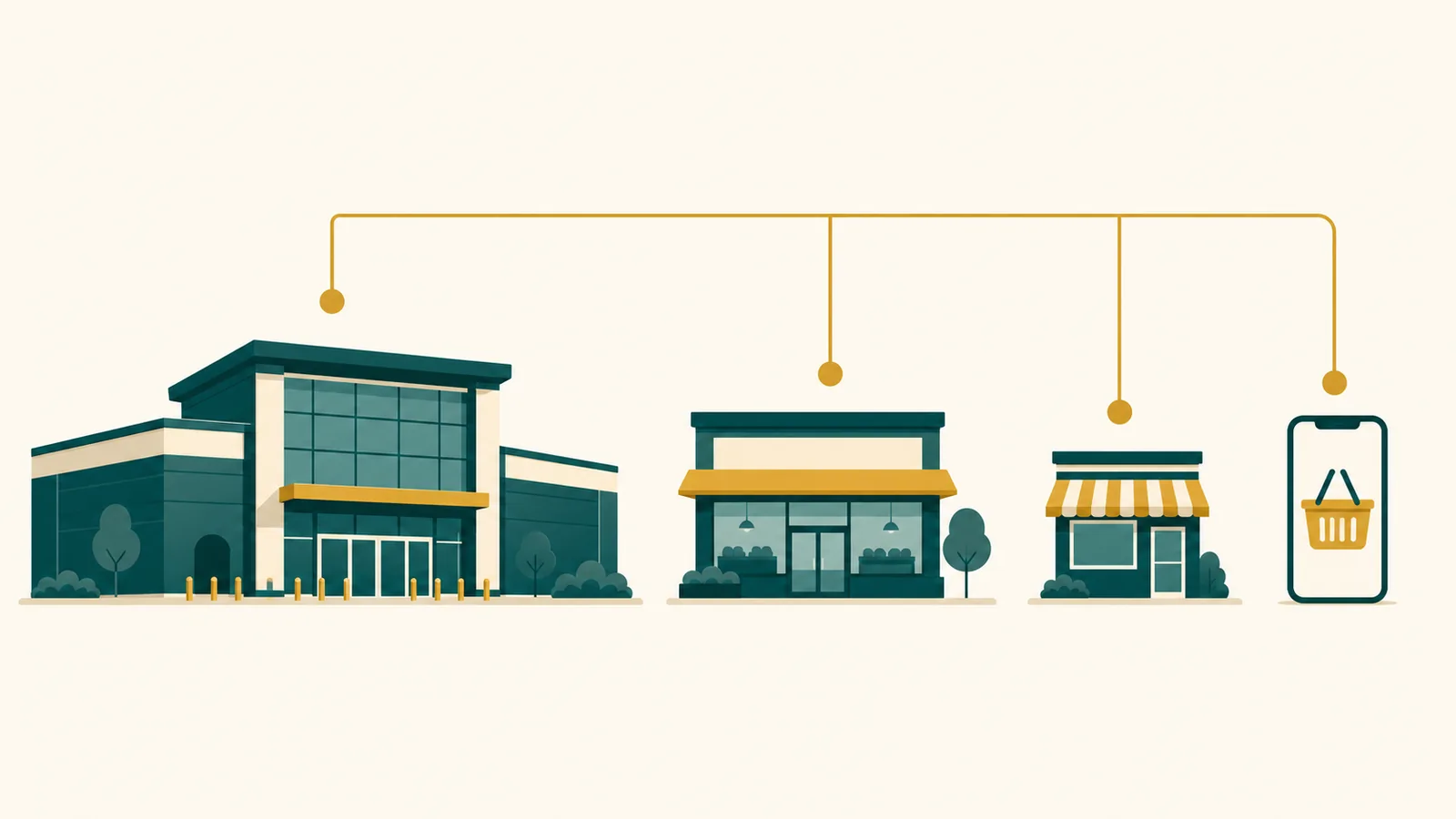
What that looks like day to day is a brand owner not having to learn the buying process at LuLu, then separately at Carrefour, then again at Choithrams, Al Maya or a baqala network, one channel at a time. A single distribution relationship can carry a product across hypermarket, supermarket, premium, discount and convenience formats, plus traditional trade and e-commerce through platforms like Amazon.ae, Noon and Talabat, run on the same Odoo-based inventory system with barcode and batch traceability. For a brand trying to work out where it fits among the names in this directory, that's usually the more useful starting question: not which single chain to chase first, but which distribution partner already has a working relationship with the ones that matter for your product.
Key takeaways
- The UAE grocery market splits into five broad formats: hypermarket, everyday supermarket, premium, discount and convenience, and most shoppers use several of them in the same month.
- Hypermarket names like LuLu, Carrefour, Union Coop, Nesto and Géant anchor the big weekly shop, often through more than one store format under the same group.
- Choithrams, Al Maya and West Zone represent the everyday neighbourhood supermarket tier that handles a large share of routine grocery spending.
- Spinneys and Grandiose compete on quality and experience rather than scale, while Viva runs the country's clearest discount format.
- Zoom covers the convenience, quick-trip occasion, often built into fuel stations rather than standing as its own destination.
- Traditional trade baqalas still carry serious FMCG volume and shouldn't be treated as an afterthought next to the big chain names.
- A listing strategy that matches product and pack format to the right channel works better than treating every UAE modern trade retailer the same way.
The names in this directory will keep shifting. Store counts grow, franchises change hands the way Géant's did, and new formats will keep appearing as shopper habits move. What tends to stay constant is the underlying structure: a handful of formats, each serving a different kind of trip, each demanding a slightly different approach from any brand that wants a place on the shelf. From LuLu, Carrefour, Union Coop and Spinneys down to a single baqala on a residential street, the real question was never which name is biggest. It's which format fits your product, and which partner already knows how to get it there.
Knowing which format you're trying to win is the part to get right before the first buyer meeting. If you want to talk through where your product fits across this map, talk to our team, browse more distribution context on the Bagason blog, or start on the Bagason homepage for an overview of how the three pillars fit together.
Frequently asked questions
What are the biggest supermarkets in UAE?
There's no single official ranking, since store count, floor space and sales figures aren't published consistently across groups. The names shoppers encounter most often across the country include LuLu, Carrefour, Union Coop, Nesto and Géant in the hypermarket tier, alongside Choithrams, Al Maya and West Zone at everyday supermarket scale, plus Spinneys, Grandiose, Viva and Zoom in the premium, discount and convenience formats.
What's the difference between a hypermarket and a supermarket in the UAE?
A hypermarket is a large-format store selling food alongside electronics, homeware and apparel, often spanning thousands of square metres. A supermarket is smaller and food-focused, usually positioned closer to residential areas for a routine grocery run rather than a full weekly or monthly shop.
Which UAE supermarket chains are considered premium?
Spinneys and Grandiose are generally positioned as premium grocers, built around curated ranges, fresh and imported categories, and a more elevated in-store experience. Spinneys also operates under the Waitrose and Al Fair banners in the UAE and Oman, giving it more than one price point within that premium-leaning group.
Is there a discount supermarket chain in the UAE?
Viva positions itself as the UAE's first food discounter, running a leaner store format and rotating special offers rather than carrying the full breadth of a hypermarket. It competes mainly on everyday price rather than range or store experience.
How does a food brand get listed with UAE supermarket chains?
Each chain runs its own category buying process with its own minimum order quantities, delivery expectations and paperwork requirements, including Arabic-label compliance and product registration. Most brands work with a distributor who already has trading relationships across modern trade, traditional trade and HORECA rather than approaching every chain separately.
Do UAE supermarkets also sell groceries online?
Most of the major chains now offer online ordering and delivery alongside their physical stores, and some, like Carrefour, have added express delivery services on top of that. Grocery also reaches shoppers through marketplaces such as Amazon.ae, Noon and Talabat, separate from a chain's own website or app.