Ask our team which two GCC markets get lumped together most often, and the answer is always the same: Kuwait and Qatar. Both are smaller than Saudi Arabia, both sit within easy shipping reach of Dubai, and both get treated in a lot of expansion decks as a single line item, "Kuwait/Qatar, phase two." Brands running an export food Kuwait Qatar plan as one motion usually end up redoing half the work, because the two markets run on different registration tracks, different partner expectations, and different label review habits.
Bagason ships across the GCC out of our Dubai hub, and Kuwait and Qatar are two of the five export destinations we work regularly, alongside Saudi Arabia, Oman and Bahrain. This piece is written from that distribution seat, not a legal or consultancy one. Treat every regulatory detail here as a general shape rather than a submission checklist, and confirm anything specific with a licensed clearing agent or local partner before a shipment moves.
We will walk through how Kuwait and Qatar differ in practice: the registration layers each requires, what a local partner does in each market, the labelling points that trip up brands moving from a UAE base, and a sequencing approach that treats these as two separate projects rather than one.
Why export food Kuwait Qatar plans need two playbooks, not one
Kuwait and Qatar share more surface similarities than most GCC pairs. Both are compact geographically compared with Saudi Arabia. Both have a single dominant capital city that carries most of organised retail. Both draw on Gulf Cooperation Council Standardization Organization, GSO, technical regulations for a good share of their food safety framework, the same shared baseline that underpins UAE, Omani and Saudi rules.
Where they part ways is in who administers registration, how strictly labelling gets checked at the point of entry, and what kind of local partner a brand needs on the ground. Kuwait's food safety oversight runs through the Kuwait Municipality's food and control functions alongside Kuwait's Public Authority for Industry for certain categories, while import documentation and business licensing sit with Kuwait's Ministry of Commerce and Industry. Qatar centralises much of its food safety and registration work under the Ministry of Public Health and the Ministry of Municipality, with product registration increasingly channelled through Qatar's national single-window platform for trade.
That difference in structure matters more than it sounds. A brand that treats Kuwait food import rules as a template for Qatar food registration, or the reverse, tends to submit the wrong documents to the wrong desk and loses weeks correcting course. Two separate project plans, run in parallel if resources allow, get a brand to shelf in both markets faster than one combined plan run twice.
What carries over between the two
Some groundwork does transfer. A complete technical file, ingredient specifications, manufacturing and hygiene certificates, shelf-life data, and halal documentation, is useful evidence in both Kuwait and Qatar even though each authority reviews it separately. Building that file once, to a high standard, and reusing it across both submissions saves real time compared with assembling paperwork from scratch for each market.
What does not transfer is the registration itself. A product cleared in Kuwait has no standing in Qatar, and the reverse holds too. Each market reviews the product, and the label, on its own terms.
There is also a practical currency and documentation layer that sits underneath both markets and rarely gets mentioned in a headline expansion plan. Commercial invoices, certificates of origin, and health or free-sale certificates issued by UAE authorities need to be current, correctly attested, and consistent SKU by SKU. A mismatch between what a certificate says and what a carton actually contains, a pack-size change made after a certificate was issued, for instance, is a common and entirely avoidable reason a shipment sits at port longer than it should in either country. Brands running export food Kuwait Qatar plans in the same quarter should build a simple document tracker per SKU rather than relying on memory or a shared folder nobody owns.
Kuwait food import rules: the shape of registration
Kuwait's food import framework runs through a combination of business licensing and product-specific food safety review. A UAE brand exporting to Kuwait generally needs an importer of record registered in Kuwait, which in practice is almost always a local distributor rather than the brand's own entity, at least for a first entry. That distributor handles the commercial registration side and, in many cases, the coordination with Kuwait Municipality's food inspection functions once shipments start arriving at port.
Product registration in Kuwait tends to move through categories rather than a single blanket process. Packaged staples, sauces, snacks and beverages generally move through more straightforward review than products carrying a specific nutrition claim, novel ingredients, or specialised formulations aimed at a particular dietary need. That pattern is consistent across the Gulf: the simpler the product story on the label, the smoother the registration path tends to be.
Where Kuwait diverges from what a UAE brand expects
Brands used to Dubai Municipality's registration process sometimes assume Kuwait will move at a similar pace and through a similar single point of contact. That assumption does not always hold. Kuwait's food control system has, at different points, involved coordination across more than one government body depending on the product category, and a brand that has not confirmed the current routing for its specific category can lose time figuring out where a file needs to go.
A few practical points worth building into a Kuwait plan from the start:
- Confirm the current registration routing for your specific product category before assembling documents, since this has shifted in recent years and a generic checklist can be out of date.
- Line up a Kuwaiti importer of record early. Few UAE brands register their own entity in Kuwait for a first shipment, and a distributor who already holds active registrations moves faster than a brand starting from zero.
- Expect ingredient and additive lists to be checked against GSO technical regulations, the same baseline used across most of the Gulf, and restricted additives to be a common reason for a file getting sent back.
- Keep expectations product-by-product. Registering one SKU in a range does not clear the rest of that range automatically.
Here's the thing: a Kuwait entry that starts with two or three simple, well-documented SKUs and expands the range after those clear tends to move faster overall than a brand that submits its full catalogue on day one and waits for every line to clear together.
Commercial agency law and why it deserves early legal input
Kuwait's commercial agency framework has a reputation across the region, and much of it is earned. Historically, agency and distribution arrangements registered under Kuwaiti commercial law have been difficult for a foreign brand to exit once signed, even where performance has been weak. That is not a reason to avoid Kuwait. It is a reason to have a Kuwait-qualified commercial lawyer review any distribution agreement before signature, rather than relying on a template contract used elsewhere in the Gulf.
Pay particular attention to how a Kuwaiti agreement defines the products covered, the channels covered, and the circumstances under which either side can end the relationship. A narrowly scoped agreement, covering one product category and a defined initial term, gives a brand room to expand with a different partner later if the first relationship does not deliver, without the friction of unwinding an open-ended exclusive arrangement.

Qatar food registration: how the process differs
Qatar leans more heavily on a single national platform than Kuwait does. Product registration, import permits and much of the documentation review for food products increasingly runs through Qatar's unified trade licensing and single-window systems, coordinated with the Ministry of Public Health on the food safety side. For a UAE brand, that centralisation is generally a practical advantage: fewer separate desks to track, and a clearer sense of where a submission sits at any given time.
That said, centralisation does not mean faster by default. The review still runs product by category, with the same general pattern seen elsewhere in the Gulf: straightforward pantry items and beverages typically clear review faster than products carrying dietary claims or unfamiliar ingredients. Novel formulations, functional claims, and anything positioned around a specific health outcome draw closer scrutiny everywhere in the region, and Qatar is no exception.
The local partner question in Qatar
Qatar's market, more than most in the Gulf, tends to reward brands that arrive with a properly matched local partner rather than the first distributor willing to take on a range. Qatar's retail landscape is concentrated: a small number of large groups control a significant share of organised trade in Doha, and a distributor's existing shelf relationships with those groups often matters more to a brand's early success than the registration process itself.
A partner who already moves product through Qatar's main retail groups, and who understands current single-window submission expectations, generally gets a new SKU to shelf faster than a brand attempting to manage that submission directly from Dubai. This is one area where a local partner's standing in Gulf distribution does more of the practical work than the paperwork alone.
What Qatar's single-window system means in practice
A unified digital submission point sounds like it should remove friction, and in several respects it does. A brand or its Qatari partner can track a registration's status in one place rather than chasing separate departments by phone or email, which is a real improvement over how registration worked in Qatar, and still works in parts of the wider Gulf, a decade ago.
A single-window system does not guarantee a fast outcome, though. Documentation still needs to be complete and accurate on first submission, because a centralised system that flags a missing certificate returns the whole file for correction rather than processing the parts that are in order. Brands registering food products in Qatar for the first time do best treating the submission as a one-shot exercise: get every document right before uploading anything, rather than submitting early and patching gaps as requests come back.
Local partner Gulf distribution: agent, distributor, or direct
Every GCC market forces a version of the same decision: work through a commercial agent, appoint a distributor, or attempt a more direct entry. Kuwait and Qatar answer that question differently enough that treating them the same is where a lot of brands lose ground.
Kuwait has historically leaned toward exclusive commercial agency relationships in several sectors, arrangements that can be difficult to unwind once signed, so the choice of Kuwaiti partner deserves real diligence before any agreement is put in writing. A brand should confirm exactly what exclusivity is being requested, what categories or channels it covers, and what performance expectations sit on both sides, before committing a range to a single Kuwaiti partner.
Qatar's distribution landscape is somewhat less rigid on exclusivity by default, though many brands still choose a single strong distributor for their first phase, because Doha's retail concentration rewards a partner with existing shelf relationships more than it rewards having several smaller players competing for the same accounts. In both markets, a distributor's warehousing capability, HACCP-aligned handling, and existing HORECA and modern trade relationships matter as much as the commercial terms on paper.
Questions worth asking before signing with either market's partner
- Which retail groups and channels does this partner already serve, and does that match where your product belongs?
- What warehousing and cold-chain capability, where relevant, does the partner operate day to day?
- Is any exclusivity being requested time-bound, category-bound, or open-ended, and what happens if performance targets are not met?
- Does the partner have current, active product registrations in place, or will your brand be their first attempt at a new category?
We have seen a UAE brand sign an exclusive Kuwaiti agreement quickly to "get moving," then spend a year working around a partner whose retail relationships never matched the product. Slower, better-matched partner selection almost always outperforms speed for its own sake in both these markets.

Labelling nuances: what changes on the pack in each market
Both Kuwait and Qatar draw on shared GSO technical standards for the core of their labelling requirements: Arabic-language declarations, full ingredient lists, allergen information, production and expiry dating, and net weight or volume. Where they diverge is in how closely those declarations are checked at the point of registration and, in some cases, at the point of entry.
Kuwait's labelling review tends to focus closely on ingredient list accuracy and on any claim that strays toward a health or dietary benefit. A plain, accurate Arabic translation of the ingredient statement generally clears without much friction. A label that implies a functional outcome, even loosely, invites a level of scrutiny that can stall a shipment at the exact point a brand least wants delay: the port.
Qatar applies a broadly similar standard but reviews it through its centralised registration system rather than a separate inspection step, which means labelling issues are more likely to surface earlier, during registration, than after product has already shipped. That is generally the better failure mode for a brand: catching a labelling problem before a container leaves Jebel Ali costs far less than catching it after arrival in Doha.
The claim discipline that applies in both markets
This is where the compliance guidance we give every brand exporting through Bagason applies just as firmly in Kuwait and Qatar as it does at home: describe what a product is, not what it supposedly does for the person eating it. "Made with whole grains" or "a source of protein" describes composition. Anything implying that a product treats, prevents, or improves a health condition invites exactly the kind of scrutiny that slows a submission down, in both markets, without exception.
Halal status deserves the same discipline. Halal expectations run high across both Kuwaiti and Qatari retail, and getting the right documentation in place with your supplier is real, practical work. What should never happen is asserting a halal certification on packaging bound for either market unless that certification is confirmed and current for that specific destination. Treat it as compliance groundwork to get right quietly, not a claim to lead with on the pack.
Retail landscape: what a shelf looks like in each market
Kuwait's organised retail runs through a mix of large domestic co-operative societies, which still carry substantial weight in day-to-day grocery shopping, alongside international and regional supermarket banners familiar to anyone who has worked UAE modern trade. Traditional trade, smaller independent grocers, remains a meaningful channel outside the main co-operative network, in a pattern that will feel familiar to a UAE distributor used to the baqala side of the business.
Qatar's retail picture concentrates more heavily around Doha, where a smaller number of large retail groups account for most organised trade. HORECA carries real weight in Qatar given the country's hospitality and tourism sector, and hotel and catering supply channels deserve a place in a Qatar plan from the outset rather than treating them as a later expansion. Quick commerce and online grocery have also taken hold in both Kuwait City and Doha in recent years, following much the same pattern UAE brands have already watched play out with Talabat, Noon and Amazon.ae closer to home.
Neither market's retail structure is complicated on its own. What catches brands out is assuming the UAE's channel mix, HORECA-heavy in Dubai, baqala-heavy across the wider Emirates, translates directly. Qatar leans more hospitality-weighted than Kuwait does. Kuwait leans more co-operative-society-weighted than Qatar does. A distribution plan that accounts for that difference from the start reaches the right shelves faster than one written around a generic GCC template.
Packaging and pack-size choices that move product in each channel
Kuwait's co-operative societies and Qatar's hospitality trade often want different pack formats even for the exact same product. A co-operative society buyer in Kuwait, serving household shoppers doing a weekly stock-up, tends to favour family and value pack sizes that sit well on a wide shelf set. A Doha hotel or catering buyer, by contrast, is often looking for foodservice-format cartons, bulk or catering packs designed for a kitchen rather than a home pantry.
Getting this wrong is a quieter mistake than a registration delay, but it costs sales just the same. A brand that ships only retail-format packs into Qatar's hospitality channel, or only catering cartons into Kuwait's co-operative network, is technically compliant and commercially mismatched. Confirming preferred pack formats with each local partner before the first production run is a small step that saves a wasted first shipment.
Customs and shipping: getting product from Jebel Ali to shelf
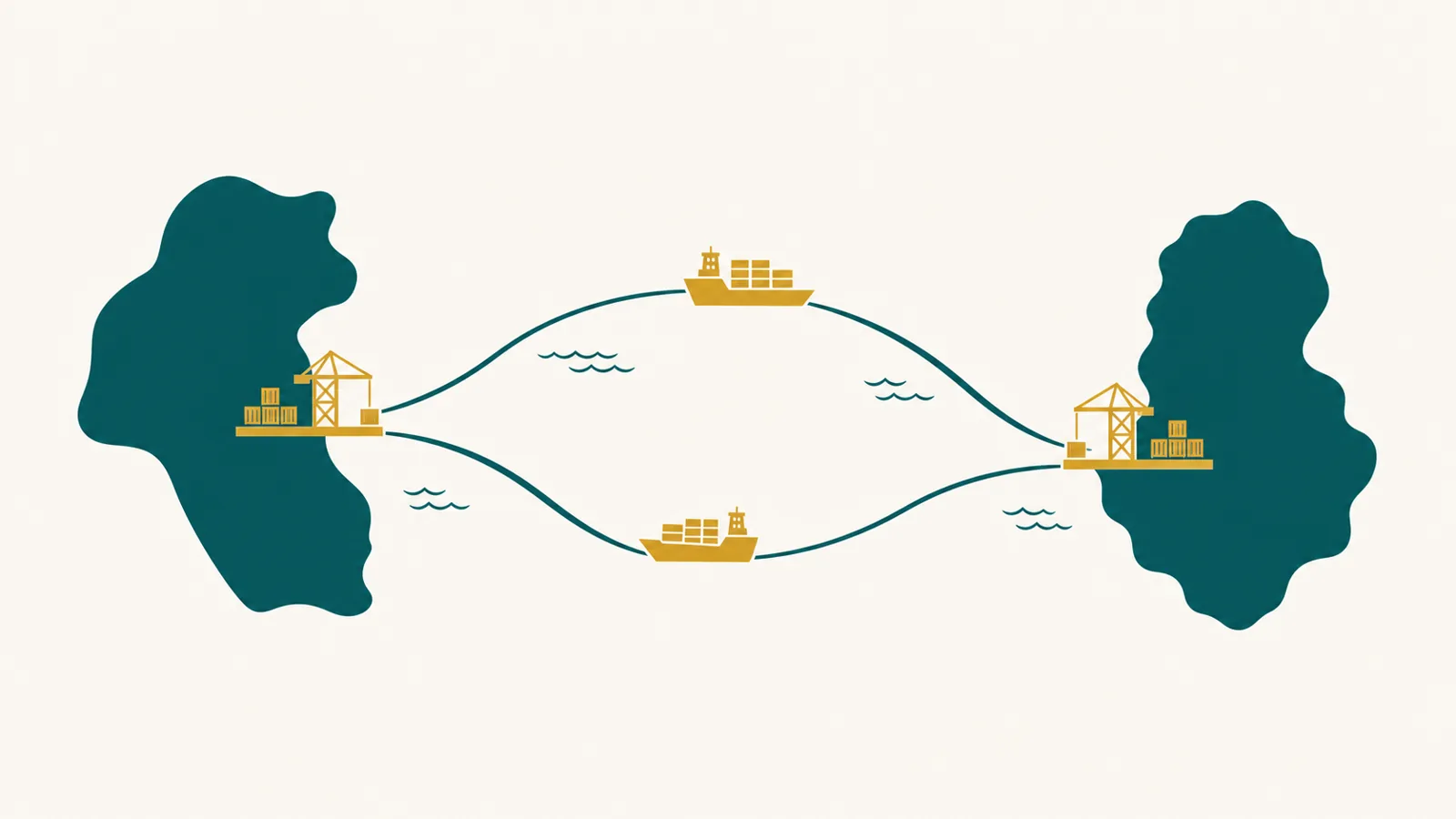
The physical shipping side of Kuwait and Qatar entry is more alike than the registration side, largely because both routes typically run through sea freight out of the UAE, whether directly from Jebel Ali or via a regional transhipment hub, with air freight reserved for smaller or time-sensitive volumes. Transit times are short enough by regional standards that a brand's bigger planning question is usually port and customs clearance readiness rather than the voyage itself.
Clearance at Kuwait's ports and at Qatar's Hamad Port both depend on the same underlying discipline: a complete, matching set of shipping documents, arriving with the cargo rather than trailing behind it. Certificates of origin, health certificates, packing lists and commercial invoices need to describe the same product, in the same units, as what is physically in the container. A discrepancy as small as a mismatched carton count between the packing list and the bill of lading is enough to hold a shipment at either port while paperwork gets corrected.
Where a distribution partner's local customs relationships matter
A Kuwaiti or Qatari partner who already clears shipments regularly through their own customs broker relationships tends to move a new brand's first container through noticeably more smoothly than one relying on a generic freight forwarder unfamiliar with that specific port's current documentation habits. This is one more reason partner selection in each market deserves real diligence rather than a quick handshake: a partner stands between your container and the port authority, a role that goes well past being a sales relationship.
Bonded or transit warehousing, common practice for goods moving onward through the wider Gulf, can also apply to shipments destined for Kuwait or Qatar that route through an intermediate hub. Confirming with your freight forwarder exactly which documents are needed at each stage, rather than assuming a single certificate covers the whole journey, avoids the kind of delay that a brand only discovers the first time it happens.
GCC market entry food sequencing: what a realistic first year looks like
Brands new to GCC market entry food planning often want a single timeline covering every destination market at once. In practice, a phased approach that treats Kuwait and Qatar as separate, parallel tracks tends to reach revenue faster than a combined plan that waits for every market to clear together.
A workable first-year sequence generally looks something like this:
- Build one complete technical file per SKU, covering specifications, manufacturing certificates, shelf-life data and halal documentation, reusable across both Kuwait and Qatar submissions.
- Select and confirm a Kuwaiti partner and a Qatari partner separately, evaluating each against that market's actual retail structure rather than a single generic distributor checklist.
- Submit a small, simple starter range, two to four SKUs with clean, uncomplicated labels, into each market first, rather than the full catalogue at once.
- Use the first shipments to confirm labelling review outcomes and registration timing in practice, then expand the range once that pattern is understood.
- Layer in HORECA and quick commerce channels once modern trade or co-operative listings are secured, rather than chasing every channel simultaneously from day one.
That sequencing is not exotic. It respects that Kuwait and Qatar run two different registration systems, overseen by two different authorities, reviewed against two different sets of local expectations, even though both draw from the same broader Gulf standards.
Where a distribution partner earns its place
A brand can attempt all of this from Dubai without local ground support in either market, though the path runs slower and riskier than working with a distributor who already operates the customs, warehousing and last-mile side in-market. Bagason's own export work runs through our Dubai hub with HACCP-aligned warehousing and GPS-tracked delivery, and the same port-to-shelf thinking that gets a product onto a Carrefour or LuLu shelf in the UAE applies to getting it registered, labelled correctly, and delivered in Kuwait and Qatar. If you are weighing where to start, our blog covers the other GCC markets we work in, and reaching out through our contact page is the fastest way to talk through a specific range.
Key takeaways
- Kuwait and Qatar run separate registration systems, different lead authorities, and different local partner expectations. A combined plan usually costs more time than two parallel ones.
- Kuwait food import rules involve Kuwait Municipality's food safety functions alongside Ministry of Commerce and Industry licensing, with commercial agency exclusivity a real consideration before signing a partner.
- Qatar food registration channels through a more centralised single-window system with the Ministry of Public Health, rewarding brands that pick a well-matched local partner over a fast one.
- Labelling in both markets draws on shared GSO standards, but claim discipline, describing composition rather than implying a health outcome, matters everywhere in the Gulf, no exceptions.
- A phased, simple-SKU-first entry into each market, backed by one strong technical file, generally reaches shelf faster than a full-catalogue push into both at once.
Kuwait and Qatar reward patience more than speed. Get the technical file right once, choose each market's partner on fit rather than convenience, and treat the label as the place where compliance discipline shows up first. A UAE brand that respects the differences between these two markets, rather than folding them into one GCC line item, tends to spend less time correcting course and more time selling. Our home page has more on how our Dubai-based export operation supports brands moving into these markets.
Frequently asked questions
What is the main difference between Kuwait and Qatar food import rules?
Kuwait's food safety oversight runs through Kuwait Municipality alongside Ministry of Commerce and Industry licensing, with a stronger role for commercial agency law. Qatar centralises much of its registration through a national single-window platform coordinated with the Ministry of Public Health. Both draw on shared GSO technical standards, but the submission routes and partner expectations differ enough that a combined plan usually costs more time than two separate ones.
Do I need a local distributor to export food to Kuwait or Qatar?
In practice, yes, for a first entry. Both markets generally require an importer of record registered locally, and a distributor who already holds active registrations and existing retail relationships moves a new brand to shelf far faster than the brand attempting direct entry from the UAE. Choosing that partner carefully matters more than choosing one quickly.
Does a UAE food registration transfer to Kuwait or Qatar?
No. The underlying technical file, specifications, manufacturing certificates, shelf-life data and halal documentation, is useful evidence in both markets, but the registration number itself does not carry over. Each country reviews the product and its Arabic label against its own current requirements before it can be sold there.
What should change on packaging for Kuwait versus Qatar?
Both require accurate Arabic-language declarations, full ingredient lists, allergen information, and standard dating and net-weight information under shared Gulf standards. Beyond that, Kuwait's co-operative-society retail often favours family pack sizes, while Qatar's larger hospitality trade often wants foodservice or catering formats, so pack-size choice deserves its own conversation with each local partner.
How long does registration usually take in these markets?
Timelines vary by product category and current authority workload, so a fixed figure would be misleading. Straightforward pantry items, sauces and beverages tend to move faster than products carrying dietary claims or unfamiliar ingredients. Confirming current expectations with a licensed clearing agent or local partner before committing a shipment date is the safer approach in both Kuwait and Qatar.
Is Kuwait's commercial agency law something a smaller brand needs to worry about?
Yes, regardless of company size. Agency and distribution agreements registered under Kuwaiti commercial law can be difficult to exit once signed. Having a Kuwait-qualified lawyer review the scope, term and termination clauses before signature protects a brand's ability to change partners later if the relationship does not perform as expected.