If you are trying to shortlist top GCC FMCG distributors for a new brand launch, the first thing you notice is that "GCC coverage" means different things to different companies. Some run their own warehouses and sales teams in every Gulf market. Others lean on independent partners country by country. A smaller group works from a single UAE hub and exports outward, never opening a second entity at all. None of these models is automatically better than another, but they change how fast a brand can get onto shelves in Riyadh, Muscat, or Manama, and who is accountable when something goes wrong at the border.
This guide profiles a set of UAE-based FMCG distribution companies with genuine reach beyond the Emirates, organised by how they cover the region in practice, rather than by size or age. Each profile is built from the company's own public materials, not from internal rankings or market-research reports. Bagason Group, a Dubai-founded FMCG distributor and marketer, is included in the same neutral format, described only from its own operational facts.
Here's what we'll cover: how coverage models differ, why Saudi Arabia usually sits apart from the rest of the region, seven named companies organised by coverage type, and a short section on what to check before you sign with any of them.
What does "GCC-wide reach" actually mean for a UAE FMCG distributor?
A company can claim regional reach in at least three distinct ways, and the difference matters more than most brand owners realise before their first shipment gets stuck in customs somewhere. The first is owning licensed operating entities in more than one Gulf country, with local warehousing, a local sales team, and direct retailer relationships in each market. Second, a network of independent distribution partners in each country, coordinated from a UAE head office but not owned by it. Third is a single UAE hub that imports, stores, and then re-exports onward to GCC buyers, without a separate legal or physical presence in the destination country.
Each model has trade-offs. Own entities give a brand one point of contact and consistent execution, but they cost more to build and are slower to expand. Partner networks scale faster but mean a brand is managing several relationships, not one, and quality can vary from country to country. A re-export hub is the leanest option and works well for categories that do not need daily replenishment, though it usually means longer lead times into the destination market and less local market feedback. When you compare top GCC FMCG distributors, ask which of these three models you are looking at. The answer changes what you can expect from the relationship six months in, not just at the pitch meeting.
No single model among the three is inherently superior, and the same company can even run different models in different countries. A distributor might hold a full licensed entity in Oman, where the market is close enough to the UAE to justify the investment, while treating Saudi Arabia or Qatar as an export-only relationship. Reading a company's own materials closely, rather than taking a "we cover the GCC" headline at face value, is the only reliable way to know which situation applies.
Why Saudi Arabia sits apart from the rest of the GCC for most distributors
Saudi Arabia is usually the hardest market on this list to treat as an afterthought, and that shapes how UAE-based distributors organise their regional footprint. Product registration runs through the Saudi Food and Drug Authority, and many categories also need to clear the SABER conformity platform before goods can be cleared at the border, a process distinct from the UAE's own Dubai Municipality and ESMA requirements. Label language, ingredient declarations, and in some categories shelf-life documentation all need to match Saudi rules specifically, not a generic GCC standard.
This is one reason several of the companies in this guide either run a dedicated Saudi entity, as Bidfood and Truebell do, or route Saudi business through export shipments handled separately from their UAE-Oman core, closer to the SAFCO or Bagason pattern. The GCC Standardization Organization, known as GSO, does set shared technical regulations that member states are meant to align with over time, and this has narrowed some of the historical gaps between Saudi and the other five markets. But a brand entering the region should still expect Saudi Arabia to need its own registration timeline, its own label review, and often its own commercial conversation, separate from Oman, Bahrain, Qatar, and Kuwait, which tend to move closer to the UAE's own process.

Distributors that operate their own entities across multiple Gulf countries
These companies do not just export into neighbouring markets. They hold local trade licences, run warehouses, and employ sales staff inside more than one GCC country, which typically means faster replenishment and a single accountable operator per market rather than a chain of subcontracted relationships.
Al Seer Group
Al Seer Group is a Dubai-headquartered FMCG distributor founded in 1961, describing itself as a leading distributor across the "Lower Gulf" of the UAE and Oman. It operates dedicated divisions covering retail, pharmacy, and out-of-home channels, supported by its own warehousing and delivery fleet in both markets. Its public positioning centres on brand representation and in-market execution rather than pure logistics, and it presents its Oman operation as a natural extension of its UAE base rather than a separate export relationship.
Bidfood Middle East
Bidfood Middle East, formed from the 2005 merger of the UAE's Horeca Trade with global foodservice group Bidcorp, operates across the UAE, Saudi Arabia, Oman, Bahrain, and Jordan. According to its own materials, the company runs multiple distribution centres and offices across these markets, serving hotels, restaurants, cafes, and cloud kitchens through its foodservice channel. It also operates myBidfood, a business-to-business ordering platform for its foodservice customer base, and its scale across five markets makes it one of the broader examples of an owned-entity model among FMCG distributors Gulf-wide.
Truebell Marketing and Trading
Truebell, founded in 1984 and headquartered in the UAE, describes itself as an importer, wholesaler, distributor, and exporter with divisions spanning food, beverages, hospitality supplies, and retail duty-free. Its own materials cite established operations in Kuwait and Saudi Arabia alongside its UAE base, plus large bonded and duty-paid warehousing across ambient, chilled, and frozen categories. The company positions itself around long-standing category specialisation in food and licensed beverage imports for the GCC, built up over four decades rather than a recent regional push.
Distributors built around retail and distribution partner networks
A second group covers the region less through owned foreign entities and more through a combination of direct UAE distribution and retail partnerships that extend outward from a home base. This model tends to suit companies whose own retail footprint doubles as a distribution advantage, and it blurs the line between "distributor" and "retailer" more than the other two models do.
Al Maya Group
Al Maya Group, established in Dubai in 1982, is a diversified retail and distribution conglomerate operating across the UAE and wider GCC. Its own materials describe warehousing space exceeding a million square feet, a large logistics and distribution operation, and more than 50 international food brands introduced to the region under its distribution arm. Alongside FMCG distribution, the group runs its own supermarket chain and other retail formats across the UAE and GCC, which gives it a direct retail lens on the categories it distributes, and a built-in shelf for brands it chooses to carry. Searches for the best FMCG distribution companies in GCC markets often surface Al Maya first precisely because its retail and distribution arms sit under one roof.

Manufacturing and export from a UAE production base
Not every regionally reaching company is a pure distributor. Some cover the GCC by manufacturing locally and exporting outward, which changes the commercial conversation from listing fees and shelf space to supply agreements and container volumes.
National Food Products Company (NFPC)
NFPC, headquartered in Dubai with a major production facility in Abu Dhabi's Khalifa Industrial Zone, has been operating for more than four decades and owns dairy, juice, and bakery brands including Lacnor, Oasis, Milco, and Royal Bakers. Its own materials describe direct sales and distribution centres in the UAE and Oman, with export business reaching the wider GCC, the Levant, Africa, and parts of Asia. Among GCC food distribution companies, NFPC's profile sits closer to a manufacturer-exporter than a pure third-party distributor, since its regional reach is built on production capacity as much as on a sales-team footprint abroad.
The re-export model: a single UAE hub serving GCC buyers
The leanest coverage model keeps all physical infrastructure inside the UAE and reaches the rest of the Gulf through export shipments rather than a local entity. It suits categories and brands where a distributor's core strength, whether that is import compliance, warehousing, or foodservice specialisation, is easiest to concentrate in one place rather than replicate across borders. The trade-off is usually lead time: an order bound for Muscat or Manama has to clear UAE export processes and the destination country's import process in sequence, rather than being pulled straight from a local warehouse.
SAFCO International
SAFCO International, a Dubai-based foodservice distributor and general trading company established in 1994, imports and distributes food and non-food products to hotels, restaurants, airlines, and institutional buyers across all seven emirates from its own logistics base in Sharjah. Its public materials describe an export network reaching GCC markets, Africa, the CIS region, and the Indian subcontinent, run alongside its domestic UAE distribution business. SAFCO positions itself primarily as a UAE foodservice specialist that also trades internationally, rather than as a company with standing entities in other GCC countries, which places it firmly in the hub-and-export category.
Bagason Group
Bagason Group is a Dubai-founded FMCG distributor and marketer, established in 2007, that both owns brands (including American Harvest, India Mills, Tropico, and Nutrizain, among others) and distributes partner brands such as Everest, Bikaji, and Wai Wai from a single Dubai hub. Its coverage runs across all seven UAE emirates through modern trade, traditional trade, HORECA, and e-commerce channels, supported by HACCP-run warehousing and a GPS-tracked delivery fleet, with export reaching Saudi Arabia, Oman, Kuwait, Bahrain, and Qatar. Bagason's GCC business runs on the same import-clearance, product-registration, and Arabic-label compliance process it uses domestically, applied to outbound shipments rather than a second in-country entity. For brand owners weighing a UAE FMCG company's regional reach against setting up their own GCC operation, this is one example of the hub-and-export route. It is the model Bagason describes for its own operations, not a claim made about anyone else's.
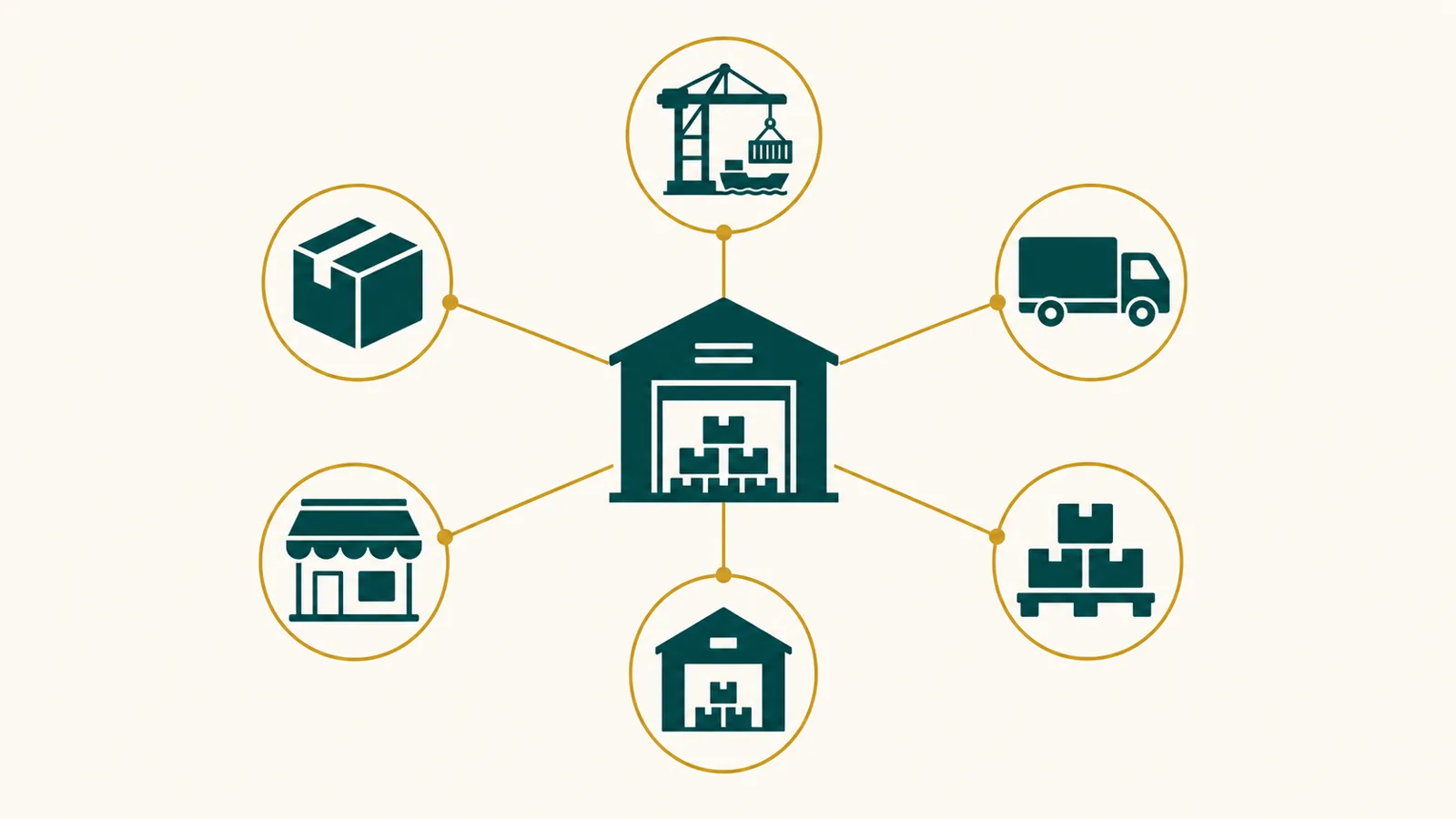
Retail, traditional trade, HORECA and e-commerce: how channel reach differs across the Gulf
Coverage model is one axis. Channel reach is another, and the two do not always move together. A distributor with owned entities in five countries might still be weak in one channel across all of them, while a single-hub exporter might dominate a narrow channel it has spent years mastering.
Modern trade, the large supermarket and hypermarket chains, tends to run on centralised buying and category management, so a distributor's strength here often comes down to listing relationships built over years rather than logistics alone. Traditional trade, the independent grocery stores and baqalas that still account for a large share of everyday FMCG purchases across the region, rewards a different skill: van sales networks, frequent small-drop delivery, and route density in each city. HORECA, meaning hotels, restaurants, catering, and cloud kitchens, is its own specialist channel again, with different pack sizes, ordering cadence, and credit terms than retail. Bidfood and SAFCO both built their regional identity around this channel specifically. E-commerce and quick commerce add a fourth layer on top, with fulfilment speed and digital listing content mattering as much as physical distribution.
A brand launching across the GCC rarely needs a single distributor that is strong in all four channels in every country. It is more common, and often more effective, to match the distributor's channel strength to the channel where the brand's own customer shops.
E-commerce and quick commerce: a newer test of regional reach
Online grocery and quick commerce have added a channel that older coverage models were not built around. Amazon.ae, Noon, and Talabat operate on their own onboarding, content, and fulfilment rules, separate from a distributor's physical warehouse footprint. A company can hold owned entities in five GCC countries and still be a late mover online, while a smaller, more digitally organised operator moves faster in this channel precisely because it never had legacy retail systems to migrate.
For a brand owner, this means asking a distributor about e-commerce readiness as its own line item, not assuming it comes bundled with physical retail or foodservice strength. Content quality, such as accurate product listings, images, and searchable descriptions, matters as much here as warehouse location does for traditional trade. A distributor that treats e-commerce as an extension of its existing sales team, rather than a distinct discipline with its own account managers, tends to show it in slower listing turnaround and thinner product content.
What good execution looks like once a product actually lands
Signing a distributor is the easy part. What happens in the following weeks separates a working GCC relationship from a stalled one. A first order that clears customs on schedule, arrives at the agreed warehouse, and gets scanned into a proper batch-tracked inventory system tells a brand more about a distributor's execution than any capability presentation. So does the speed of the first reorder: a distributor that waits for a brand to chase a repeat order is signalling something about how the relationship will run at scale.
Two other signals are worth watching early. The first is how quickly a distributor flags a problem, whether that is a registration delay, a damaged pallet, or a retailer pushing back on price, rather than letting a brand find out from the retailer directly. The second is whether reporting on sell-through and stock levels arrives on a predictable schedule or only when asked for. Neither signal shows up in a company profile or a pitch deck, which is exactly why the shortlist questions below matter more than a name on this list.
Why the coverage model matters more than company size
Company size on its own tells you almost nothing about whether a distributor can get your product onto a shelf in Doha next quarter. A large company built entirely around owned UAE retail may have deep local reach and no export infrastructure at all. A smaller specialist foodservice distributor might move fast into five countries because it never had to build local retail relationships in the first place, only a customs and logistics process. So what does this mean in practice? The question to ask is not how big a distributor is, but which of the three coverage models it runs day to day, and whether that model matches how fast the brand needs to be in-market.
There is also a category dimension. Foodservice-led companies such as Bidfood and SAFCO built their GCC presence around hotels, restaurants, and institutional buyers, a channel with different volume and margin patterns than retail. Retail-and-distribution groups such as Al Maya built theirs partly through owning the shelf itself. Manufacturer-exporters such as NFPC built theirs around production scale rather than a sales-team footprint in each country. No one approach is better or worse in the abstract. It just needs to match what a brand is trying to sell and to whom.
Timing matters too. A brand chasing a seasonal window, a Ramadan launch or a back-to-school promotion, needs a distributor whose coverage model can move inventory fast enough to hit that window in every target country at once. A brand building a slower, steadier presence in one or two new markets can afford the longer lead times that come with a re-export hub. Matching the model to the timeline avoids a common mismatch: signing a fast-moving retail distributor for a slow-moving HORECA launch, or the reverse.
What this list does and does not claim
Every profile above is drawn from each company's own published materials: its website, its stated history, and the markets and channels it describes for itself. None of it comes from a market-research firm, a survey, or an internal Bagason scoring model, and none of the companies are ranked against one another. A company appearing earlier or later in this guide reflects the order of the coverage categories, not a judgement about which distributor performs better.
This also means the guide cannot verify claims a company makes about its own scale, only report them as stated. A brand doing real due diligence should treat every profile here, including Bagason's own, as a starting point for questions rather than a finished answer. The next section sets out what those questions should be.
How to shortlist a GCC-capable FMCG distributor
Once a brand understands which coverage model a distributor runs, shortlisting becomes a short list of concrete questions rather than a general search for "the best" partner. Here's what to check before a first meeting turns into a signed agreement, ideally before any exclusivity terms are discussed.
- Ask which GCC countries the distributor covers with an owned entity versus a partner versus export only. Get this in writing, since sales conversations tend to describe reach in aspirational terms.
- Check the channel mix against the product. A foodservice specialist and a modern-trade retail distributor solve different problems, even inside the same country.
- Ask how product registration and label compliance are handled per destination market, since Saudi Arabia, Oman, and the other Gulf states each run their own registration and standards processes.
- Confirm who holds inventory risk on export shipments. A hub-and-export model usually means longer replenishment cycles, so minimum order quantities and lead times need to be agreed upfront.
- Ask for references from brands already listed in the specific country being targeted, not just from the distributor's home UAE market.
- Clarify who owns the retailer relationship if the arrangement ends. Some distributors register products and negotiate listings under their own name, which can complicate a future switch to another partner.
A conversation that starts with these questions tends to surface the real operating model within the first few minutes, whether or not the distributor's own marketing leads with it. What's more, the answers usually predict how the relationship will run day to day far better than a glossy capability deck does.
It also helps to run this conversation with more than one distributor at a time, even if a brand already has a preferred name in mind. Two companies claiming the same "GCC coverage" headline can turn out to mean genuinely different things once the questions above are asked directly, and the gap between them is usually where a launch either stays on schedule or slips by a quarter.
Key takeaways
- UAE-based distributors reach the wider GCC through three broad models: owned entities in multiple countries, partner networks coordinated from the UAE, or a single UAE hub that exports outward.
- Saudi Arabia usually requires its own registration process and, often, its own commercial arrangement, separate from Oman, Bahrain, Qatar, and Kuwait.
- Al Seer Group, Bidfood Middle East, and Truebell Marketing and Trading each describe owned or long-established operations in more than one Gulf country.
- Al Maya Group combines FMCG distribution with its own retail footprint across the UAE and GCC.
- NFPC covers the region primarily through UAE and Abu Dhabi manufacturing and export, rather than a distribution sales team abroad.
- SAFCO International and Bagason Group both run a UAE hub model, concentrating infrastructure domestically and reaching GCC buyers through export.
- Company size is a weak signal on its own. Coverage model, channel specialisation, and timeline fit matter more when shortlisting a partner for a specific market.
The Gulf is not one market with six flags. It is six regulatory regimes, several different retail landscapes, and a foodservice sector that runs on its own rhythm entirely. That is the real reason a simple ranking of top GCC FMCG distributors would miss the point: the right answer changes with the country, the channel, and the category. A distributor's coverage map only tells you it can reach a country, not that it can execute well there for a specific category, and that gap only closes once a real order has moved through the system.
If you want to talk through where Bagason's Dubai hub and GCC export lane fits your own plans, get in touch with our team, or browse more distribution context on our blog. You can also learn more about how Bagason runs its own operation on our homepage.
Frequently asked questions
What makes a distributor a genuine GCC-wide operator rather than just a UAE company?
Genuine GCC reach usually means one of three things: a licensed operating entity with local warehousing in another Gulf country, an established partner network in each market, or a UAE hub that exports directly to GCC buyers. A company only strong in the UAE, with no export or partner arrangement, is not really a regional operator yet, regardless of how it describes itself in marketing materials.
Is Saudi Arabia covered the same way as the rest of the GCC by most distributors?
Not usually. Saudi Arabia runs its own product registration through the Saudi Food and Drug Authority and often the SABER conformity platform, separate from UAE requirements. Many UAE-based distributors treat Saudi as a distinct entity or a dedicated export lane, while grouping Oman, Bahrain, Qatar, and Kuwait more closely with their home UAE process.
Do bigger distribution companies always offer better GCC coverage?
No. Company size does not reliably predict coverage model or channel strength. A large UAE retail-led group can have little export infrastructure, while a smaller foodservice or e-commerce specialist can move into several countries quickly because its coverage model needs less physical replication per market.
Should a brand use one distributor for the whole GCC or a different one per country?
Both approaches are common. A single distributor with owned entities across several countries offers one point of contact, while per-country partners can offer deeper local channel strength in each market. The right choice depends on the brand's category, channel, and how quickly it needs to launch in each country.
How is Bagason Group's GCC model different from a company with its own entities in Saudi or Oman?
Bagason runs a single Dubai hub covering all seven UAE emirates, then exports to Saudi Arabia, Oman, Kuwait, Bahrain, and Qatar using the same import-clearance and product-registration process it applies domestically. It does not operate a separate licensed entity in those markets, which places it in the UAE-hub coverage category described in this guide.
What should a brand ask a distributor before signing a GCC distribution agreement?
Ask exactly which countries are covered by an owned entity, a partner, or export only, and get the answer in writing. Also confirm channel fit, how product registration is handled per country, who carries inventory risk on export orders, and whether references exist from brands already listed in the specific target market.