GCC FMCG Export and Distribution
Bagason Group uses its Dubai base as a hub to distribute across the GCC — reaching Saudi Arabia, Oman, Kuwait, Bahrain and Qatar through one regional partner that coordinates registration, logistics and market entry from the UAE.
Treat the GCC as one region, from a single UAE hub
The Gulf is not six separate export projects — it is one of the most attractive consumer regions in the world, and it rewards brands that approach it as a whole. GCC FMCG distribution means reaching Saudi Arabia, Oman, Kuwait, Bahrain, Qatar and the UAE through a coordinated strategy rather than six disconnected agents. The GCC operates a shared customs union, its populations are young and affluent, and imported food and beverage lines enjoy strong, steady demand. Saudi Arabia alone is the largest market in the Gulf and often the single biggest prize for a growing brand.
Capturing that opportunity is harder than it looks. Each country runs its own product-registration regime, its own labelling expectations and its own logistics realities, and the paperwork for one market rarely transfers cleanly to the next. Most brands underestimate the complexity of multi-country entry and end up with strong UAE sales but no meaningful presence next door. A single regional partner that already understands these differences turns that friction into a coordinated rollout.
Bagason Group has operated from Dubai since 2007, distributing 700+ products across every FMCG category. We use the UAE as the natural hub for the wider Gulf — consolidating stock, clearing goods and then coordinating GCC export distribution into the neighbouring markets. For brand owners, that means one accountable partner instead of a patchwork of importers, each with its own systems, terms and priorities.
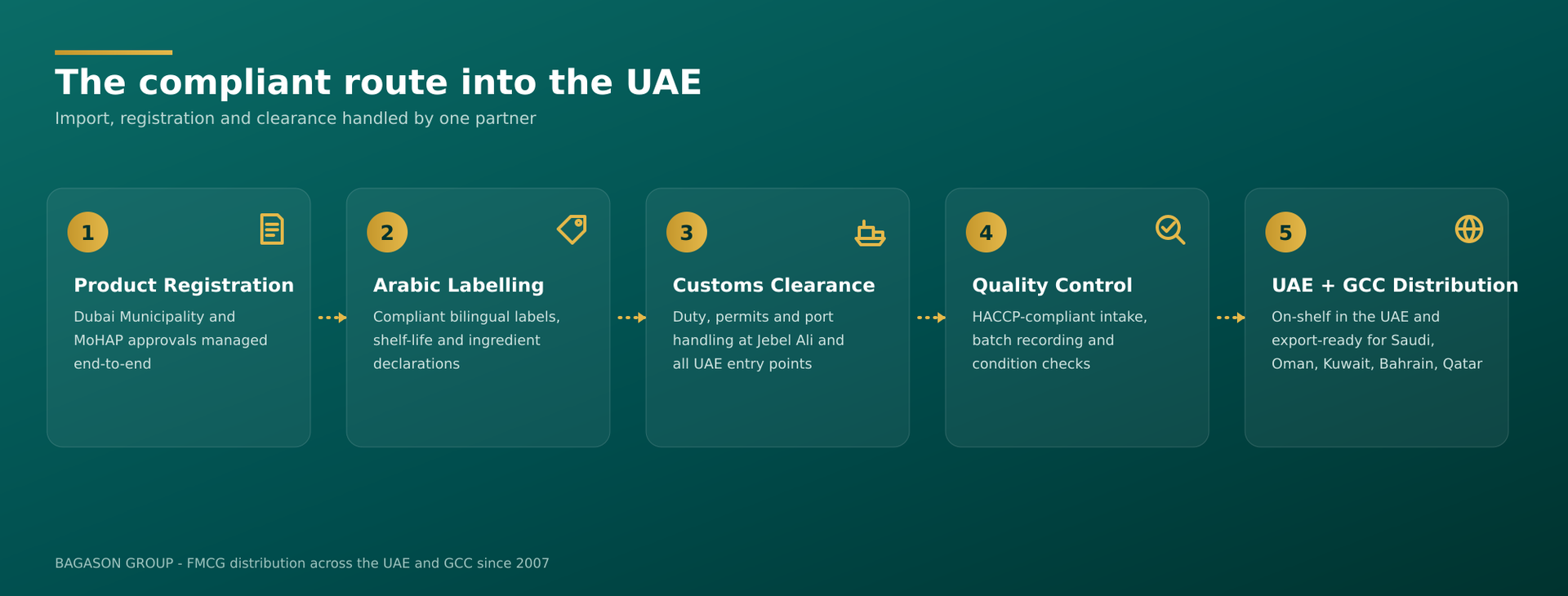
The compliant route into the UAE
A single Gulf region worth building for
The six GCC states share far more than geography. A common customs union, deep trade links and broadly similar consumer tastes make the Gulf one addressable region for the right FMCG portfolio. Household incomes are high, expatriate communities are large and diverse, and imported pantry staples, snacks, beverages and specialty foods sell year-round. For a brand that has proven itself in one market, the logical next move is to extend across the Gulf rather than stop at a single border. The regional population runs into the tens of millions, and much of the food and consumer-goods supply is imported — which is exactly the demand an ambitious FMCG brand is built to serve.
The prize is real, but so is the complexity. Registration authorities, labelling rules and retail structures differ meaningfully from country to country, and a distributor that treats each market as identical will stumble. The value of a regional partner is precisely in navigating those differences — knowing what Saudi Arabia requires that Oman does not, and where a shared approach genuinely saves time and cost. Rather than a distributor per border, brands increasingly want one commercial relationship that carries the strategy, the stock and the accountability across the whole region.
That is the approach we take. We treat the Gulf as a single plan with market-specific chapters, so a brand gets the efficiency of one partner without pretending the countries are interchangeable. The result is a rollout that is both coordinated and realistic — ambitious about the opportunity, honest about the work each market demands.
Where Bagason coordinates GCC export distribution
From our UAE hub we coordinate export distribution into the five neighbouring GCC markets. Each has its own character — and its own entry requirements — which we plan for from the outset rather than discovering along the way.
Saudi Arabia
The largest market in the Gulf and usually the biggest opportunity. SFDA registration and Arabic labelling are essential, and we plan Saudi entry as the anchor of most GCC rollouts.
Oman
A steady, accessible market with strong links to the UAE. Proximity and shared trade lanes make Oman a natural early step in a phased Gulf expansion.
Kuwait
A high-income market with sophisticated retail demand for imported and specialty lines, supported by coordinated registration and consolidated shipping from our hub.
Bahrain
A compact, open market that responds well to imported food and beverage brands, and pairs naturally with a wider Saudi and Gulf distribution plan.
Qatar
An affluent market with strong appetite for premium and specialty products, served through coordinated documentation, halal compliance and reliable supply.
UAE hub
Our Dubai base anchors the whole region — consolidating stock, clearing goods and launching each brand at home before extending across the Gulf.
Multi-country registration, labelling and logistics
The single biggest obstacle to Gulf-wide distribution is regulatory. Every market maintains its own registration process, and requirements that satisfy one authority will not automatically clear the next. Saudi Arabia requires SFDA registration for food and consumer products; other markets have their own municipality and health-authority approvals. Getting this sequence right — and preparing the correct dossier for each country — is where most self-managed export attempts lose months.
Labelling adds another layer. Arabic labelling is expected across the GCC, and halal certification matters for a wide range of food lines throughout the region. A label that is compliant in the UAE may still need adjustment for a neighbouring market. We plan labelling and certification once, for the whole region, so artwork and documentation are built to travel rather than reworked market by market.
Logistics is the final piece. Consolidating inventory in our HACCP-compliant Dubai warehousing — with 6,000+ pallet positions, barcode tracking and batch traceability — lets us ship efficiently across Gulf borders, manage the customs-union paperwork and keep stock flowing to each destination. Because goods are cleared and consolidated once at the hub, a brand avoids the cost and duplication of holding separate stock and clearances in every market. Everything runs on a single centralised ERP, so a brand owner sees stock, orders and movement across all markets from one accountable source rather than reconciling reports from several independent importers.
Handled well, this turns a daunting six-country project into a manageable programme. Handled badly — or piecemeal, one importer at a time — it is where brands lose months and momentum. The point of a hub-and-partner model is to keep the complexity our problem, not yours, so your team can focus on the product and the demand rather than the paperwork behind every border.
Why brands choose one regional partner
- One accountable relationship. Instead of managing five or six separate importers with different systems and terms, you work with a single partner coordinating the whole Gulf.
- Realistic sequencing. We do not promise all six markets at once. We recommend a phased rollout — usually anchored on Saudi Arabia — that matches your capacity and registration timelines.
- Regulatory depth. SFDA registration, per-country approvals, Arabic labelling and halal compliance are planned for the region from day one, not discovered mid-launch.
- Hub efficiency. Consolidated UAE warehousing and clearance reduce the cost and delay of servicing multiple Gulf markets separately.
- ERP transparency. Real-time stock, order and sell-through visibility across every market, so you can plan production and promotions with confidence.
How to plan your GCC market entry
We start with an honest conversation about priorities. Share your product range, any existing GCC registrations and your target markets, and our commercial team will return a regional plan covering which countries to enter first, the registration steps required in each, labelling and certification needs, and a realistic timeline. Because the UAE hub, warehousing, systems and export experience are already in place, we can move from agreement to first shipments without rebuilding infrastructure for every market.
Whether you are an international manufacturer eyeing the Gulf, a brand already live in the UAE looking to extend into Saudi Arabia and beyond, or an exporter wanting one dependable regional partner, Bagason gives you a single, coordinated route to distribute across the Gulf.
More than distribution: marketing and sales included
Bagason Group is a house of brands, not a freight operator. The same team that distributes your product also markets it - launch campaigns, in-store activations, POSM and e-commerce content - and sells it through key-account managers and a field force covering 8,000+ outlets. We build our own brands with this machine, and we run it for the partner brands we represent.
Explore our trade marketing services, sales and merchandising coverage, or the full brand representation offer.
A sample of what we already distribute
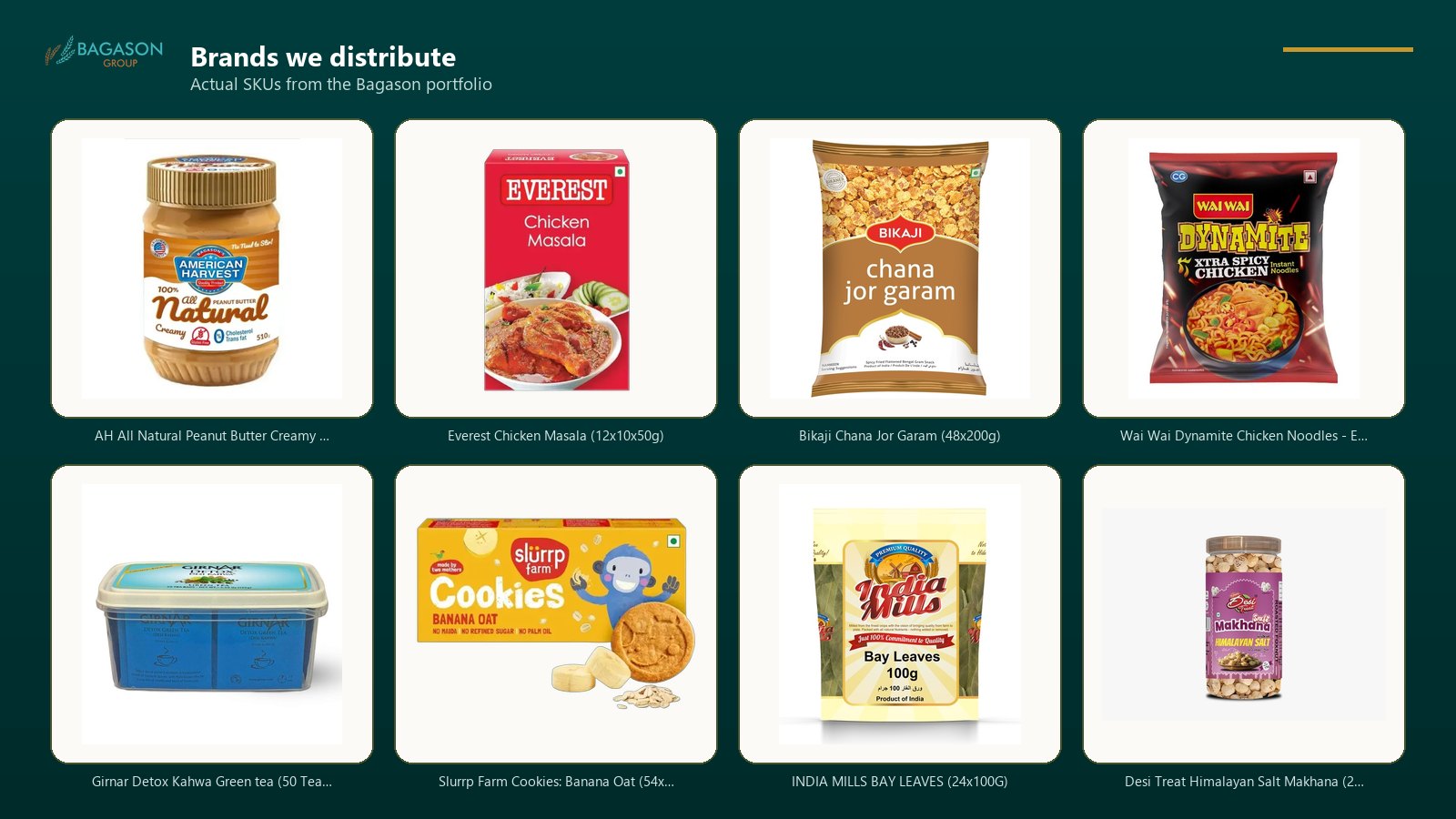
Actual SKUs from the Bagason portfolio — American Harvest, India Mills, Everest, Bikaji, Wai Wai, Girnar, Slurrp Farm and more. See all brands.
One partner from port to shelf, across the UAE and GCC


Questions from brands, retailers and buyers
What does GCC FMCG export distribution mean?
Which GCC countries can Bagason help me reach?
Do I need separate product registration for each GCC market?
Is Arabic labelling and halal certification required across the GCC?
Why use the UAE as a hub for GCC distribution?
Can you expand a brand that is already selling in the UAE?
Do you also handle marketing and sales, or only distribution?
Ready to expand across the GCC?
Get a coordinated regional plan covering which Gulf markets to enter first, registration and labelling steps, and a realistic timeline for expanding across the GCC.