By 9:45 on a school morning in Khalidiya, a mother is doing the same arithmetic thousands of UAE parents run before the gates close: what goes in the lunchbox that won't melt, won't get sent home, and won't leave a six-year-old face-down on the desk by 1pm. A juice box is out, the school's note made that clear. The chocolate-coated wafer she grew up on is on a list now. What stays? A small tub of laban, a few khalas dates, almonds, a wedge of cucumber, a wholegrain cracker with a slab of white cheese. It is, almost exactly, the snack tray her grandmother kept by the majlis floor cushions in Al Ain forty years ago. The Gulf snack table is changing fast, but a lot of the answers were already in the pantry.
This is the quiet story behind a lot of headlines about sugar taxes and school red lists. Better-for-you eating in the Emirates is not a Western import bolted onto Gulf life. The region's oldest, most generous foods, dates, nuts, laban, fresh fruit, toasted seeds, were functional snacks long before anyone printed a nutrition panel. What's new is the pressure to make the everyday snack drawer match that heritage instead of fighting it: less added sugar, more protein and fibre, real ingredients a parent can pronounce, served with the same warmth that makes a Gulf home a Gulf home. This guide walks through how families across Abu Dhabi, Dubai, Sharjah and the Northern Emirates are doing exactly that, from the lunchbox to the majlis to the long fasting days of Ramadan, without anyone feeling short-changed.
The Gulf snack table is changing, and the reasons are local
Three forces have pushed better-for-you snacking from a niche concern into a mainstream household habit, and all three are homegrown rather than borrowed from a foreign wellness blog. The first is regulation reaching into the school bag. Abu Dhabi's education authorities have steadily tightened what's allowed on campus, and the school food rules now circulated to parents read like a clear line in the sand: fizzy drinks, energy drinks, sugary juices, chocolate, sweets and salty crisps are off the approved list, while water, milk, laban, fresh fruit, vegetables, nuts and wholegrains are actively encouraged. A 2026 refresh of that guidance, often discussed by parents as the school "Red List," put the spotlight squarely on added sugar and ultra-processed snacks. For a family, this isn't an abstract policy. It's a daily editing job at the kitchen counter.
The second force is fiscal. The UAE's excise tax already adds 50 per cent to the price of carbonated soft drinks and a punishing 100 per cent to energy drinks, and the policy direction across the GCC has been to tie the tax more tightly to sugar content, so the sweeter the drink, the steeper the bill. When the sugary option costs visibly more at the till in Lulu or the corner baqala, the better-for-you swap stops being a sacrifice and starts looking like common sense. Price is a powerful nudge, and Gulf shoppers feel it every week.
The third force is the market answering back. The healthy-snacks category in the UAE has been climbing past the one-billion-dollar mark, with double-digit growth as brands race to put lower-sugar, higher-protein, seed-and-grain-forward options on shelves. That scale matters because it changes availability. Better-for-you is no longer a single dusty corner of one premium supermarket; it's roasted chickpeas next to the crisps, no-added-sugar date bars by the checkout, and unsweetened laban stacked beside the cola. When demand crosses that threshold, distributors and retailers respond, and the healthier choice becomes the easy, close-to-home choice.
The tension every family is resolving sits underneath all three. Nobody in the Gulf wants to trade away dates and qahwa, the ritual of pressing a second handful of nuts on a guest, or the abundance of a properly laid majlis. Generosity is not negotiable here; a half-empty platter reads as a half-hearted welcome. So the real question isn't whether to choose health over hospitality. It's how to keep the spread generous and beautiful while quietly lowering the sugar and lifting the protein, the fibre and the good fats. The rest of this guide is the practical answer, and it leans hard on foods the region already loves.
What we actually mean by better-for-you in a Gulf context
Strip away the marketing and "better-for-you" comes down to a handful of honest, checkable things. More fibre, so a snack actually fills you and steadies digestion. More protein, so energy holds rather than spiking and crashing. Healthy fats from nuts, seeds and olive oil instead of cheap refined oils. Less added sugar, the kind that's been poured in rather than the kind that comes naturally bundled with fibre inside a date or an apricot. Ingredients you recognise and could buy yourself, rather than a paragraph of additives. And sensible portions, because even the most virtuous nut becomes a problem by the third overflowing handful. That's the whole framework. No buzzwords, no detox, no miracle superfood, just food that does more for the body per bite.
What makes the Gulf lucky is that its heritage larder already scores well on every one of those measures. Dates are fibre, potassium and slow-burning natural sugar wrapped in one chewy package. Nuts and seeds are protein and heart-healthy fats. Laban and labneh are protein and gut-friendly cultures. Fresh fruit and crunchy vegetables are water, fibre and micronutrients. These weren't invented to chase a trend; they sustained desert households through long days and longer journeys, and they were chosen precisely because they travel well, keep without refrigeration and deliver real energy. Reframing them as today's "functional snacks" isn't clever rebranding. It's recognising that the original Gulf snack table was ahead of the science by several centuries. Much of the work, then, is editing out the modern additions, the sugary drinks, the wafer bars, the neon crisps, rather than reinventing the wheel.
Reading a UAE snack label: sugar, salt and the 'per 100g' trick
Packaging in UAE supermarkets is a tale of two numbers, and brands know which one flatters them. The front of the pack shouts "high in protein" or "source of fibre" or "no artificial colours." The back, in the nutrition table, tells the truth. The single most useful habit is to read everything per 100g, not per serving, because serving sizes are set by the manufacturer and are routinely smaller than anyone eats. A bar that looks modest at "8g sugar per serving" can hide a 20g-plus serving definition, so the per-100g column is your honest comparison tool between two products on the same shelf.
For sugar, a rough working rule used by nutrition educators is that anything above roughly 22.5g of total sugar per 100g is high and under about 5g per 100g is low. Salt deserves the same scrutiny in a climate where you're already losing it through sweat: above around 1.5g of salt per 100g is high, and the table may list sodium instead, which you multiply by 2.5 to get salt. Scan the ingredients list too, because it runs in order of weight. If sugar, glucose syrup, dextrose or fruit-juice concentrate appears in the first three ingredients, you're holding a sweet, whatever the front of the box claims. For kids' snacks especially, that thirty-second check at the shelf is the highest-leverage thing a parent can do.
Why 'low fat' often means more sugar, and what to check instead
"Low fat" is one of the oldest tricks in the aisle, and it trips up health-minded Gulf shoppers constantly. When fat is stripped out of a yogurt, a biscuit or a salad dressing, something has to replace the flavour and texture it carried, and that something is very often sugar, sometimes a great deal of it. A low-fat fruit yogurt can carry more sugar per pot than a small bowl of ice cream, while a plain full-fat Greek yogurt or labneh delivers more protein, more satisfaction and a fraction of the sugar. The fat in nuts, seeds, olives, avocado and dairy isn't the enemy a 1990s diet poster made it out to be; it's part of what makes these foods filling and steadying.
The more useful instinct is to chase protein and fibre and ignore the "low fat" flag. Compare two yogurts and pick the one with higher protein and lower sugar, regardless of fat. Choose the cracker with visible whole grains and seeds over the pale "light" version. Buy the labneh, the white cheese, the unsweetened laban, the plain nuts. In a market full of health halos, the quiet, unbranded staples, the ones with the shortest ingredient lists, are almost always the better buy.
Heritage on the plate: dates, nuts and seeds as the original power snack
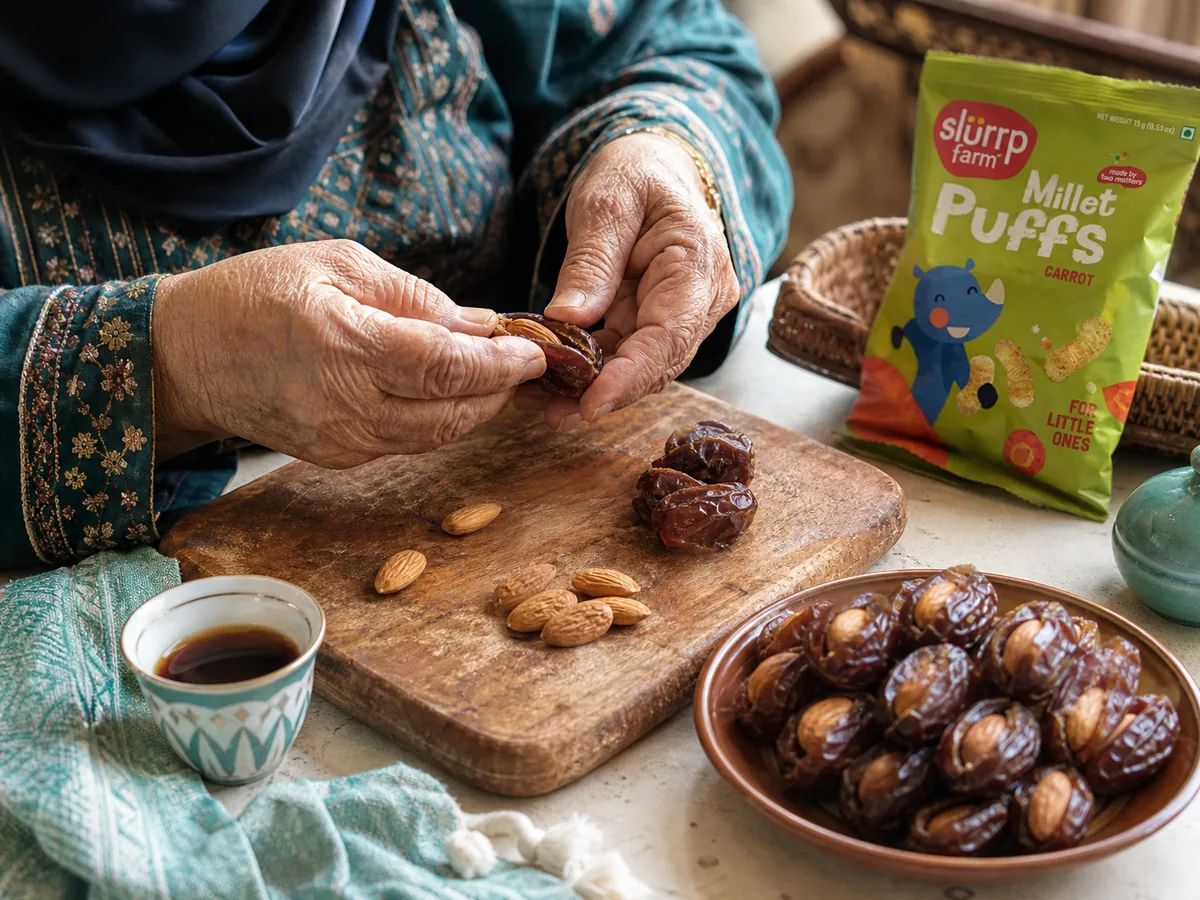
If you built the perfect endurance snack from scratch, you'd probably arrive at the date. Grown across the Emirates and traded throughout the Gulf for millennia, dates pack natural sugars for quick energy alongside fibre that slows their absorption, plus a genuinely useful dose of potassium, magnesium and antioxidants. The variety matters more than most shoppers realise. Khalas, the Emirati favourite, is caramel-soft and balanced, the everyday date you'll see passed around with qahwa. Fard, prized in Oman and the UAE, is darker, richer and slightly less sweet on the palate. Lulu is small, smooth and mild, an easy one for children. And majdool, the large, fleshy "king of dates," is the showpiece, soft enough to stuff and impressive enough for a guest. A couple of dates deliver real energy in a tidy, naturally sweet package, which is exactly why they break the fast at iftar.
The make-ahead trick that turns dates into a proper majlis sweet is tamr mahshi, stuffed dates. Slit a majdool or khalas date, lift out the stone, and press in a whole toasted almond, a walnut half, or a smear of unsweetened nut butter. For a gathering, you can vary the fillings down the platter, almond in one row, walnut in the next, a thread of orange zest or a dusting of crushed pistachio over a few, and arrange them so the tray looks abundant without a gram of added sugar. Stuffed dates keep for days in a cool, sealed box, so a Friday-morning batch carries you through a week of drop-in guests, the children's after-school dip in energy, and your own 4pm slump.
The nut and seed tray is the date's natural partner and a powerhouse in its own right. Almonds bring vitamin E and protein; pistachios add fibre and a satisfying shell-cracking ritual that slows you down; walnuts carry plant-based omega-3s; cashews are creamy and mild for younger palates. Sunflower and pumpkin seeds round it out with magnesium, zinc and more protein, and they're cheap, which matters when you're feeding a houseful. The catch with all of them is portion. These foods are calorie-dense by design, that's their gift on a long day, so a handful is a serving, not a starting point. A practical guide for adults is a small cupped handful, roughly 30g, a day; for children, scale it to their own smaller hand, perhaps 15 to 20g, and keep an eye on whole nuts with the very young for choking, offering nut butter or finely chopped versions instead.
Pairing dates with qahwa, laban and unsweetened gahwa for balanced energy
The traditional Gulf pairing of dates with qahwa, the lightly spiced Arabic coffee scented with cardamom and sometimes saffron, is more than ceremony; it's quietly sensible nutrition. Qahwa is served unsweetened, so the date provides all the sweetness, and the bitterness of the coffee balances it rather than piling sugar on sugar the way a Western coffee-and-cake pairing does. Drink the gahwa as it's meant to be taken, without added sugar, and the snack stays clean. For a more filling mid-morning or post-school version, set a couple of dates beside a glass of plain laban; the protein and fat in the cultured milk slow the release of the date's sugars and turn a quick lift into steadier energy that carries an hour or more. It's the same principle behind every smart snack in this guide, pair a natural carbohydrate with protein or fat, applied to a combination Gulf families have served for generations without ever calling it a strategy.
Toasting and spicing nuts at home without drowning them in salt
Shop-bought roasted nuts are often roasted in cheap oil and finished with far more salt than anyone needs, which undoes a lot of their goodness. Toasting your own takes ten minutes and gives you full control. Spread raw almonds, cashews or a mix on a dry tray and toast in a moderate oven, around 160C, for eight to ten minutes, shaking once, until they smell fragrant and turn a shade darker, or do it in a dry pan over medium heat, stirring constantly so they don't catch. While they're warm, toss with the lightest touch of olive oil, just enough to make seasoning stick, and a spice blend rather than a fistful of salt: a little cumin and a pinch of chilli, or za'atar, or smoked paprika with a whisper of garlic powder. The spices deliver big flavour with negligible sodium, the kitchen smells incredible, and you've made a snack that costs less and tastes better than the tin. Cooled completely and stored airtight, your spiced nuts hold their crunch for a couple of weeks, ready for the lunchbox, the majlis bowl or the desk drawer.
Building a balanced lunchbox that survives a UAE school day
A lunchbox in the Emirates has to clear two bars: it has to be genuinely nourishing, and it has to survive hours in a warm bag before the lunch bell. The formula that handles both is simple to remember, protein plus produce plus a smart carbohydrate plus hydration. Protein and fat are what keep a child level through the afternoon; produce brings fibre, water and micronutrients; a wholegrain carbohydrate gives steady fuel without the white-bread crash; and hydration is non-negotiable in this climate. Build every box around those four slots and you rarely go wrong, whatever the specifics.
Map that against the reality of Abu Dhabi's banned-list and the swaps almost make themselves. The fizzy drink or sugary juice becomes water and a small laban or milk. The bag of crisps becomes home-spiced roasted chickpeas, air-popped popcorn, or a few of those toasted nuts. The chocolate bar becomes a date-and-nut bite or two squares of plain fruit. None of these are punishments; done well they're the snacks kids actually finish, and they keep the lunchbox firmly on the right side of the school's rules while you, and the lunchbox monitor, can both relax. The brands that make this easy, the trusted laban, the no-added-sugar bars, the clean roasted chickpeas, increasingly reach UAE shelves through distributor networks like the one Bagason runs, which is part of why %the brands we bring to Gulf shelves% you'll find these options in the big hypermarkets and the neighbourhood baqala alike rather than only in specialist health shops.
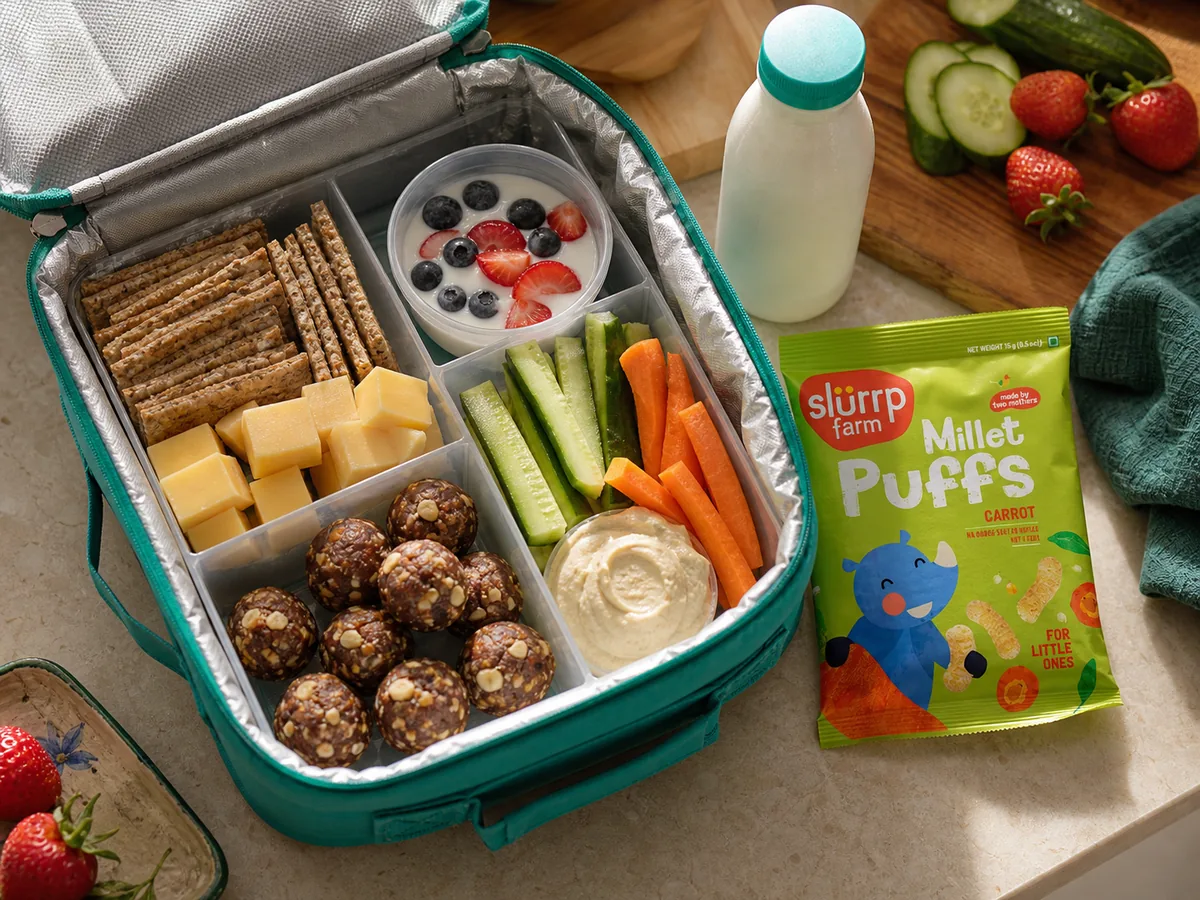
Five no-cook lunchbox builds (wholegrain crackers and cheese, yogurt and berries, hummus and veg, date bites, fruit and seeds)
None of these need a stove, and each hits the protein-produce-carb-hydration shape. First, wholegrain crackers with batons of white cheese or a wedge of laughing-cow-style triangles, a handful of cherry tomatoes and cucumber sticks, and a bottle of water; the cheese carries the protein, the crackers the slow carb. Second, a tub of plain or lightly sweetened Greek yogurt with a separate little pot of berries or chopped apple to stir in at lunch so nothing goes soggy, plus a few seeds for crunch. Third, a pot of hummus with carrot, cucumber and pepper sticks and a small wholegrain pita torn into dippers, with laban on the side. Fourth, two homemade date-and-nut bites, a piece of fruit, and cheese cubes, the sweet box that's still school-legal. Fifth, a fruit-and-seed combo, grapes or apple slices, a small handful of pumpkin and sunflower seeds, and a string-cheese, simple, fast and reliably eaten. Rotate the five across the week and the box never feels repetitive.
Keeping food safe in the heat: cool packs, insulated bags and what to avoid packing
The Gulf climate is unforgiving on a lunchbox, and food safety isn't a footnote here. Once a packed box sits above roughly 20C for a few hours, dairy, cut fruit and anything moist starts heading into bacteria-friendly territory. Use an insulated lunch bag as standard and tuck in a frozen ice pack, or freeze the water bottle overnight so it thaws into a cold drink while keeping everything around it chilled. Pack high-risk items, yogurt, cheese, anything with mayonnaise, right against the cold source. Lean on naturally stable foods for the worst of the summer: whole fruit, dried dates, nuts and seeds, crackers and hard cheeses shrug off the heat far better than a creamy dip left warm. Cut fruit browns and ferments faster than whole, so a whole apple or a small bunch of grapes often beats a pre-sliced one. And teach children to bring the box home rather than leave it baking in a hot locker, both for hygiene and so you can actually see what they did and didn't eat.
Snacks that keep kids fuelled without the sugar crash
The reason a sugary snack backfires by mid-afternoon is worth explaining simply, because once parents see the mechanism they make better swaps instinctively. A snack that's pure fast sugar, a sweet juice, a chocolate bar, a handful of sweets, sends blood sugar shooting up, the body responds by pulling it down hard, and the child lands lower and hungrier than before, often irritable and unfocused right when the afternoon lessons need attention. Pair that same carbohydrate with protein or fat, and the spike flattens into a gentle curve: the apple with cheese, the dates with laban, the crackers with hummus all release their energy slowly, holding concentration and mood steady through to home time. You don't need to remove sweetness, you need to anchor it.
Fussy eaters are where good intentions usually founder, so the wins have to be genuinely appealing. Frozen yogurt and fruit "rolls" or lollies made from blended laban and berries feel like a treat and deliver protein. Cheese cubes and string cheese are reliably popular and quietly high in protein. A homemade trail mix lets the child help choose the cast, a little cereal, some raisins, a few chocolate chips among the nuts and seeds, so they feel ownership while the balance stays sensible. Air-popped popcorn is a wholegrain that satisfies the crunch craving for a fraction of a crisp's salt and fat. Fruit kebabs, chunks of melon, grape, strawberry and banana threaded on a skewer, turn plain fruit into something children actually reach for. And the long game with sweetness is to phase it down gradually rather than ban it outright: dilute the juice a little more each week, move from flavoured to plain yogurt with your own fruit stirred in, shrink the biscuit to a single square of dark chocolate. Palates recalibrate surprisingly quickly, and a child raised on less sugar simply needs less to feel satisfied. That patient, unforced shift is %how we connect producers with UAE shoppers% the heart of how Bagason thinks about bringing better-for-you choices within everyday reach, making the healthier option the normal one rather than the special one.
<
Building a balanced lunchbox that survives a UAE school day
A lunchbox in the Gulf has two jobs: feed a child well and survive several hours in a bag that may sit near a sun-warmed window or cross a hot car park. The formula that holds up is simple to remember: protein, produce, a smart carbohydrate and hydration. Hit those four and the box is balanced before you have thought about a single brand. Protein steadies energy and concentration; produce brings fibre, vitamins and water; a wholegrain or pulse-based carbohydrate fuels the afternoon without a sugar spike; and a proper drink keeps a child alert in a climate that pulls fluid out of them faster than they notice.
Abu Dhabi's school nutrition rules have made the swaps concrete rather than aspirational. With fizzy drinks, energy drinks, sweets and crisps off the approved list, the question is no longer whether to change but what to pack instead. Water and plain laban replace the fizzy drink. Spiced roasted chickpeas or air-popped popcorn stand in for crisps. Date-and-nut bites or a small tub of fruit take the place of a chocolate bar. None of this reads as deprivation to a child, which is the point: the replacements are tasty enough that the old version is not missed.
Five no-cook lunchbox builds
- Cracker board: wholegrain crackers, cubes of mild cheese and a few cherry tomatoes. Protein, smart carb and produce in one tidy compartment.
- Yogurt and berries: a tub of plain or lightly sweetened yogurt with blueberries or chopped strawberries and a spoon of granola packed separately so it stays crunchy.
- Hummus and veg: a pot of hummus with carrot batons, cucumber sticks and wholewheat pita fingers for dipping. Filling, fibre-rich and forgiving in the heat.
- Date bites: two or three stuffed dates or homemade date-and-oat balls alongside a small cheese portion for protein balance.
- Fruit and seeds: apple slices (a squeeze of lemon keeps them from browning), a few grapes and a small twist of pumpkin and sunflower seeds.
Keeping food safe in the heat: cool packs, insulated bags and what to avoid packing
Heat is the variable parents elsewhere never think about and Gulf parents cannot ignore. An insulated lunch bag with a frozen gel pack is not a luxury here; it is the difference between a yogurt that is fine at noon and one that should never be eaten. Freeze a small water bottle overnight and it doubles as a cool pack that melts into a cold drink by lunch. Be cautious with anything that spoils quickly in warmth: mayonnaise-heavy fillings, cut melon left loose, and soft cheeses without a cool pack are best avoided. Hard cheese, hummus, whole fruit, crackers, nuts and roasted chickpeas all travel well and forgive a warm morning. Pack the cold things touching the gel pack and the dry things to the side, and the box arrives in good shape.
Snacks that keep kids fuelled without the sugar crash
The reason a sugary snack backfires by mid-afternoon is straightforward once you see it. Sugar on its own enters the bloodstream fast, energy spikes, and the body overcorrects, leaving a child tired, distracted and reaching for more sweetness. Pair that same carbohydrate with protein or fat and the whole curve flattens: apple with a few almonds, dates with cheese, wholegrain crackers with hummus. The sweetness is still there, but it arrives gently and lasts. This single habit, never sending a carbohydrate out the door alone, does more for steady concentration than any single "superfood".
Fussy eaters need wins they will actually accept, and the trick is to make the better option fun rather than worthy. Fruit kebabs threaded on a skewer turn plain fruit into something a child chooses. Homemade trail mix lets them scoop their own blend of nuts, seeds, a few raisins and a sprinkle of dark chocolate chips, which feels like a treat and behaves like a balanced snack. Cheese cubes, air-popped popcorn and yogurt with a swirl of fruit all clear the low bar fussy eaters set. The longer game is phasing down sweetness gradually: blend a sweet yogurt half-and-half with plain, dilute juice with water a little more each week, choose fruit that is naturally less sugary. Palates recalibrate quietly, and a child who once needed a very sweet drink stops noticing the difference within a month.
The modern majlis spread: generous, beautiful and lighter
Hospitality is non-negotiable in Gulf homes, and no one wants a majlis that feels mean. The good news is that a generous table and a lighter table are the same table when you design it well. Picture a tiered dish at the centre piled with glossy dates and mixed nuts, a board of fresh fruit cut to catch the eye, a bowl of labneh pooled with good olive oil and dusted with za'atar, a dish of warm spiced roasted chickpeas, and a platter of vegetable crudites beside a bowl of ruby-red muhammara. It looks abundant because it is abundant; it simply leans on whole foods rather than a wall of sugar.
The art is in balance, not banishment. Keep one or two genuinely indulgent sweets, perhaps a small pile of luqaimat drizzled with date syrup, and let the lighter mezze surround them. Guests still reach for the treat, but they fill up on labneh, fruit and nuts along the way, so the spread feels both spoiling and kind. Presentation carries a lot of this weight: smaller serving bowls refilled often look more generous than vast platters, and a beautifully cut fruit platter signals care more loudly than a tray of identical packaged sweets ever could.
A 30-minute majlis board you can assemble from the pantry
With a reasonably stocked kitchen you can build an impressive board before guests finish parking. Tip dates and mixed nuts into the centre. Spoon labneh into a shallow bowl, flood it with olive oil and scatter za'atar. Drain a tin of chickpeas, toss with cumin, paprika and a little oil, and roast at 200C for fifteen to twenty minutes while you cut cucumber, carrot and pepper into batons. Slice whatever fruit is in the bowl, halve a few cherry tomatoes, set out olives and a wedge of cheese. Add warm pita torn into pieces. The whole thing comes together in half an hour, costs little and looks like it took real effort.
Sweets in moderation: smaller luqaimat, date energy balls, fresh fruit as the closing course
Sweets do not have to leave the majlis; they just take a smaller, smarter shape. Make luqaimat bite-sized rather than golf-ball-sized so guests can enjoy two without overdoing it. Set out date energy balls, blitzed from dates, oats, nuts and a little tahini and rolled in sesame or desiccated coconut, which taste like dessert and carry real fibre and protein. Then let a fresh fruit platter be the closing course, the way a bowl of cut watermelon and oranges traditionally rounds off a Gulf meal. The table still ends on a sweet note, but the last thing on everyone's fingers is fruit.
Hydration is a snack strategy in the Gulf heat
In a 45C summer, thirst routinely disguises itself as hunger. The body's signals for the two overlap, and a slightly dehydrated child or adult will often reach for a snack when a glass of water was what they actually needed. Treating hydration as part of the snacking plan, rather than an afterthought, quietly cuts a lot of mindless grazing. Offer a drink first; wait a few minutes; the phantom hunger frequently passes.
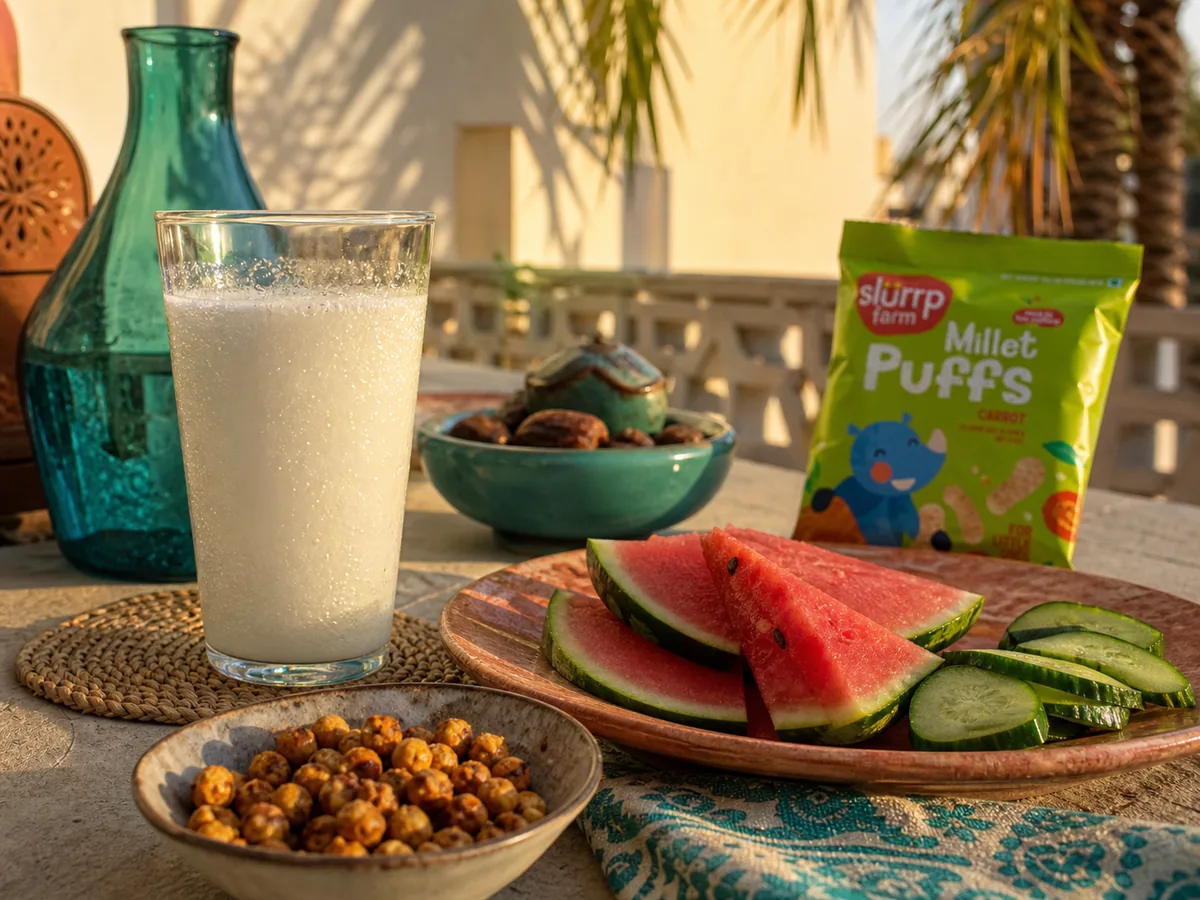
Build a hydration toolkit and the heat becomes far easier to manage. Water-rich fruit does double duty as snack and fluid: watermelon, cucumber, oranges and other citrus are most of the way to a drink already. Traditional cultured drinks like laban and ayran hydrate while delivering protein and gut-friendly cultures. Infused water, a jug of plain water with mint, lemon, cucumber or a few berries, makes plain water appealing to children who find it boring, with none of the sugar of a soft drink. For long days outdoors, a little electrolyte support earns its place, which is precisely where modern hydration products meet very old wisdom about replacing what the heat takes out of you.
Laban, ayran and chaas: traditional probiotic drinks that double as snacks
Across the Gulf and the wider region, cultured dairy drinks have cooled people through summers for generations. Laban, the slightly tangy fermented milk of the Levant and Gulf, and ayran, the salted, whisked yogurt drink beloved from Turkey through the Arab world, are both genuinely filling, which makes them a snack in their own right. South Asian households across the UAE bring chaas, spiced buttermilk lightened with water and seasoned with cumin and a little salt, to the same job. All three carry protein, calcium and live cultures, settle the stomach after a rich meal, and replace fluid and a touch of sodium after time in the heat. A glass of any of them mid-afternoon does more than a sugary drink and leaves a child fuller.
When electrolytes matter: sport, sun and recovery for active families
For most snacking, water and the fluid in fruit and laban is plenty. Electrolytes earn their place in specific situations: a child playing football in the afternoon sun, a long beach or desert day, a teenager training hard, or anyone recovering from a stomach bug. When you sweat heavily in Gulf heat, you lose not just water but sodium and potassium, and replacing only the water can leave you flat. Water-rich fruit, a pinch of salt on food, laban and a sensible electrolyte drink all help restore the balance. Reserve them for genuine exertion rather than everyday thirst, and skip the sugary "sports" drinks that pack in more sugar than a soft drink; the goal is replacing minerals, not loading up on sweetness.
Snacking through Ramadan and the season of gatherings
Ramadan reorganises the whole rhythm of eating, and snacking with it. The tradition of breaking the fast on dates and water is nutritionally astute: dates lift blood sugar gently after a long fast and the water begins rehydration before the main meal. The pattern worth protecting is what comes next. After the initial dates, leaning into protein and slow carbohydrates, lentil soup, grilled meat, wholegrains, vegetables, sustains energy far better than diving straight into a parade of syrup-soaked sweets that spike and crash the body during a season when sleep is already short.
Suhoor is where good snacking choices pay the biggest dividend. A pre-dawn plate built on protein and fibre, eggs, labneh, oats, wholegrain bread, a little fruit, releases energy slowly through the fasting hours, while a sugary suhoor leaves you hungry by mid-morning. Hydrating foods at suhoor, yogurt, cucumber, melon, help carry you through the long daylight stretch when no water passes your lips. Through Ramadan and into Eid, the gifting and grazing culture is part of the joy, and it manages beautifully with a little intention: portioned date boxes, nut assortments and lighter homemade sweets make generous, welcome gifts that do not bury the recipient in sugar. The season stays as warm and abundant as ever; the table simply does the body a few quiet favours.
Smart swaps: a practical better-for-you snack swap chart
Most of the work of eating better at home is not willpower; it is making the good option the easy one. These one-for-one swaps keep the satisfaction and shed the worst of the sugar, salt and refined oil. Bagason works across exactly these categories, connecting trusted regional and international brands to Gulf shoppers, and you can read more about that breadth in our %where you'll find our products across the region%.
- Chocolate bar → a date-and-nut bite or two stuffed dates. Same sweet hit, plus fibre and protein.
- Crisps → spiced roasted chickpeas or air-popped popcorn. The crunch survives; the fried oil and salt mostly leave.
- Fizzy drink → laban, ayran or a jug of infused water. Hydration with no added sugar.
- Sugary cereal bar → a homemade oat-and-seed bar or a date energy ball. Real grains and fats instead of glucose syrup.
- Sweetened flavoured yogurt → plain yogurt with fresh fruit stirred through. You control the sweetness.
- Salted shop-roasted nuts → home-toasted nuts with baharat or za'atar. Flavour from spice, not a flood of salt.
- Boxed fruit juice → whole fruit and water. The fibre stays in, the sugar concentration drops.
The routine that makes these stick is a short weekly batch-prep: on one quiet evening, roast a tray of chickpeas, roll a batch of date balls, portion nuts and seeds into small tubs, and wash and cut a container of vegetable batons. When the healthier option is already made and within reach, it becomes the default and the packet of crisps stays in the cupboard. Twenty minutes once a week resets the whole household's snacking.
Stocking a better-for-you pantry: what to keep on hand
A snack table this good is really a well-stocked shelf in disguise. Keep the staples in, and a balanced snack is never more than a minute away. Map your shopping to a few simple groups. Pantry essentials and wholegrains: oats, wholegrain crackers and pita, tinned chickpeas and lentils, dates, dried fruit, tahini and good olive oil. Spices that bring flavour without sugar or excess salt: baharat, za'atar, sumac, cumin, paprika, cardamom, cinnamon. Smarter snacks: mixed nuts, sunflower and pumpkin seeds, popcorn kernels, oat-and-seed bars and a quality dark chocolate for treats. Hydration staples: laban and ayran in the fridge, bottled water, and the makings of infused water. With those four shelves covered, every idea in this article is already within reach.
Finding these brands close to home is easier than it once was, and that is where the distribution network behind the shelves matters. A strong distributor brings trusted regional and international better-for-you products into the big hypermarkets and, just as importantly, into the neighbourhood baqala where families actually do their daily shopping. Brands looking to reach Gulf households can find out how that works on our %partner with Bagason to reach Gulf families%. The practical upshot for a parent is simple: the dates, nuts, wholegrains, spices and laban that make this table possible are stocked within a short walk of most homes, and buying healthy snacks online in the UAE has made the weekly restock easier still.
A printable starter shopping list for the modern Gulf snack table
- Fresh and chilled: dates, seasonal fruit, cucumber, carrots, cherry tomatoes, labneh, plain yogurt, laban or ayran, mild cheese.
- Pantry: oats, wholegrain crackers and pita, tinned chickpeas, mixed nuts, sunflower and pumpkin seeds, popcorn kernels, tahini, olive oil, hummus.
- Spice shelf: baharat, za'atar, sumac, cumin, paprika, cinnamon, cardamom.
- Treats in moderation: dark chocolate, oat-and-seed bars, ingredients for date energy balls.
Reading provenance and shelf life when stocking up in UAE heat
Heat is hard on food long before it reaches your kitchen, so a little label-reading pays off. Buy nuts and seeds from shops with good turnover; their oils turn rancid faster in warmth, and a stale, bitter almond is a sign of poor storage rather than a bad nut. Check date codes on dairy and laban carefully in summer, and keep them cold from shelf to fridge with as little a gap as possible. Store opened nuts, seeds and wholegrain flours in airtight containers, and in the hottest months the fridge or freezer keeps them fresh far longer than a cupboard. Dates are forgiving and keep for months in a sealed tin, which is part of why they have anchored the Gulf pantry for so long. A quick glance at provenance and a sensible look at shelf life means the good food you carried home stays good until you eat it.
Bringing it together: tradition and nutrition on the same table
The throughline of all this is reassuring rather than restrictive. The snacks at the heart of Gulf life, dates, nuts, fresh fruit, laban and water, were functional foods long before anyone marketed them that way. The modern shift is not a rejection of that heritage; it is a light touch on top of it. Pair the date with a nut, surround the luqaimat with labneh and crudites, offer water before the packet of crisps, and keep the spice shelf doing the work that sugar and salt used to do.
Carry one simple operating rule into the kitchen and the rest follows: anchor every snack and every gathering on dates, nuts, fruit, dairy and water, and treat sweets as accents rather than the main event. Do that, and the lunchbox holds up through a hot school day, the children stay steady through the afternoon, and the majlis stays exactly as welcoming and generous as it has always been, just a little kinder to everyone who gathers around it.
]]><![CDATA[Frequently Asked Questions
What snacks are allowed in Abu Dhabi schools under the current rules?
Abu Dhabi's school nutrition policy steers families toward water, plain laban and milk, fresh and dried fruit, vegetables, wholegrain crackers, cheese, nuts where allergy policies permit, and home-prepared bites like date balls and spiced chickpeas. Fizzy drinks, energy drinks, sweets, chocolate bars and crisps are off the approved list. Always check your specific school's allergy and nut policy, as many UAE schools are nut-free for safety, and pack seed-based alternatives if so.
Are dates healthy given how sweet they are?
Yes, in sensible portions. Dates carry natural sugars alongside fibre, potassium and magnesium, so they release energy more steadily than refined sugar. Two or three dates is a reasonable snack for an adult and one or two for a child. Pairing a date with a nut or a little cheese slows the sugar release further, which is exactly why the traditional date-and-gahwa or date-and-laban combination works so well.
How do I keep lunchbox food safe in UAE heat?
Use an insulated lunch bag with a frozen gel pack, or freeze a small water bottle overnight to double as a cool pack that melts into a cold drink by lunch. Pack perishables like yogurt and cheese touching the cold pack, and lean on heat-tolerant items such as hummus, hard cheese, whole fruit, crackers, nuts and roasted chickpeas. Avoid mayonnaise-heavy fillings and loose cut melon without proper cooling.
What can I serve at a majlis that feels generous but is lighter?
Build the spread around dates and mixed nuts, a fresh fruit platter, labneh with za'atar and olive oil, spiced roasted chickpeas and vegetable crudites with muhammara. Keep one or two indulgent sweets like small luqaimat as accents rather than the centrepiece. Smaller bowls refilled often look more generous than vast platters, and guests fill up on the whole foods while still enjoying a treat.
Is laban a good snack for children in the Gulf?
Laban is one of the best everyday choices for Gulf families. It delivers protein, calcium and gut-friendly live cultures, hydrates in the heat and is filling enough to count as a snack on its own. It works as a lunchbox drink in place of fizzy drinks and as an afternoon pick-me-up. Ayran and spiced chaas (buttermilk) do a similar job for households that prefer them.
How do I help a fussy eater accept healthier snacks?
Make the better option fun and reduce sweetness gradually. Fruit kebabs, build-your-own trail mix and fruit kebab skewers turn plain food into something children choose. Blend sweet yogurt half-and-half with plain, dilute juice with a little more water each week, and pair every carbohydrate with protein or fat to avoid the sugar crash that drives more snacking. Palates recalibrate within a few weeks without a fuss.
]]> <div class="bgn-blog-cta" style="margin-top:36px;padding:24px 26px;border-radius:14px;background:#f5f2ee;border:1px solid rgba(0,0,0,0.07);border-left:4px solid #CA7345;"><p style="margin:0 0 10px;font-weight:700;color:#1a6985;font-size:1.02rem;">Distribution solutions from Bagason Group</p><p style="margin:0 0 12px;color:#555;font-size:0.92rem;">Bagason Group distributes 700+ products to 30,000+ retail outlets across the UAE and GCC. Explore the pages most relevant to this article:</p><ul style="margin:0;padding-left:1.1rem;line-height:1.9;"><li><a href="/fmcg-distributor-uae">FMCG Distributor UAE</a></li><li><a href="/fmcg-distributor-abu-dhabi">FMCG Distributor in Abu Dhabi</a></li><li><a href="/fmcg-distributor-sharjah">FMCG Distributor in Sharjah</a></li><li><a href="/fmcg-distributor-northern-emirates">FMCG Distributor Northern Emirates</a></li></ul></div><div class="bgn-author-eeat" style="margin-top:28px;padding:20px 24px;border-radius:14px;display:flex;gap:16px;align-items:flex-start;background:#fff;border:1px solid rgba(0,0,0,0.08);"><div style="flex:0 0 52px;height:52px;border-radius:50%;background:linear-gradient(135deg,#1a6985,#CA7345);display:flex;align-items:center;justify-content:center;color:#fff;font-weight:800;font-size:1.1rem;">BG</div><div><p style="margin:0;font-weight:700;color:#2b2b2b;">Bagason Editorial Team</p><p style="margin:2px 0 8px;font-size:0.82rem;color:#888;text-transform:uppercase;letter-spacing:0.05em;">FMCG Distribution Editorial Desk · Bagason Group, Dubai</p><p style="margin:0;font-size:0.92rem;color:#555;line-height:1.6;">Written by the editorial desk of <a href="/about-us" style="color:#1a6985;font-weight:600;text-decoration:none;">Bagason Group</a>, a Dubai-based FMCG distributor operating since 2007 with 700+ products, 30,000+ retail outlets and coverage across all seven emirates and the GCC. Learn more about <a href="/what-we-do" style="color:#1a6985;font-weight:600;text-decoration:none;">how we distribute</a>.</p></div></div>